
Novo Resources Corp (TSX:NVO, OTCQX:NSRPF, ASX:NVO, FRA:1NOR) has delineated multiple compelling exploration targets at its Wyloo gold–silver–antimony project in the southern Pilbara, paving the way for the company’s first reverse circulation (RC) drilling campaign at the emerging polymetallic system.
Recent soil and stream sediment results have expanded key anomalies at both the Wyloo SE and Wyloo SW prospects, with strong multielement geochemistry highlighting prospective corridors for systematic testing in 2026.
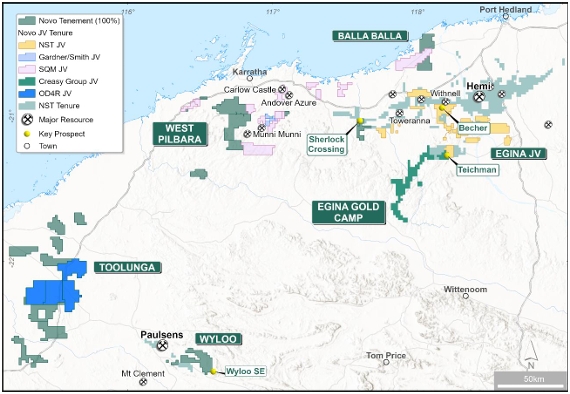
Novo Pilbara and Onslow District tenure showing significant prospects and location of the Wyloo Project in the southern Pilbara.
New geochemistry sharpens drill focus
At the core of the update is a robust soil geochemical anomaly at Wyloo SE, where a known polymetallic vein system has been the focus of earlier reconnaissance work. A grid of 162 soil samples returned elevated values over a strike of around 150 metres, with peak results including 57.2 parts per million (ppm) silver, 142 ppm antimony, 1,440 ppm arsenic, 2,180 ppm zinc and 1,530 ppm lead.
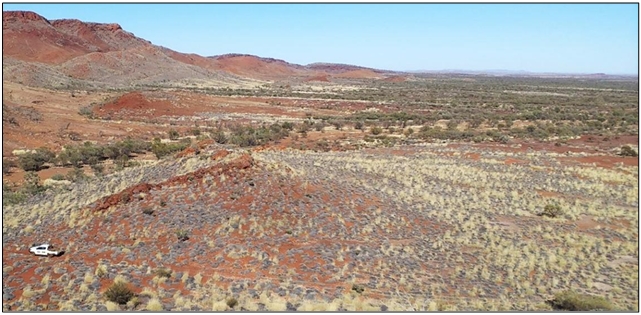
Photo during reconnaissance at Wyloo SE, looking southwest from the mapped rhyolite dome.
The multielement anomalism trends parallel to host stratigraphy and crosscuts the mapped vein array — suggesting both stratigraphic and structural controls on mineralisation. Importantly, the soil anomaly remains open under cover to the southwest and northeast, highlighting significant untested ground.
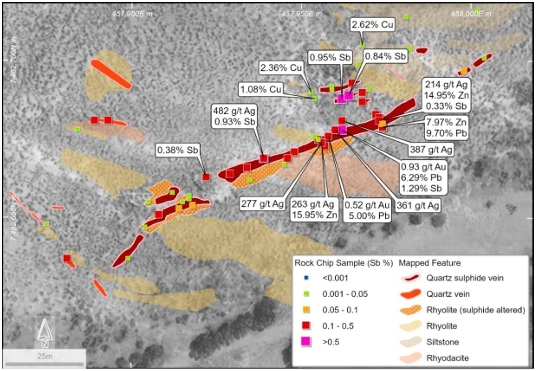
Previously released peak rock chip results at the Wyloo SE prospect and geology (outcrop mapping), highlighting significant Ag, Sb, Au, Cu, Zn and Pb results from the main vein array. Much of the target area only poorly outcrops (refer Figure 3 for geological setting).
At Wyloo SW, follow-up exploration targeting an earlier, high-order antimony stream sediment anomaly has delineated a large 2.5 kilometre by 800 metre target zone. Peak sediment values of 19.9 ppm antimony and 57 ppm arsenic, supported by consistent base metal associations, confirm an active mineralising system beneath transported cover.
Selective rock chip sampling returned elevated arsenic (up to 570 ppm), copper (526 ppm), zinc (431 ppm) and antimony (26 ppm) in outcrop within the target area, reinforcing the prospectivity of the SW target ahead of broader drilling.
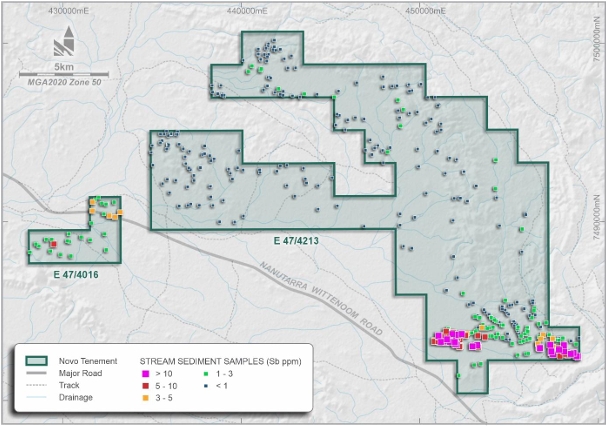
Wyloo tenure showing high order stream sediment antimony anomalies in the southern sector of the tenement, including recently received data for the Wyloo SW anomaly.
Maiden drilling planned for June quarter
To advance these targets, Novo has scheduled a heritage survey for early March, enabling access for an initial RC drill program at Wyloo SE in the June quarter. The program, totalling about 1,500 metres, is designed to test:
- The main ENE-trending polymetallic vein array;
- The adjacent Tasha Fault zone; and
- Stratigraphy-parallel soil anomalies defined in recent work.
Sectional drilling will aim to assess the vertical zonation of mineralisation, better define potential plunge directions and establish the grade and thickness of the system at depth.
Work at the Wyloo SW prospect will follow, with broad reconnaissance drilling planned to test beneath the 1–3-metre sheetwash cover and narrow down sources of the significant stream sediment anomalies.
A growing portfolio in the Pilbara
Wyloo represents an important addition to Novo’s growing Pilbara footprint, complementing other initiatives in the region focused on gold and base metal discovery. The projects sit within the dynamic tectonic setting of the Ashburton Basin, adjacent to a regional structural corridor that hosts known mineralisation, including the Paulsons gold deposit some 40 kilometres to the northwest.
Novo’s exploration strategy in Western Australia builds on a track record of systematic target generation — exemplified by multiple discoveries and resource expansions across its Egina Gold Camp earlier in its portfolio. The company’s approach combines geochemistry, mapping and structural interpretation to unlock buried mineral systems often obscured by cover sequences.

Executive co-chairman and acting CEO Mike Spreadborough said the latest results at Wyloo “enhance our confidence in the scale and prospectivity of the target”, noting that both SE and SW prospects are now primed for drill evaluation.
“This reinforces the broader potential of the Wyloo Project, with multiple targets now emerging for systematic drill testing,” Spreadborough said.
Pending heritage clearances, Novo aims to deliver first drill results from Wyloo later in the year as part of its broader 2026 exploration campaign.