
Western Yilgarn NL (ASX:WYX, OTC:WYGXF) has flagged a new high-grade gallium–tellurium target at its Ida Holmes Junction Project in WA’s Northern Goldfields after rock-chip sampling returned standout surface assays across two widely spaced exploration licences.
The early-stage discovery includes gallium grades of up to 185.5 parts per million (ppm) alongside elevated tellurium values. Western Yilgarn said the mineralisation has now been confirmed across Exploration Licences E36/1020 and E36/1046, which are about 39 kilometres apart, suggesting the potential for a large, regionally extensive system rather than isolated occurrences.
Gallium and tellurium are both classified as critical minerals due to their importance in semiconductors, electronics and clean-energy technologies, with supply chains increasingly under scrutiny as demand accelerates.
Strong surface results from maiden program
The latest results stem from a December 2025 rock-chip program that collected 48 samples across the company’s tenements. Geochemical analysis confirmed widespread surface gallium and tellurium mineralisation, with particularly strong results returned from E36/1046.
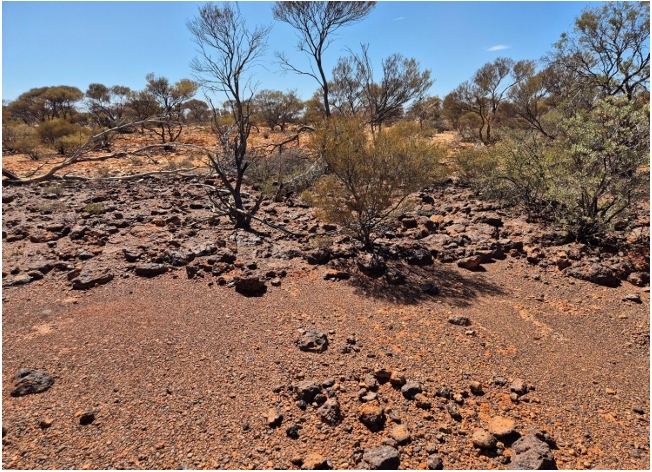
Extensive agglomerate outcrop hosting high-grade gallium mineralisation over E36/1046
At E36/1046, Western Yilgarn’s maiden rock-chip program delivered very high-grade gallium and tellurium values over a strike length of around 1.5 kilometres. All 12 samples collected from the area returned elevated gallium, with peak values of 185.5 ppm Ga (249.35 ppm Ga₂O₃), alongside consistent tellurium enrichment of up to 1.29 ppm Te.
Standout results included:
- 169 ppm Ga, 227.17 ppm Ga₂O₃ and 1.29 ppm Te
- 185.5 ppm Ga, 249.35 ppm Ga₂O₃ and 1.19 ppm Te
- 171 ppm Ga, 229.86 ppm Ga₂O₃ and 1.26 ppm Te
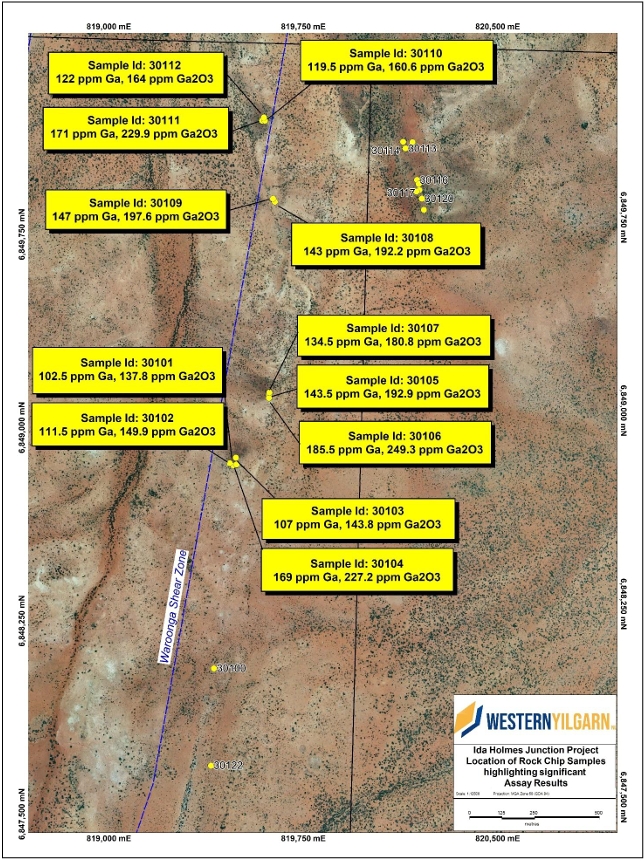
Location map over E36/1046 highlighting the high-grade gallium rock chip results
Western Yilgarn interprets the tight clustering of high-grade samples as evidence of strong structural control, rather than superficial or random enrichment. The company said the mineralisation is likely linked to the nearby Waroonga Shear Zone, which may have acted as a conduit for mineralising fluids during repeated hydrothermal events.
Many of the samples were collected from pisolitic agglomerate lithologies, further supporting the high gallium tenor observed at surface.
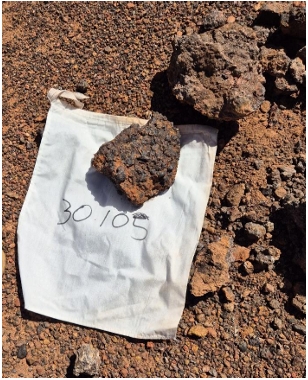
Gallium-tellurium mineralisation within hard pisolitic agglomerate yielding 143.5 ppm Ga, 192.89 ppm Ga2O3, 1.22 ppm Te from sample 30105
Continuity confirmed at earlier discovery area
Follow-up sampling at E36/1020, where high-grade gallium was first reported in August 2025, also confirmed continuity of mineralisation.
Three new rock-chip samples targeted the same pisolitic agglomerate units that previously returned gallium values of up to 195.5 ppm. The latest assays delivered gallium grades of up to 153 ppm Ga (205.66 ppm Ga₂O₃) and 144.5 ppm Ga (194.24 ppm Ga₂O₃), extending the known mineralised zone to roughly 200 metres along strike and up to 120 metres in width.
According to the company, the confirmation of strong gallium grades across licences separated by nearly 40 kilometres indicates the mineralisation is part of a much larger system that remains open in all directions.
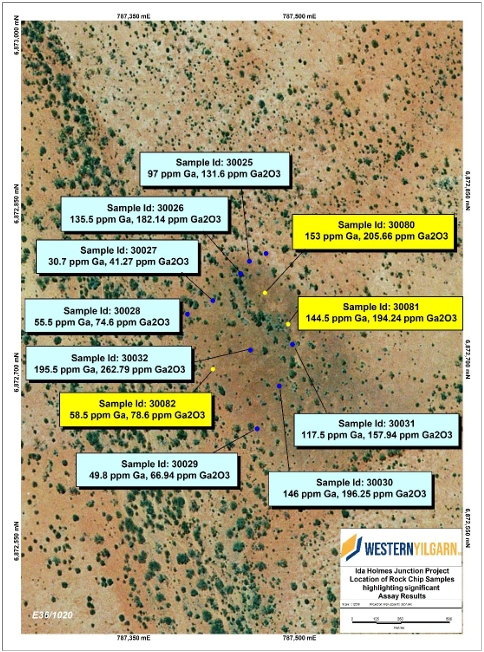
Rock-chip sampling at E36/1020 returned strongly anomalous gallium grades
Strategic location in the Northern Goldfields
The Ida Holmes Junction Project sits within the Yilgarn Craton and is centred on the intersection of two major regional structures — the Holmes Dyke and the Mt Ida Fault. The project is located near several established mining operations, including BHP’s Leinster and Mt Keith nickel projects, and about 60 kilometres north of Delta Lithium’s Mt Ida lithium project.
Non-executive director Pedro Kastellorizos said the results validate the project’s critical minerals potential and highlight the scale of the emerging system.
“Our latest ground reconnaissance rock-chip program has confirmed the presence of very high-grade gallium–tellurium mineralisation across multiple, widely spaced tenements, highlighting the scale and regional continuity of this potential emerging mineralised system,” Kastellorizos said.
“The confirmation of such strong gallium tenor across this distance demonstrates that mineralisation is not isolated, but rather potentially part of a much larger, regionally extensive system,” he said, noting that the mineralisation remains open in all directions.
Western Yilgarn said planning is now under way for follow-up surface exploration to extend and further delineate the newly identified mineralised zones along strike, as it works to define the full extent of the gallium–tellurium system at Ida Holmes Junction.
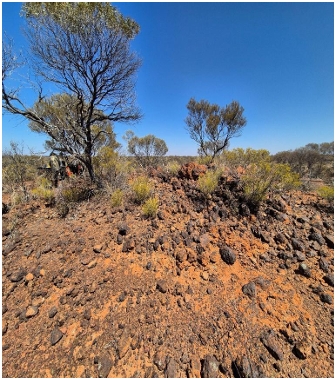
Gallium-tellurium mineralisation within hard pisolitic agglomerate yielding 117 ppm Ga, 229.9 ppm Ga2O3, 1.26 ppm Te from sample 30111