
Fortuna Metals Limited (ASX: FUN) has reported shallow hand-auger drilling results that it says confirm high-grade rutile mineralisation at its Mkanda rutile and graphite project in Malawi.
Assays from 96 hand-auger holes, based on 0–2 metre composites, returned in-situ rutile grades of up to 1.78%, with 36 of the 96 results (37.5%) grading above 1.0% rutile and more than 20% above 1.2%, according to the company.
Top results reported from surface include:
- 2 metres at 1.78% rutile from 0 metres (MHA0136)
- 2 metres at 1.70% rutile from 0 metres (MHA0068)
- 2 metres at 1.61% rutile from 0 metres (MHA0142)
- 2 metres at 1.53% rutile from 0 metres (MHA0122)
- 2 metres at 1.51% rutile from 0 metres (MHA0038)
- 2 metres at 1.50% rutile from 0 metres (MHA0090)
- 2 metres at 1.43% rutile from 0 metres (MHA0159)
- 2 metres at 1.37% rutile from 0 metres (MHA0107)
- 2 metres at 1.37% rutile from 0 metres (MHA0105)
- 2 metres at 1.34% rutile from 0 metres (MHA0091)
Fortuna said the 0–2 metres composites define “several large coherent” high-grade rutile anomalies covering about 25 km², with the mineralised footprint open in multiple directions, including at depth, along strike and laterally.
The company noted there are 534 additional 0–2-metre composites still pending, which it expects will help refine the size of anomalies identified to date and guide which full-depth intervals should be prioritised for lab analysis. Fortuna added that grade can vary between surface samples and deeper intervals, with grades often decreasing at depth in individual holes.
Fortuna has now completed 675 hand-auger holes across about 180 km² of the Mkanda project on a notional 80-by-400-metre spacing. It said future programs are intended to assess whether rutile mineralisation extends between the anomalies and over broader areas.
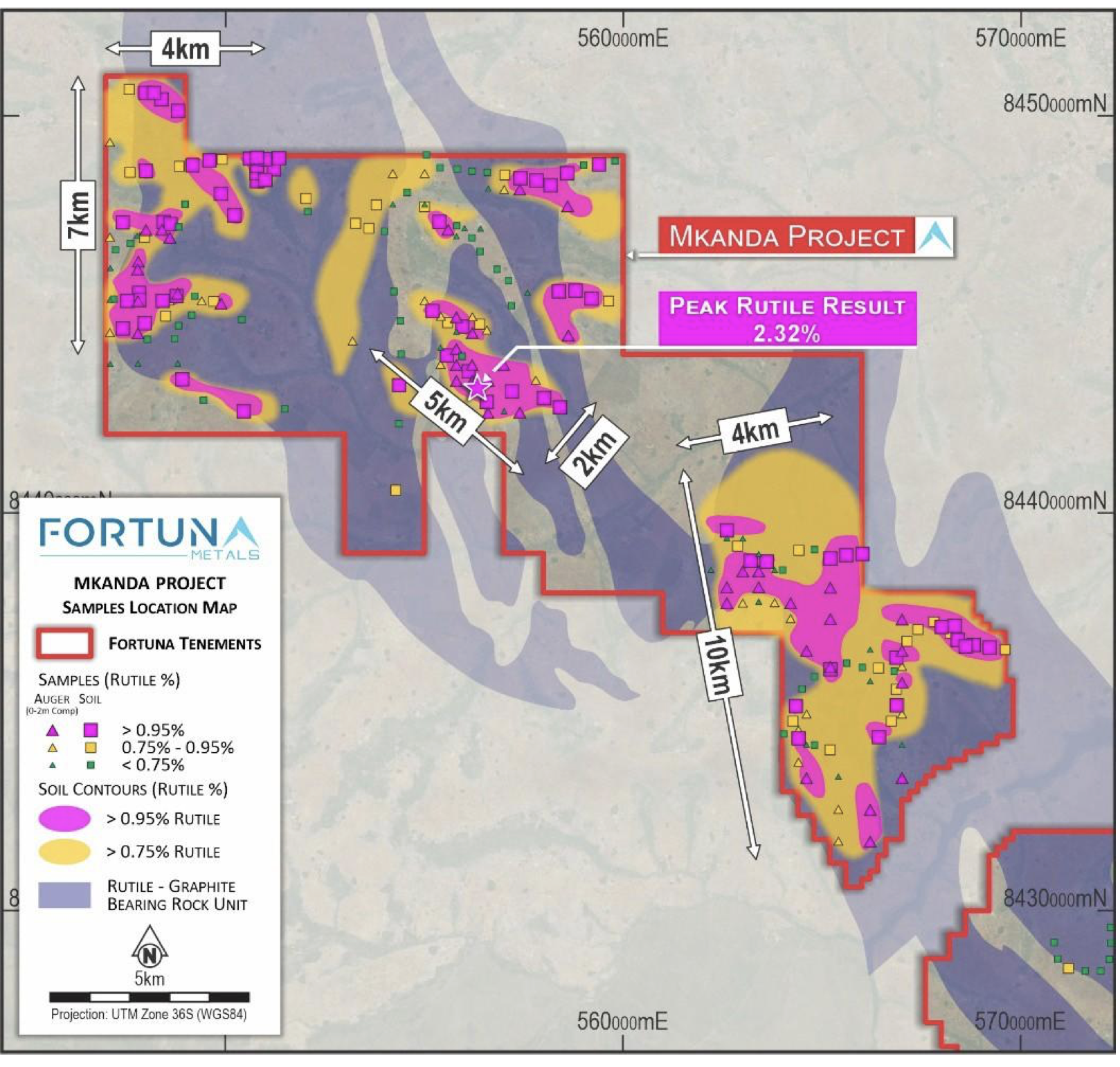
High grade >0.95% rutile (magenta) defined by soil and shallow 0-2m drilling composite, with the majority open along strike and laterally over large areas at the Mkanda.
“We are extremely pleased with the latest shallow 0-2m results that have helped outline several large coherent anomalies of high grade >1.0% rutile mineralisation. The footprint of the anomalous areas now extends over 25km2 and remain open in many areas with assays for 564 drill holes not received. Sovereign Metals' initial 644Mt inferred resource covered ~49km2," Fortuna CEO Tom Langley said.
"We look forward to receiving the remaining 534 shallow 0-2m assays to further delineate and expand the rutile mineralisation at surface ahead of further drilling in Q2 this year. The shallow assays provide a very cost-effective strategy as a first pass to identify the highest priority areas that fall within the high-grade >1.0% rutile anomalies."
Further assays pending as Fortuna plans targeted follow-up drilling in 2026
The company expects to release further results from the 2025 hand-auger drilling through Q1 2026, including remaining 0–2-metre composites and full-hole assays from priority high-grade areas (with average hole depths of 8–10 metres). Areas of higher-grade rutile are slated for follow-up drilling on a 200-by-200-metre grid during the 2026 campaign.
Separately, Fortuna said it is reviewing potential for associated monazite and zircon, referencing Sovereign Metals’ rare earths discovery at Kasiya, about 20 kilometres north of Mkanda in a similar geological setting.
Fortuna also reported receiving a letter from Malawi’s Department of Mining stating Executive Order No. 2 of 2025 — which restricts raw mineral exports — does not apply to Fortuna Metals’ Malawi projects.
“We are grateful to the Malawian Ministry of Energy and Mining for their support of our projects in Malawi by providing a letter clarifying that the company is unaffected by the raw mineral ban announced last October. Fortuna welcomes the government’s initiative to further support the local mining industry by value adding and beneficiating minerals in Malawi before being exported," Langley said.
The need for titanium
Titanium is increasingly used in robotics and advanced manufacturing because it combines low weight with high strength and durability, supporting lighter components without sacrificing performance. Titanium alloys can also enable complex, lightweight designs that reduce energy use while maintaining operating effectiveness, with applications extending to industrial automation and precision handling in sectors such as medical equipment and high-tech manufacturing.
In the titanium supply chain, natural rutile (TiO₂ 93–97%), leucoxene (TiO₂ 70–93%) and ilmenite (TiO₂ 48–64%) are the main feedstocks for titanium dioxide pigment, titanium metal and other end uses including welding electrodes.
Natural rutile is considered the highest-grade titanium feed source, and the company cited pricing of about US$1,100–1,700 per tonne, alongside an outlook that the titanium metal market could grow from about US$30B in 2025 to US$54B by 2034 (CAGR 6.5%). Fortuna added that declining output from legacy producers and depletion of traditional deposits could tighten supply as demand rises.
“Natural rutile is a critical mineral used to make titanium metal needed for the forecast surging demand for humanoids and robotics in the coming decade, with Tesla recently announcing they would cease making two car models to instead focus on making the Optimus humanoid this year. Tesla are expecting ~1 million humanoids sold in 2027 and billions of humanoids by 2040," Langley said.
"With ~10.4kg of rutile projected to be used in each humanoid unit, there is the potential for a severe supply shortfall. We aim to be able to fill that gap with supply of our own high-grade rutile to manufacture titanium metal in the coming years.
“These results continue to confirm the similarity across broader areas of the Mkanda project to the geological setting seen at Kasiya, just 20km to the north. The 675 drillholes completed in just three months late last year is testament to the favourable project access and in-country Malawi team. Our focus is to undertake exploration with intent and speed to market as we aim to delineate a material rutile resource estimate next to Sovereign Metals’ world-class Kasiya deposit. The 675 drill holes are a first pass to identify the highest grade areas of rutile that will then shape further resource drilling programs in 2026. We are extremely catalyst-rich as these results define the magnitude of the rutile discovery made to date.
“The company has embarked on a busy Q1 with the management team in country this month and attending the 121 Mining Investment Conference in Cape Town to meet with existing and potential new investors. We look forward to updating the market with a consistent flow of rutile, graphite and rare earths drilling results throughout Q1 and Q2 of 2026.”