
Flagship Minerals (ASX: FLG) has completed an ASTER remote-sensing review over its Pantanillo Gold Project in Chile’s Maricunga Gold Belt, identifying extensive alteration consistent with a large-scale high-sulphidation epithermal and porphyry-related system and generating multiple new surface and near-surface targets.
The company said the interpretation outlined large zones of alteration and inferred deeper targets beneath altered lithocaps described as barren to weakly anomalous, with the results to be integrated with existing geological, geochemical and geophysical datasets.
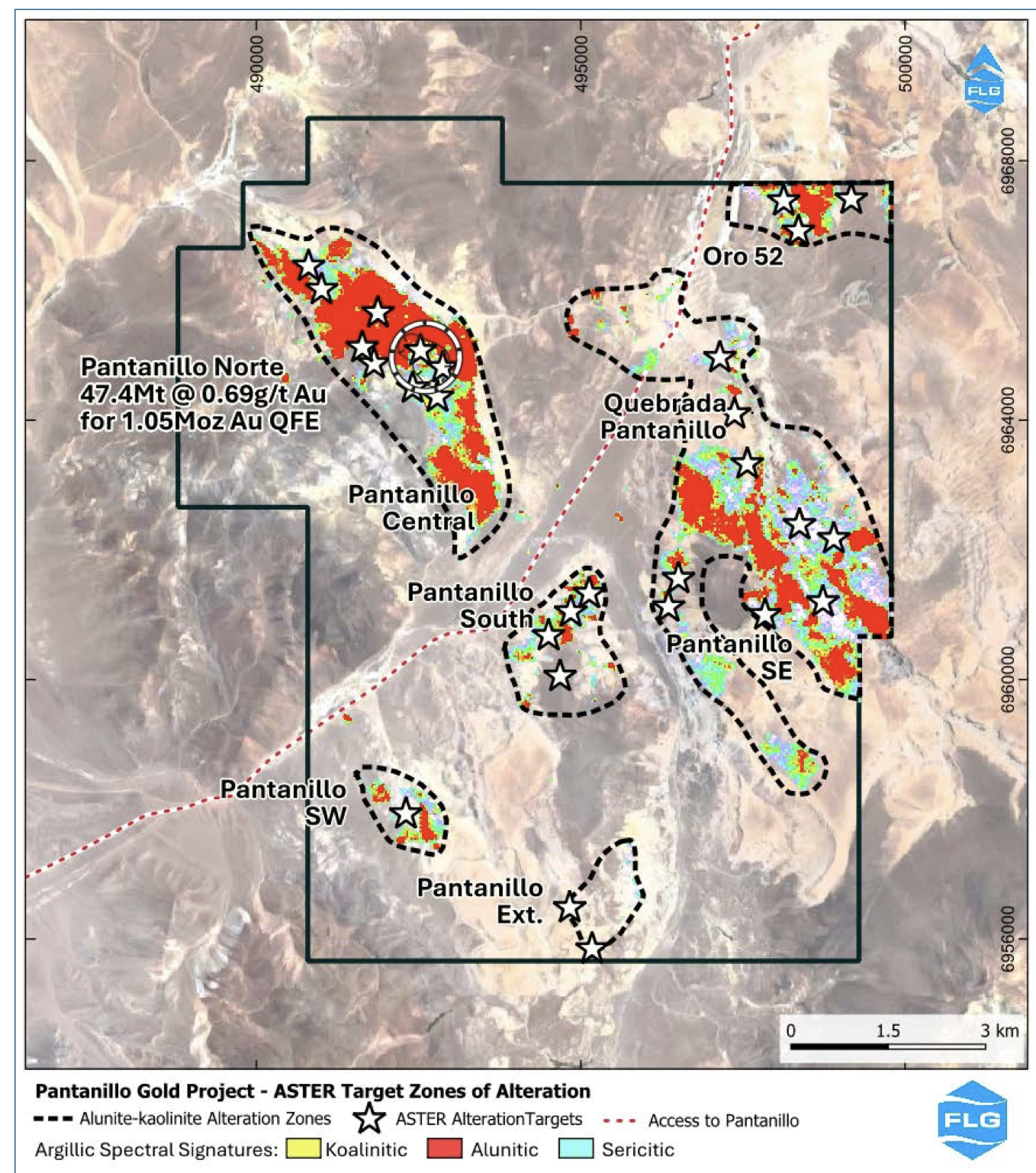
Pantanillo Gold Project – ASTER map and ASTER Alteration Targets.
“The ASTER results indicate the potential scale of the Pantanillo project, with two substantial zones of alteration >5km in length and up to 2km wide accompanied by five complimentary 1–2km alteration zones. The results provide important targeting information and will be incorporated into the current dataset and used in future exploration initiatives post the QFE update into a Mineral Resource Estimate currently underway,” Flagship Minerals’ managing director, Paul Lock, said.
Beyond the main Pantanillo NW-to-central corridor and the Quebrada Pantanillo area, the company highlighted additional alteration zones at Oro52, Pantanillo South and Pantanillo SW, with target points interpreted within or on the margins of broader alunite–kaolinite alteration.
What’s next
Flagship said the ASTER outputs will feed into drill target prioritisation after it updates the current 1.05 Moz gold qualifying foreign estimate (QFE) into a JORC (2012) Mineral Resource Estimate.
Near-term follow-up work flagged by the company includes field validation of the satellite anomalies via alteration mapping and geochemical sampling, while the broader work program is set to focus on updating and expanding the QFE into a JORC MRE, progressing metallurgical testwork and project studies for a techno-economic assessment, and planning extensional drilling in early 2026 aimed at an anticipated resource upgrade later in 2026.