
Terra Metals Ltd (ASX:TM1, FRA:21V) has delivered another strong set of drilling results from its Dante Project in Western Australia, with a second batch of assays from Reef 2 (Hyperion) reinforcing the scale, continuity and near-surface nature of the polymetallic system.
Terra said the latest results from resource upgrade drilling continue to confirm thick, laterally continuous titanium–vanadium–platinum group metals (PGM)–copper–gold mineralisation from surface, with multiple high-grade internal reef zones intersected across both reverse circulation (RC) and diamond drilling.
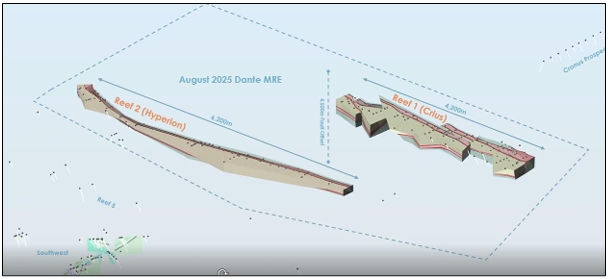
Central Dante Project, showing the location of the August 2025 Dante Reefs Mineral Resource Estimate (“MRE”) model (Reef 1 and Reef 2) and the nearby Southwest Prospect, Reef 5, and Cronus Prospect.
High-grade continuity confirmed from surface
Assays reported from 15 RC holes and one diamond hole include some of the highest individual metal grades recorded to date at Reef 2, highlighting the upside potential from continued infill drilling within previously drilled areas.
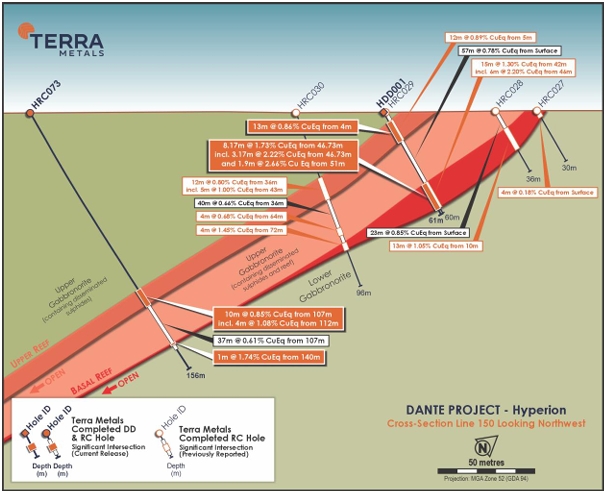
Cross section through Reef 2 (Hyperion) of the Dante Project, showing recent drill results for drillholes HDD001, and HRC073 as well as previously reported results for holes HRC027, HRC028, HRC029 and HRC030.
Standout intercepts include broad, shallow mineralised zones such as 8 metres at 1.73% copper equivalent (CuEq) from 47 metres, including higher-grade internal intervals, along with multiple intersections exceeding 40–55 metres of mineralisation from near surface. Several holes returned elevated grades across platinum, gold, copper, titanium and vanadium within the same reef positions.
Importantly, mineralisation consistently commences at or near surface and is hosted within broad envelopes containing repeated higher-grade reef zones — a geometry that supports both resource growth and future confidence upgrades as drilling density increases.
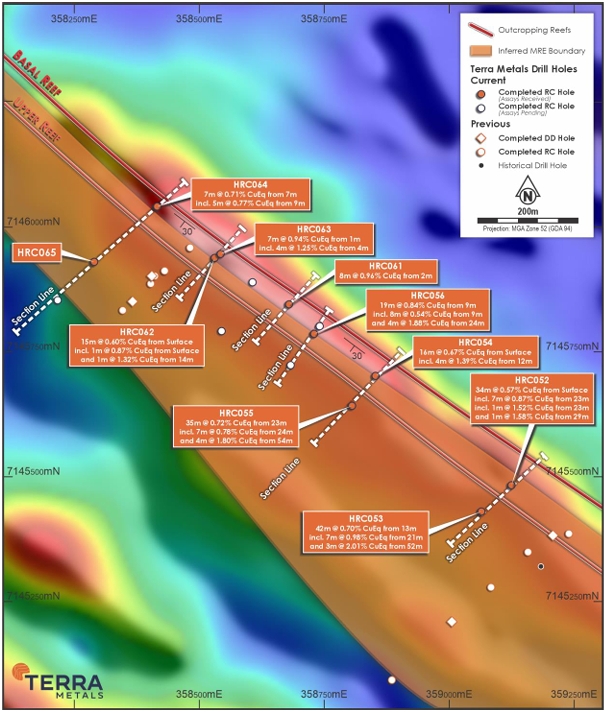
Inset 1 plan view of Reef 2 (Hyperion) basal and upper magnetite reefs as projected to surface and drill holes all drilled towards NE overlain on detailed aeromagnetic data.
Distinct reef-style system at Hyperion and Crius
The latest results further highlight the geological distinction between Reef 2 (Hyperion), Reef 1 (Crius) and Terra’s more recent palladium-rich discovery at the Southwest prospect.
Reefs 1 and 2 are characterised by platinum- and gold-dominant precious metal assemblages, copper sulphides with minimal to no nickel, and exceptionally high titanium and vanadium grades. The mineralisation is strictly stratiform, forming laterally continuous reef-style layers within a layered mafic intrusion.
This contrasts with the Southwest discovery, which hosts high-grade palladium-rich PGM–copper–nickel sulfide mineralisation in a different geological setting. Terra said the coexistence of these styles within the same project area creates a rare, diversified precious and critical metals portfolio at district scale.
Infill drilling delivers confidence and upside
From a technical perspective, Reef 2 comprises a shallowly dipping reef package, extending laterally and remaining open along strike. Drill results commonly report thick mineralised intervals with multiple internal high-grade positions, reinforcing the predictability and continuity of the system.
Infill drilling has returned some of the highest individual metal grades seen at Reef 2 to date, particularly for platinum group elements, titanium dioxide and vanadium pentoxide, alongside consistent copper enrichment.
“These results continue to validate Reef 2 (Hyperion) as a large, high-quality, near-surface polymetallic reef system with genuine scale and consistency,” managing director and CEO Thomas Line said, noting the complementary nature of the Hyperion and Southwest mineralisation styles.
Strong news flow expected to continue
More than 50% of the resource upgrade drillholes completed during the 2025 program remain pending assays, including all Reef 1 diamond and RC holes, setting the stage for a sustained flow of results.
Terra reports grades using copper equivalent calculations to reflect the polymetallic nature of the mineralisation. Metallurgical test work completed in 2025 indicates the potential to produce three high-grade concentrates, including a copper–gold–PGM sulphide concentrate, a titanium ilmenite concentrate and a vanadium-rich magnetite concentrate.
The Dante Project is located in the West Musgrave region of Western Australia within the Jameson Layered Intrusion of the Giles Complex, a mafic-ultramafic system comparable in scale to South Africa’s Bushveld Complex. With near-surface mineralisation, broad reef thicknesses and extensive strike potential, Terra believes Dante is shaping up as a long-life, multi-commodity opportunity as resource definition continues.
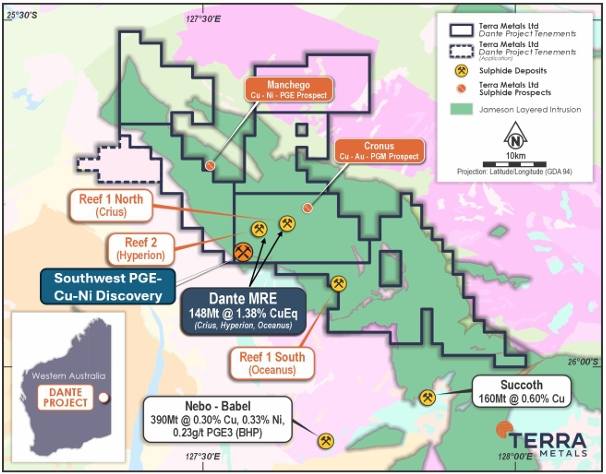
Location of the company’s Dante Project tenure, overlying the geology map of the West Musgrave Region.