
Virtuix Holdings Inc (NASDAQ:VTIX) said on Tuesday it has integrated an AI-driven 3D reconstruction technique known as Gaussian splatting into its Virtual Terrain Walk (VTW) system, a move the virtual reality company says could significantly speed up the creation of realistic battlefield simulations for defense training.
The Austin-based company, which develops full-body virtual reality systems, said the technology allows real-world environments captured with 360-degree cameras to be rapidly transformed into high-fidelity, photorealistic 3D worlds. What previously took weeks or months to build can now be completed in a matter of hours, Virtuix said.
The enhanced VTW system combines Gaussian splatting with Virtuix’s omni-directional treadmills, allowing multiple users to physically walk, run and crouch inside geo-specific virtual environments designed for ground combat mission planning and rehearsal.
“Creating realistic virtual environments has historically been a slow and labor-intensive process,” CEO Jan Goetgeluk said in a statement. “By integrating AI-driven Gaussian splatting into Virtual Terrain Walk, we can now scan real-world locations and quickly turn them into photorealistic virtual spaces that our warfighters can physically explore.”
Virtuix said VTW supports collaboration across more than 12 stations, either locally or across different geographies, enabling multi-user mission planning and leader rehearsals. The system also allows operators to modify environmental conditions and introduce simulated enemy forces to create more realistic combat scenarios.
Jay Miseli, a retired US Army colonel, described the system as “revolutionary,” saying it allows users to iterate through scenarios and better understand how environmental changes can affect battlefield outcomes.
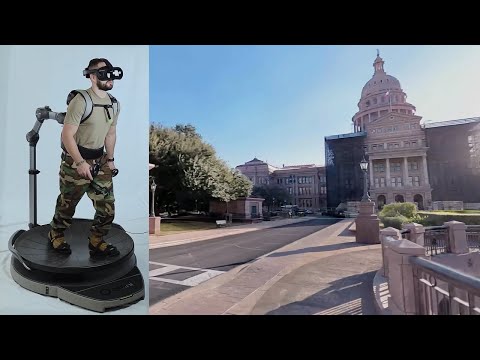
The company showcased a proof-of-concept version of VTW in December at the I/ITSEC defense and simulation tradeshow, working alongside partners Cesium, owned by Bentley Systems, and virtual reality hardware provider HTC. The demonstration highlighted how AI-based terrain reconstruction can be combined with geospatial data to support large-scale, physically navigable virtual environments.
Virtuix said it is already seeing early adoption within defense organizations, noting that Omni One test units have been purchased by Yokota Air Force Base, the US Air Force Academy and the US Military Academy at West Point.
While defense remains a key focus, Virtuix said it also sees opportunities for the technology in industrial and safety training, real estate visualization and law enforcement. The company said it plans to balance potential high-volume consumer sales of its Omni One gaming system with higher-margin enterprise and defense offerings, including recurring software licensing and customized simulation development.
“We believe AI-driven 3D reconstruction is foundational to the future of virtual reality,” Goetgeluk said.