
Corrosion is one of those industrial realities that rarely makes headlines but quietly drains enormous value from the global economy. By some estimates, corrosion costs amount to around 3.4% of global GDP each year — roughly US$4 trillion — largely through the degradation of steel infrastructure protected by industrial coatings.
Protective coatings are the first line of defence across sectors ranging from energy and transport to mining and heavy industry. Despite the economic stakes, one crucial part of the coatings lifecycle has changed very little over the past few decades: how performance is assessed once corrosion begins.
That gap is now being targeted by ASX-listed Sparc Technologies Ltd, which has partnered with the Australian Institute for Machine Learning (AIML) to develop AI-driven software designed to modernise corrosion testing and reporting.
A manual process frozen in time
Many internationally recognised corrosion tests deliberately damage a coating to accelerate failure. Under standards such as ISO 12944, a coating is “scribed” — intentionally scratched — and then exposed to harsh environments to observe how corrosion spreads from the damaged area. This spread, known as scribe creep, is a critical measure of coating performance.
The issue is how that spread is measured. Today, technicians visually inspect test panels, subjectively identify the corrosion boundary, manually measure distances and then record results. The process is labour-intensive, time-consuming and prone to variability between operators and laboratories.
According to Sparc, an experienced coatings technician can spend around 40 minutes assessing a single result — and the underlying methodology has remained largely unchanged for more than 25 years.
Bringing computer vision into the lab
Sparc and AIML’s solution applies advanced computer vision and machine learning to automate this process. High-resolution images of test panels are analysed by AI models trained on extensive historical datasets, allowing the software to detect corrosion boundaries and coating disbondment with greater speed and consistency.
A pilot project has already demonstrated proof-of-concept under ISO 12944 corrosion boundary testing, showing encouraging alignment between AI-driven assessments and traditional human evaluation. From there, the partners plan to expand the software’s applicability across a broader range of scribe-based and damage-based international testing protocols.
Beyond speed, the shift from manual judgement to AI analysis changes the nature of the data itself. Instead of a single reported measurement, the software can model large numbers of data points, enabling statistical analysis, trend identification and more detailed performance comparisons.
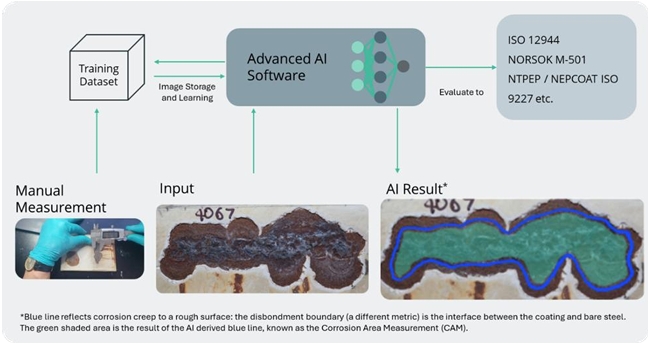
Illustrative schematic of how the technology works (Source: Sparc Technologies).
Commercial logic behind the code
While the technology challenge is significant, the commercial logic is relatively straightforward. Sparc estimates there are around 850 relevant testing laboratories globally, spanning coatings manufacturers, independent testing houses, research institutions and large industrial asset owners that conduct in-house assessments.
Letters of support have already been received from multiple industry participants, and Sparc’s current plan is to move towards beta testing in third-party laboratories within the next 12 months. The proposed commercial pathway focuses on industry co-development followed by software licensing, allowing for relatively rapid global deployment if adoption gains traction.
From a productivity standpoint alone, the potential gains are notable: assessments that currently take tens of minutes could be completed in seconds, with more consistent outcomes across labs and jurisdictions.
A broader pattern in industrial AI
The project also reflects a broader trend in industrial AI adoption. Rather than chasing consumer-facing applications, many of the most compelling use cases sit deep inside technical workflows where inefficiencies are long-accepted simply because “that’s how it’s always been done”.
For AIML, the collaboration highlights how applied machine learning can replace subjective human judgement in narrow but economically meaningful tasks. For Sparc, it complements the company’s wider focus on materials innovation and sustainability, where extending asset life and improving performance measurement can have outsized downstream benefits.
Corrosion may never be glamorous, but modernising how it’s measured could prove to be one of those quietly valuable applications of AI — the kind that doesn’t shout, but saves a lot of money.