
Galileo Mining Ltd has confirmed new zones of shallow palladium-platinum-gold mineralisation at its 100% owned Norseman project in Western Australia, following a December 2025 reverse circulation (RC) drilling campaign targeting priority prospects near the Callisto deposit.
Results from drilling at the Mission Sill prospect have validated earlier aircore geochemical anomalies, delivering broad intercepts of anomalous Platinum Group Elements (PGE) across multiple drill sections. These outcomes further support the prospectivity of geological settings analogous to those hosting the existing Callisto palladium-platinum-gold-rhodium-nickel-copper resource.
The company is now preparing to refine higher-grade zones through detailed sampling ahead of follow-up drilling, while diamond drilling beneath the Callisto resource is scheduled to commence within three weeks.
“Results from our recent RC drill campaign at Norseman have confirmed strongly anomalous PGE mineralisation near surface at the Mission Sill prospect. We are consistently seeing results above 1 g/t (3E PGE) which we believe may represent the shallow expression of a deeper and bigger mineralised system. We have an extensive 10 kilometres of prospective strike at the Mission Sill and the latest drilling has identified a structural target that may have localised mineralisation in the bedrock.," Galileo managing director Brad Underwood said.
"We look forward to advancing the Mission Sill prospect while at the same time undertaking further work at our existing Callisto deposit. At Callisto we will be completing the first deep exploration drill hole beneath the resource looking for repeats of the intrusive sill which hosts the sulphide mineralisation. This drill hole will also provide us with additional samples for metallurgical test work as we note that the metal price environment has improved since the Callisto resource was first published in 2023. With over $9 million in funding Galileo is very well positioned to continue exploration for high-value PGE-gold deposits in one of the most prospective regions of Western Australia.”
Mission Sill delivers broad shallow PGE intersections
RC drilling at Mission Sill returned multiple wide zones of PGE mineralisation from shallow depths, with anomalous grades greater than 0.4 g/t recorded in five drill holes across two sections spaced 200 metres apart.
Notable intercepts include:
- 8 metres at 1.33 grams per tonne (g/t) 3E from 24 metres within 44 metres at 0.78 g/t 3E in NRC514
- 8 metres at 1.20 g/t 3E from 8 metres within 40 metres at 0.92 g/t 3E in NRC513
- 8 metres at 0.66 g/t 3E from 40 metres in NRC510
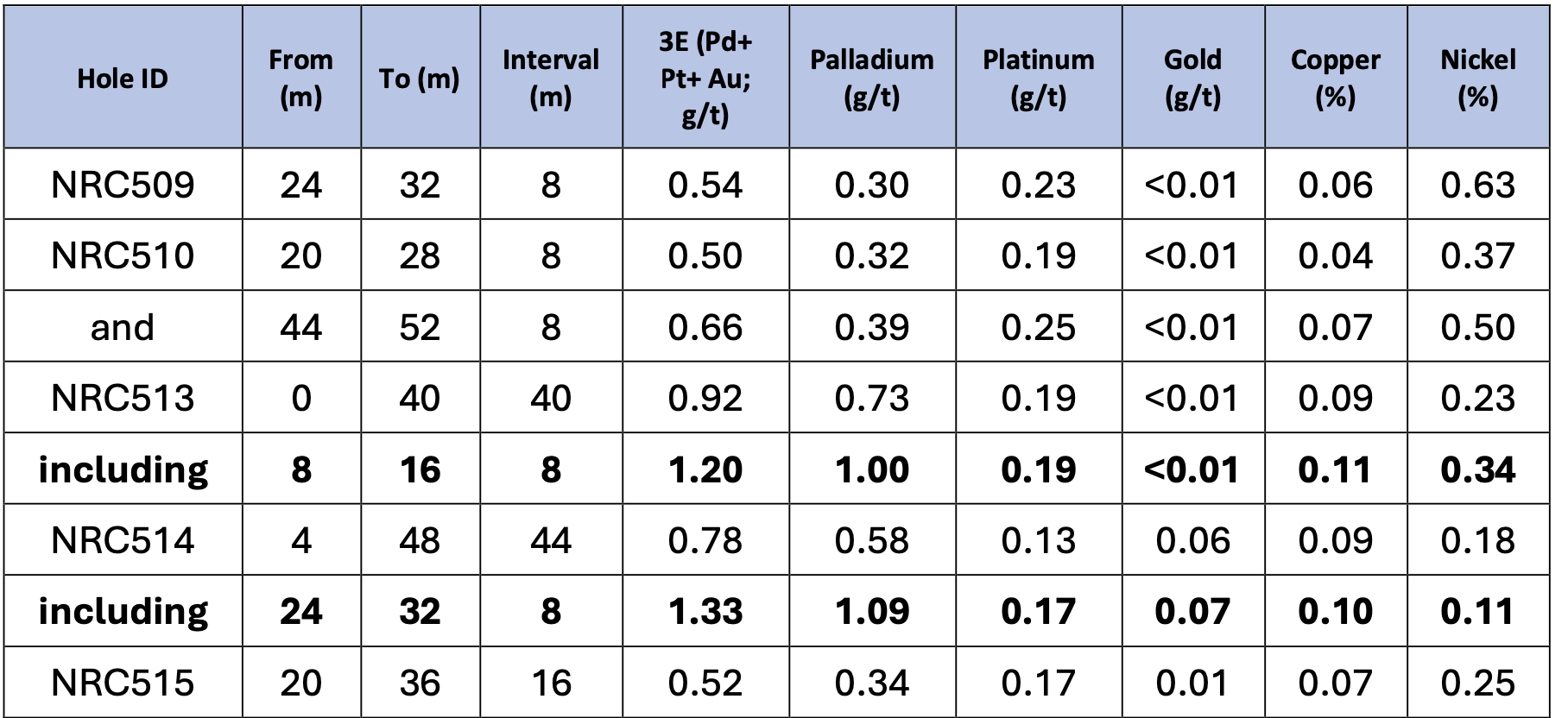
Anomalous RC drill sample assays above 0.4 g/t 3E.
The mineralisation confirms continuity along the Mission Sill intrusion and highlights a structurally controlled target at the southern end of the 10-kilometre-long prospect, where magnetic imagery shows a distinctive reorientation.
Structural controls emerging as key exploration driver
The latest drilling has sharpened Galileo’s understanding of the structural and geological controls at Mission Sill, particularly at interpreted ultramafic–mafic contacts considered favourable for sulphide-hosted PGE-gold mineralisation.
These settings closely resemble those hosting mineralisation at the nearby Callisto deposit, reinforcing Mission Sill’s potential to host additional mineralised systems within the broader Norseman project area.
Follow-up sampling planned to define higher-grade zones
Assays reported from the RC program are based on four-metre composite samples. To better define grade distribution and target potential higher-grade zones, Galileo plans to collect and assay one-metre split samples over selected intervals.
This work is intended to guide follow-up drilling and refine priority targets along the Mission Sill trend.
Metal prices remain strong
Beyond Mission Sill, Galileo is progressing preparations for diamond core drilling beneath the 17.5 Mt Callisto Mineral Resource, with drilling expected to begin in approximately three weeks.
Galileo says metal prices for palladium, platinum, gold, rhodium and copper have risen since the Callisto Mineral Resource Estimate was released in October 2023, outperforming the price assumptions used at the time (with spot prices referenced as at February 2, 2026).
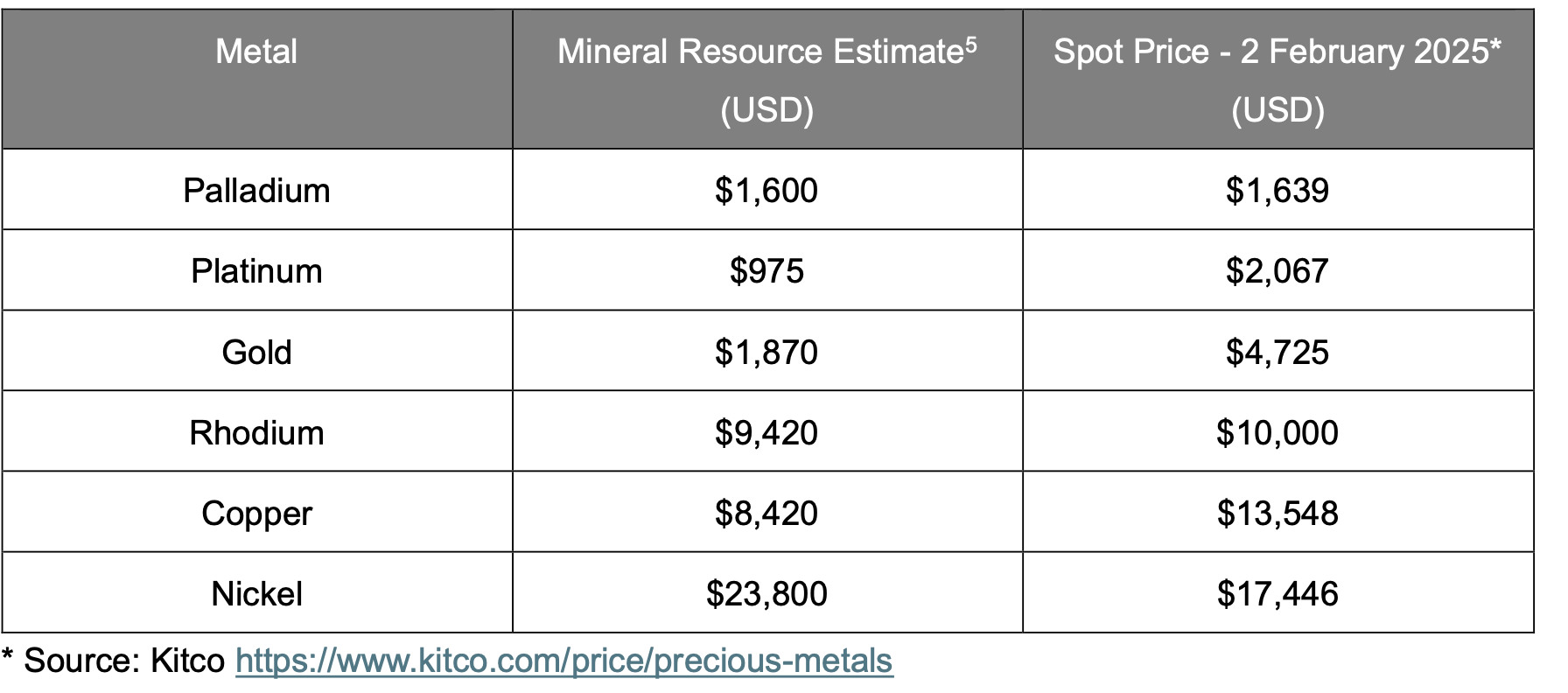
Comparison of metal prices used in the 2023 Callisto Mineral Resource Estimate and current spot prices (USD).
On the back of that uplift, the company plans new metallurgical test work to improve its understanding of metal extraction from the Callisto resource and potentially optimise recoveries.
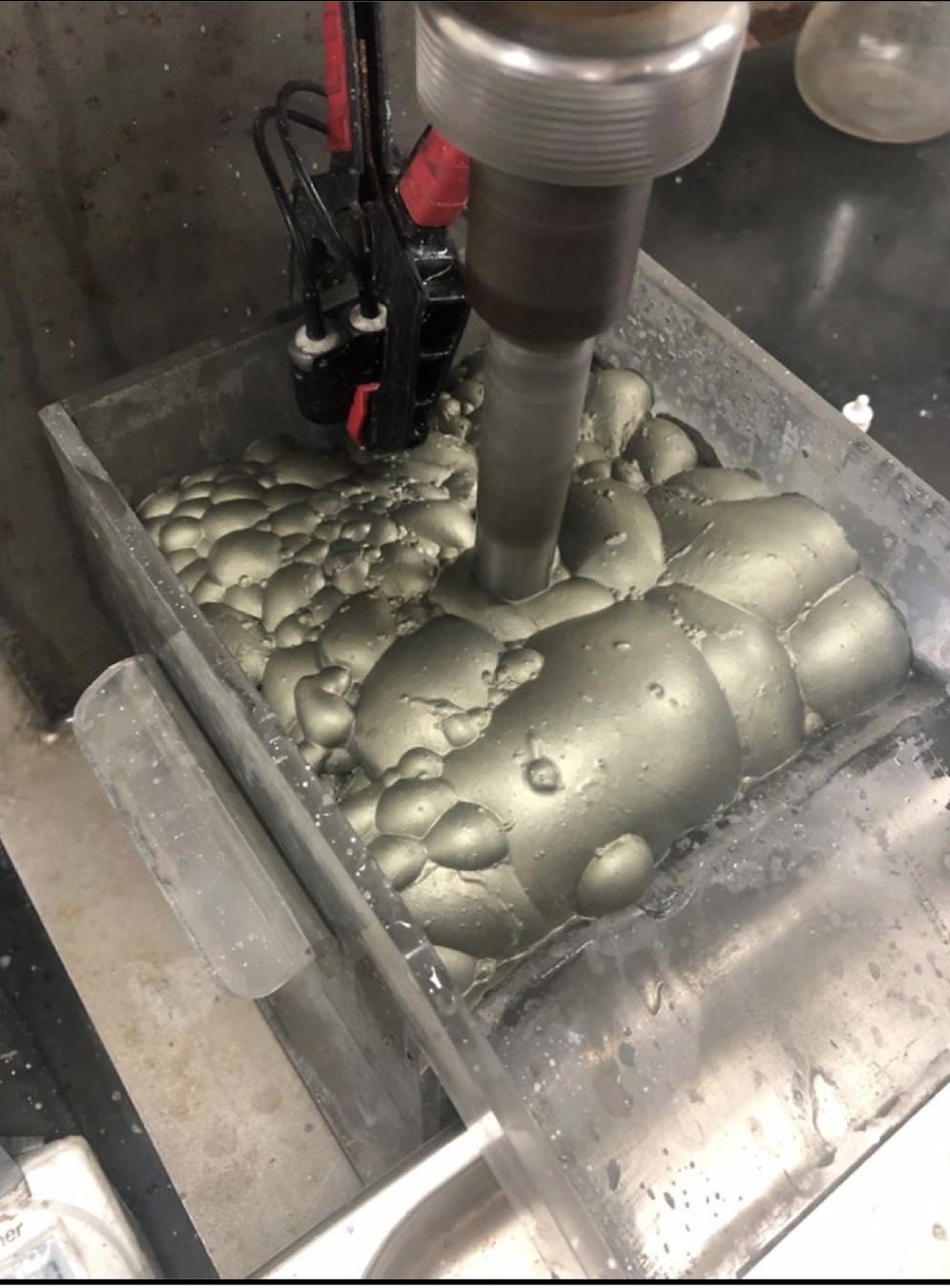
Sulphide flotation metallurgical test work of drill core sample from NRCD337 (details in ASX announcement dated 20/02/2023).
Earlier metallurgical work delivered strong recoveries using industry-standard sulphide flotation methods, and fresh samples are expected to come from an upcoming diamond drill hole that will cut Callisto mineralisation at shallow depth before testing the un-drilled zones immediately beneath the current resource.