
Premier1 Lithium Ltd will begin drilling at its high-priority Mt Kersey gold prospect at the Yalgoo Gold Project in Western Australia after completing the 100% acquisition of the project.
The company is set to start a 3,700 metre reverse circulation (RC) program targeting Mt Kersey, located east of the 100%-owned Wadgingarra prospect, which hosts a maiden inferred resource of 150kt at 2.7g/t gold for 13,000oz contained gold.
The broader Yalgoo area covers a five-square-kilometre zone of proven gold mineralisation.
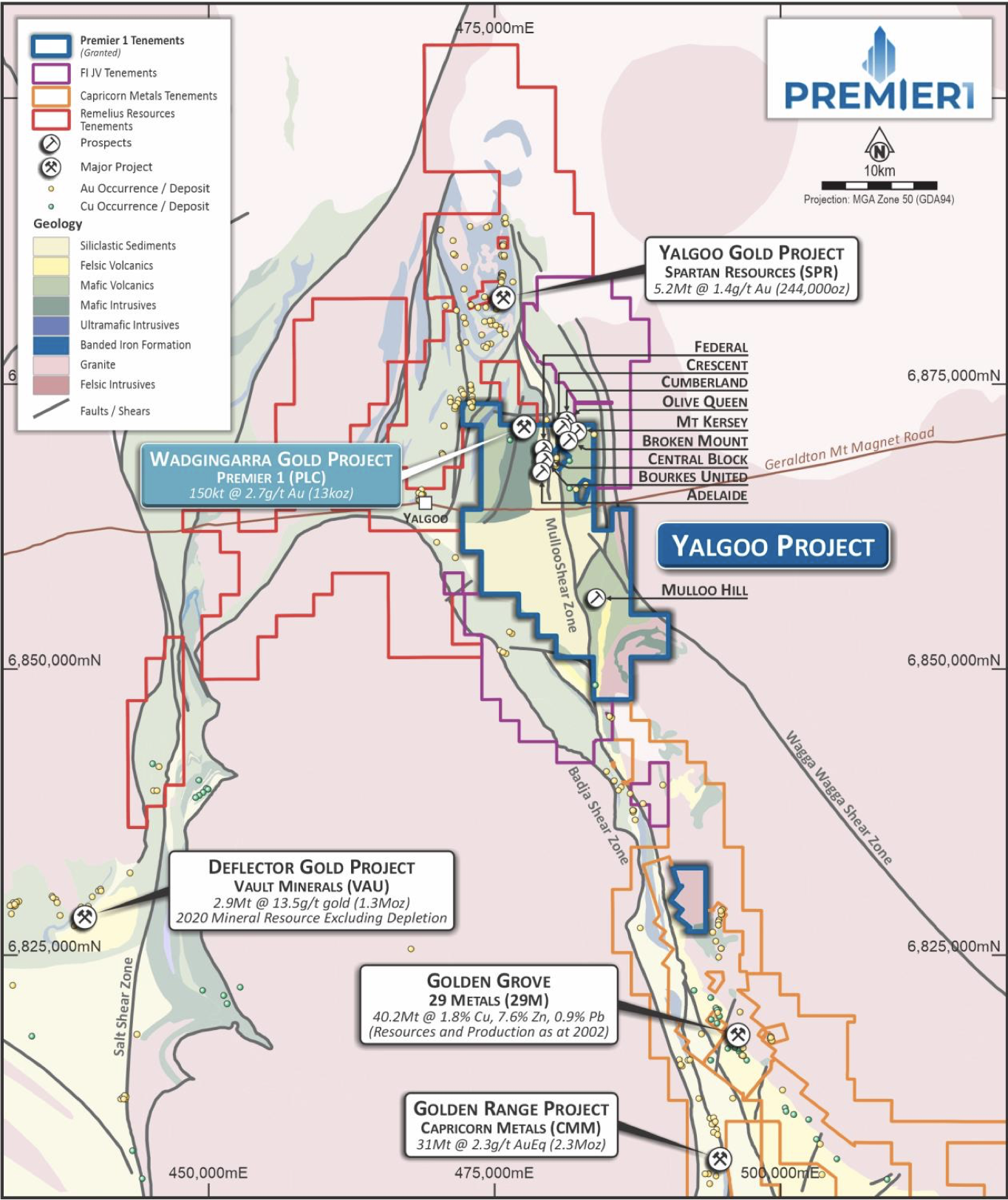
Premier1's 100% Yalgoo Gold Project.
Premier1 plans to test what it describes as a preserved hydrothermal system extending more than 1 kilometre, supported by coincident gold and multi-element soil anomalies including molybdenum, bismuth, tellurium, tungsten and arsenic (Mo-Bi-Te-W-As). Rock chip sampling has returned high-grade results of up to 26.4g/t gold and 14.2g/t gold, which the company says points to potential for higher-grade mineralisation at Mt Kersey.
With Programme of Work approvals in place and site preparations complete, Premier1 expects drilling to start in mid-February 2026.
The company said it will draw on up to $180,000 in Exploration Incentive Scheme (EIS) funding and a $176,000 Strike Drilling credit, which it expects to materially reduce cash costs for the program.
“The successful completion of our 100% acquisition of the Yalgoo Gold Project delivered Premier1 full ownership and exposure to Mt Kersey and its surrounding prospects. These targets lie within an emerging large-scale mineralised hub," executive director Simon Phillips said.
Mt Kersey Gold prospect
Mt Kersey sits on exploration licence E59/2288, east of the historic Wadgingarra mining area, and is hosted in a structurally complex package of sediments and banded iron formation with gabbro, komatiitic basalts, quartz dolerites and interpreted late-stage intermediate to felsic intrusives.
Premier1 interprets mineralisation to be controlled by secondary structures in the hanging wall of a major inverse fault on the eastern side of the target area.
“Our geological team has worked hard to secure all necessary regulatory approvals and site preparations, positioning us to commence drilling next week. Mt Kersey ranks as one of the highest priority targets at Yalgoo, and we are looking forward to seeing what this drill campaigns reveals, not only at Mt Kersey, but across the broader mineralised region we are advancing,” exploration manager Paul Smith said.
At surface, Mt Kersey features a 300-metre by 200-metre gold-in-soil anomaly up to 88ppb, alongside a broader coincident pathfinder suite (Te, Bi, As, Cu, Mo and Zn) that the company says outlines a preserved hydrothermal system extending more than 1km along strike. The anomaly trends north–south, with geochemistry transitioning from a molybdenum-rich zone in the south through Bi/Te and tungsten zones to a stronger arsenic anomaly in the north, interpreted as a shift from deeper/hotter to cooler/distal parts of the system.
Historical drilling in the area was generally shallow (around 40m) and did not properly test the key structural and geochemical targets. Later drilling by Aurox Resources (2005) and Venture Minerals (2021) focused south of the main system, leaving the core Mt Kersey target largely untested at meaningful depths and along the full extent of the hydrothermal footprint.