
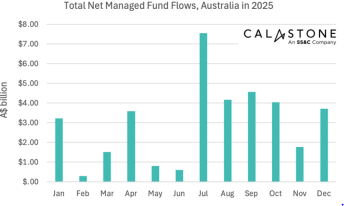
Australian managed funds recorded $35.9 billion in net inflows in 2025, with investors continuing to favour fixed income strategies while gradually rebuilding exposure to equities as market sentiment improved, according to new data from Calastone.
Fixed income anchors portfolios amid uncertainty
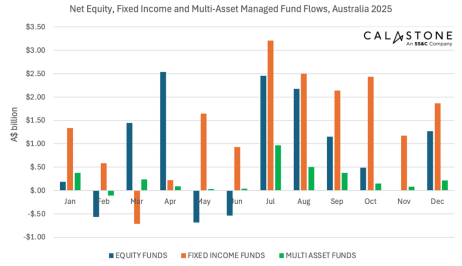
The data shows fixed income funds remained the dominant destination for capital, attracting $17.3 billion over the year as investors prioritised yield and capital preservation amid ongoing trade and geopolitical uncertainty.
After strong inflows in 2024, fixed income strategies pushed further into record territory in 2025. While the first quarter was volatile — including outflows of $714 million in March linked to tariff policy uncertainty — momentum accelerated from May as markets normalised. Fixed income flows remained consistently positive through the remainder of the year, with July the strongest month, delivering $3.2 billion of net inflows.
Equity funds stage a steady comeback
As conditions stabilised, equity funds experienced a notable recovery, recording $9.9 billion in net inflows for the year. The rebound more than offset outflows recorded in 2023 and subdued inflows in 2024, signalling a gradual but confident return to risk assets.
Equity flows were more sensitive to changes in risk appetite, Calastone reported, with demand strengthening meaningfully from August, aside from a flat November result. The strongest month was July, when equity funds attracted $2.4 billion, coinciding with easing inflation pressures and receding fears of a global recession.
“Fixed income was clearly the anchor allocation for Australian investors in 2025,” said Marsha Lee, head of Australia and New Zealand at Calastone. “Even as sentiment shifted through the year, demand for bonds remained resilient. What’s also notable is the way investors rebuilt equity exposure as market conditions stabilised — steadily and with conviction.”
Diversification returns through multi-asset strategies
Multi-asset funds also regained traction in 2025, recording $2.9 billion of inflows as investors returned to balanced portfolio allocations. Demand strengthened in the second half of the year as diversification benefits re-emerged and volatility eased.
Inflows into multi-asset strategies peaked in July at $970 million, aligning with the strongest month for both equity and fixed income flows, and remained positive through to year-end.
“What stands out is that investors remained active throughout 2025,” Lee said. “They leaned into fixed income for stability, and then steadily rebuilt equity and balanced allocations as conditions improved, signalling cautious confidence rather than complacency.”
July marks turning point for investor sentiment
Across all segments, July emerged as the key inflection point, with inflows spiking as uncertainty abated and investors reallocated capital. The coordinated strength across fixed income, equity and multi-asset funds highlighted a broad-based shift in sentiment rather than a narrow sector rotation.
The fund flow figures are based on transactions across Calastone’s Australian network between January and December 2025 and cover fixed income, equity and multi-asset funds. While the data reflects volumes transacted through the platform rather than total market share, Calastone said the scale and granularity of the dataset make it broadly representative of wider investor behaviour.