
Provaris Energy Ltd (ASX:PV1, OTC:GBBLF, FRA:WS90) has moved to firm up the manufacturing pathway for its large-scale liquid CO₂ (LCO₂) storage technology, announcing a new memorandum of understanding (MOU) with development partner Yinson Production and China-based manufacturer Himile Heavy Equipment Co. Ltd.
The MOU will assess the feasibility, cost and delivery timelines for fabricating Provaris’ proprietary LCO₂ tanks at Himile’s manufacturing facility in Rushan, China, running in parallel with the tank’s front-end engineering and design (FEED) program.
The work is aimed at supporting Floating Storage and Injection Unit (FSIU) concepts being developed by Yinson Production for carbon capture and storage (CCS) value chains.
Assessing large-scale tank manufacturability
Under the agreement, the parties will evaluate whether Himile’s Rushan facility can support the robotic fabrication of large LCO₂ tanks, including automation, laser welding and material selection.
Provaris will provide preliminary designs for the robotic production cells and associated equipment, including a digital twin model to simulate fully automated fabrication. Himile will develop preliminary design packages for required facility upgrades, estimate tank fabrication costs on a free-on-board (FOB) basis, and outline indicative timelines for facility upgrades and first tank deliveries.
Yinson Production will support studies covering logistics from Rushan to selected shipyards and the integration of tanks into FSIUs currently under development for 2026.
A kick-off meeting was held at Himile’s Rushan facility in mid-January to confirm scope and roles.
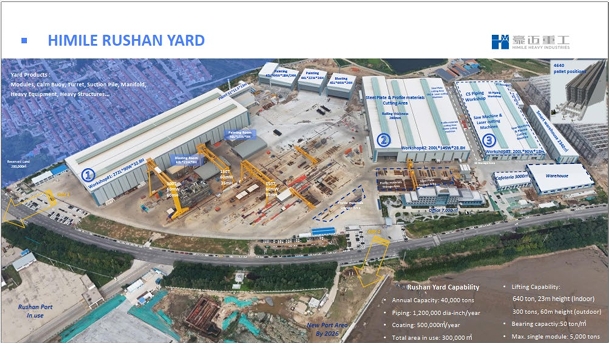
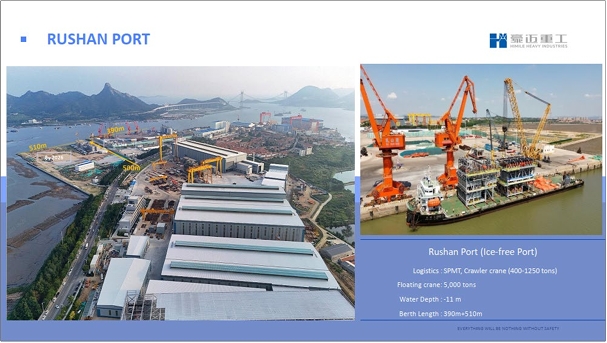
Illustration of Himile’s Rushan Yard Facility and Deep-Water Port Access (Source: Himile).
Leveraging Himile’s offshore fabrication track record
Himile brings a substantial offshore and energy fabrication pedigree to the assessment, having supplied a significant share of static equipment and pressure vessels for floating production storage and offloading vessels (FPSOs) over the past five years. The company has also delivered complex modules for floating LNG (FLNG) units, floating production units (FPUs) and storage units.
Provaris chief technical officer Per Roed said the collaboration builds confidence around scaling up tank production to meet emerging offshore CO₂ storage demand.
“Following our visit to their modern facility and processes implemented at their Rushan facility, we are confident that Himile can deliver a high-quality, cost-effective tank to meet the expected growth in maritime and offshore LCO₂ markets,” Roed said.
“Tanks that will be significantly larger than those currently offered in the market will offer cost benefits that will be of significant value to Yinson Production’s FSIU projects and other potential customers for carriers and storage.”
Supporting CCS project economics
Yinson Production chief technical officer Lars Gunnar Vogt said the MOU focuses on translating advanced tank designs into industrial-scale fabrication.
“Working with Provaris and Himile allows us to assess not just technical feasibility, but also manufacturability, cost, and delivery timelines,” Vogt said.
“These are critical factors as we develop FSIU concepts for carbon capture and storage value chains.”
Himile Heavy Industries president Zongkui Han said the partnership aligns with policy momentum around CCS and hydrogen.
“We are fully committed to leveraging our rich experience in heavy equipment fabrication to contribute to the success of the project,” he said.
FEED and class approval progressing
Provaris said its LCO₂ tank FEED and class approval program continues to track to schedule, including the design of automated fabrication processes using robotics and laser welding.
Final Phase 1 deliverables are expected to be submitted to Yinson Production in January 2026, with Phase 2 to follow. The program includes an ongoing class approval process with DNV, targeting completion by mid-2026.
The company said progress on manufacturability and cost certainty will be key to supporting commercial deployment of FSIUs and the broader CCS value chain.