
Krakatoa Resources Ltd (ASX:KTA) has confirmed high-grade gold and antimony mineralisation at its Zopkhito Antimony-Gold Project in Georgia, with maiden diamond drilling validating historical results and strengthening the case for a future JORC-compliant resource.
Results from the company’s first modern drilling campaign have confirmed that mineralisation extends both within and beyond historical workings, reinforcing Zopkhito’s status as one of the world’s highest-grade antimony systems and highlighting additional gold potential across the vein network.
The maiden program comprised 15 surface diamond holes and 18 short underground core holes drilled from within historic adits during the latter part of the 2025 field season.
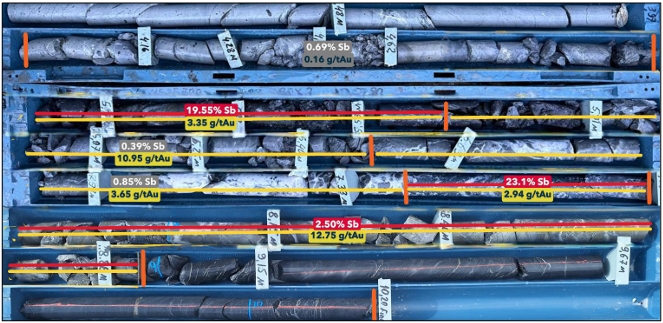
Photo of core from drillhole UG25ZOP003 showing distribution of sample intervals and high-grade assay results.
High-grade antimony and gold intersections
Surface drilling returned a number of notable gold and antimony intercepts, including:
- 8 metres at 14.1 g/t gold from 8 metres in hole DD25ZOP007, including 1.5 metres at 38.5 g/t gold and 3 metres at 1.48% antimony
- 7 metres at 3.0 g/t gold from 66.86 metres in DD25ZOP011, including 1 metre at 15.9 g/t gold and 0.47% antimony
- 2.71 metres at 3.0 g/t gold from 108.54 metres in DD25ZOP014, including 24.2% antimony over 0.33 metres
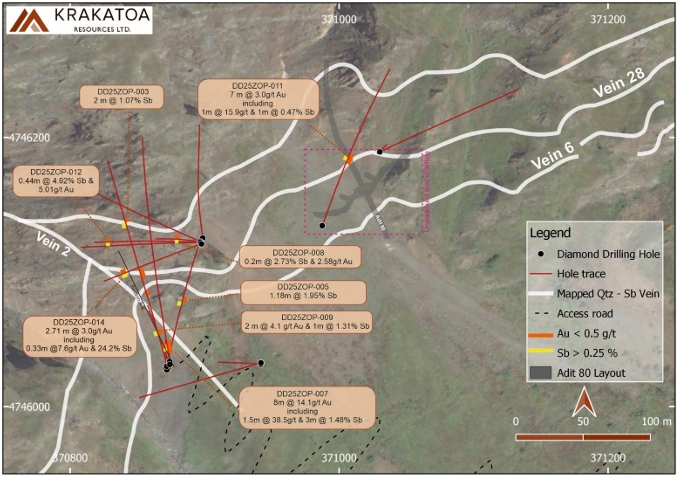
Plan view showing the drill hole collar and drill trace locations of all surface diamond drillholes. Significant assay results (>0.5 g/t Au and/or 0.25% Sb) reflecting mineralised intercepts are shown.
Underground drilling within Adit 80 delivered particularly strong antimony grades, with multiple high-grade intersections close to surface. Highlights included:
- 4.99 metres at 6.4 g/t gold and 5.07% antimony from 4 metres in UG25ZOP003, including 0.63 metres at 19.55% antimony
- 1.7 metres at 16.30% antimony and 2.47 g/t gold from surface in UG25ZOP016
- 3.29 metres at 9.03% antimony and 2.62 g/t gold from surface in UG25ZOP018
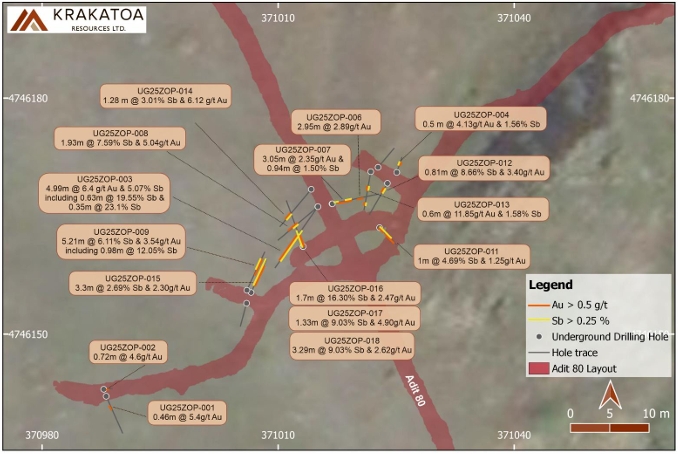
Plan view showing the underground core sampling drill hole collar and drill trace locations within Adit 80. Significant assay results (>0.5 g/t Au and/or >0.25% Sb) showing mineralised intercepts are shown.
Krakatoa said the results demonstrate that high-grade antimony mineralisation is accompanied by meaningful gold content across multiple veins and altered wall rocks.
Validation of historical resource
Zopkhito currently hosts a historical foreign resource estimate of 225,000 tonnes at 11.6% antimony and 7.1 million tonnes at 3.7 g/t gold, placing it among the highest-grade antimony systems globally.
The objective of the 2025 drilling program was to validate this historical data and underpin the conversion of the foreign estimate into a maiden JORC-compliant Mineral Resource.
CEO Mark Major said the maiden results had strengthened confidence in the project’s prospectivity.
“These results from the maiden exploration program have strengthened our resolve on the prospectivity of this deposit,” Major said.
“We successfully hit veins in the areas we targeted, supporting some of the predicted vein and mineralisation trends established during the Soviet era of exploration. This will add considerable elements for the future conversion of the Foreign Resource to a JORC system.”
He added that the confirmation of gold within the antimony veins and surrounding alteration zones represented a meaningful upside.
“There is clearly a major antimony mineral system here, one which seems to be consistent with typical structural controlled vein systems; however, the confirmation of additional gold within the antimony vein and further into the surrounding system adds another significant positive windfall to the project,” Major said.
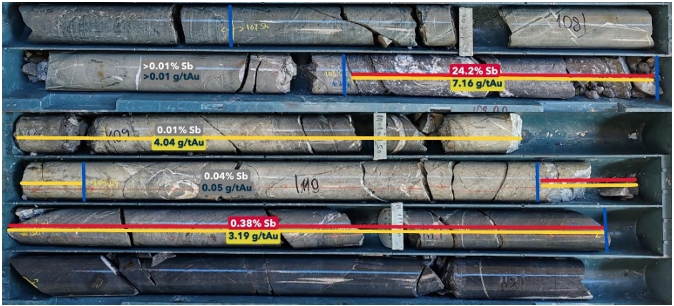
Photo of the core from drillhole DD25ZOP014 showing distribution of the mineralised zone with high grade antimony and gold grades.
Structural controls and exploration upside
The drilling focused on testing known vein systems between historic adits, particularly Vein 2 and Vein 6, which host structurally controlled stibnite-quartz mineralisation.
Surface drilling confirmed that Vein 2 extends below historic workings and can host extremely high antimony grades, while Vein 6 demonstrated a gold-rich component within the broader antimony system.
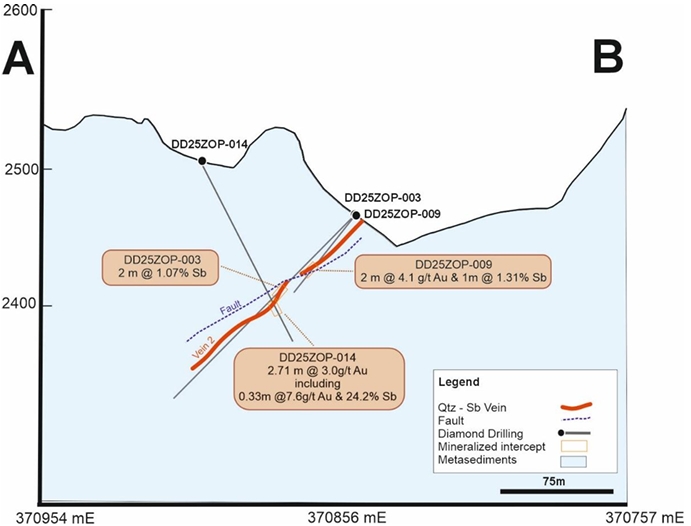
Simplified drill section A-B, mineralised antimony and gold drill results along Vein 2.
Underground drilling showed that antimony occurs in discrete high-grade bands, while gold appears more broadly distributed across veins and into the hanging wall and footwall alteration zones.
Next steps in 2026
Krakatoa is now planning a more extensive 2026 exploration program as it advances Zopkhito towards an initial JORC resource milestone.
Planned work includes additional surface and underground drilling, metallurgical test work, geological mapping, baseline environmental studies and further investigation into gold emplacement across the vein system.
Antimony is classified as a critical mineral by both the European Union and the United States, with China currently controlling around 90% of global supply. Krakatoa said Zopkhito’s location within Europe, supported by existing infrastructure and access to Black Sea ports, positions the project as a potential strategic source of Western-aligned antimony and gold.