
Cosmo Metals Ltd (ASX:CMO) has outlined results from a portable X-ray fluorescence (pXRF) geochemistry program across the underexplored Mt Everest–Mona VMS trend at its 484.1km² Bingara Project in northern NSW, identifying two previously untested target zones within a prospective corridor extending more than four kilometres.
The work was co-funded through a NSW Government grant of up to $50,000 under the “Critical Minerals & High-Tech Exploration Program”.
“We are very pleased with the success delivered from this systematic high-impact geochemistry program at the largely unexplored Mt Everest – Mona VMS trend, with at least two new high conviction VMS targets identified for follow-up exploration. We envisage this work will lead to initial drill testing in the 2026 field season, the first ever drilling within the 20 kilometres long VMS belt at Bingara, host to at least six clusters of historical copper mines,” Cosmo’s managing director, Ian Prentice said.
“We are very grateful for the non-dilutionary funding support received under the NSW Government’s Critical Minerals & High-Tech Metals Exploration Program to advance this exciting target”.
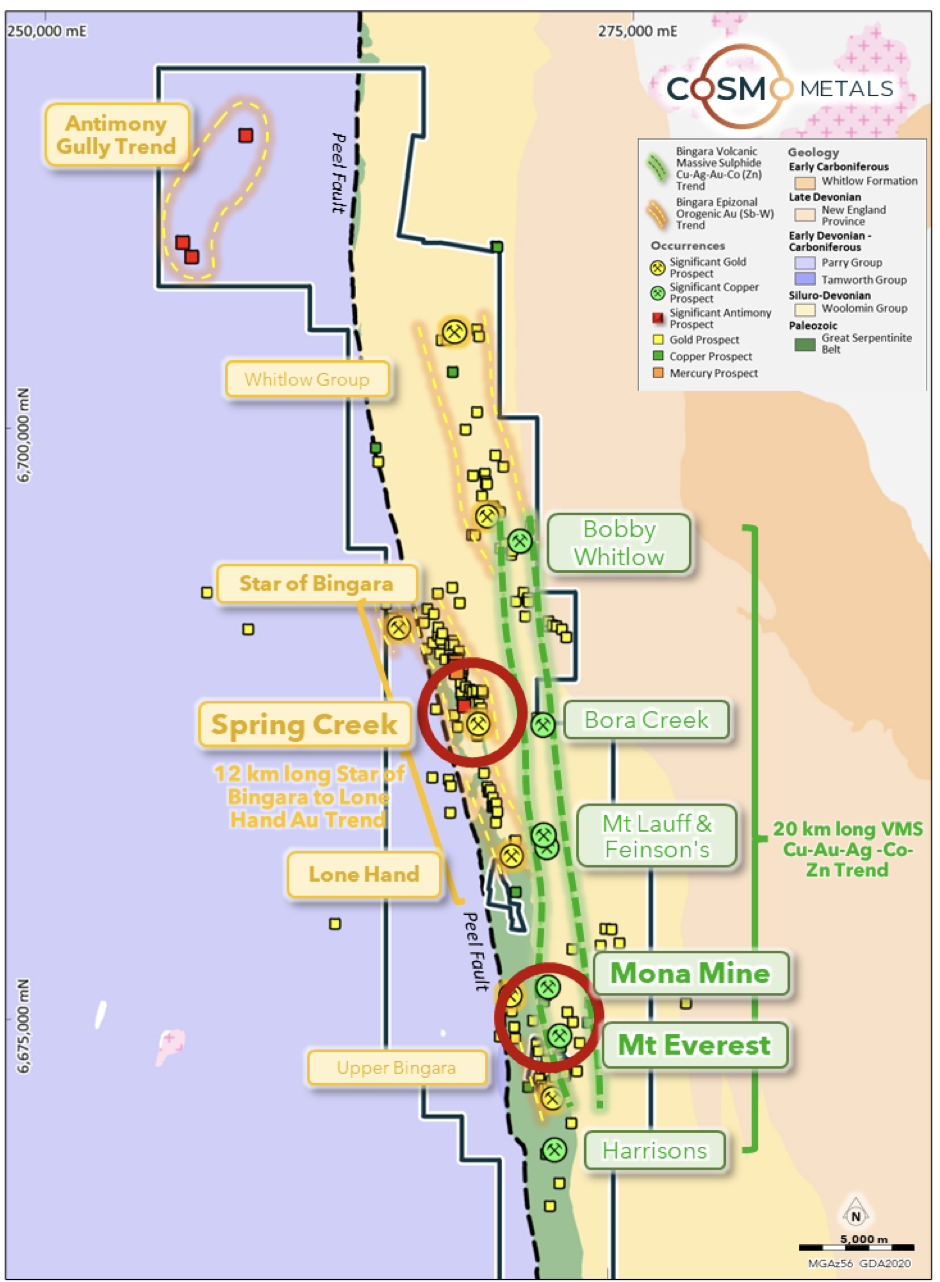
Bingara Project with prospect areas on regional geology showing Mt Everest – Mona Mine trend.
Two target zones flagged in Mt Everest–Mona corridor
Cosmo said the systematic pXRF soil and rock-chip geochemistry has defined two high-priority volcanogenic massive sulphide (VMS) target areas within a roughly 4 kilometres by 500 metres Mt Everest–Mona corridor, where the company sees evidence for Cu-Au dominated mineralisation.
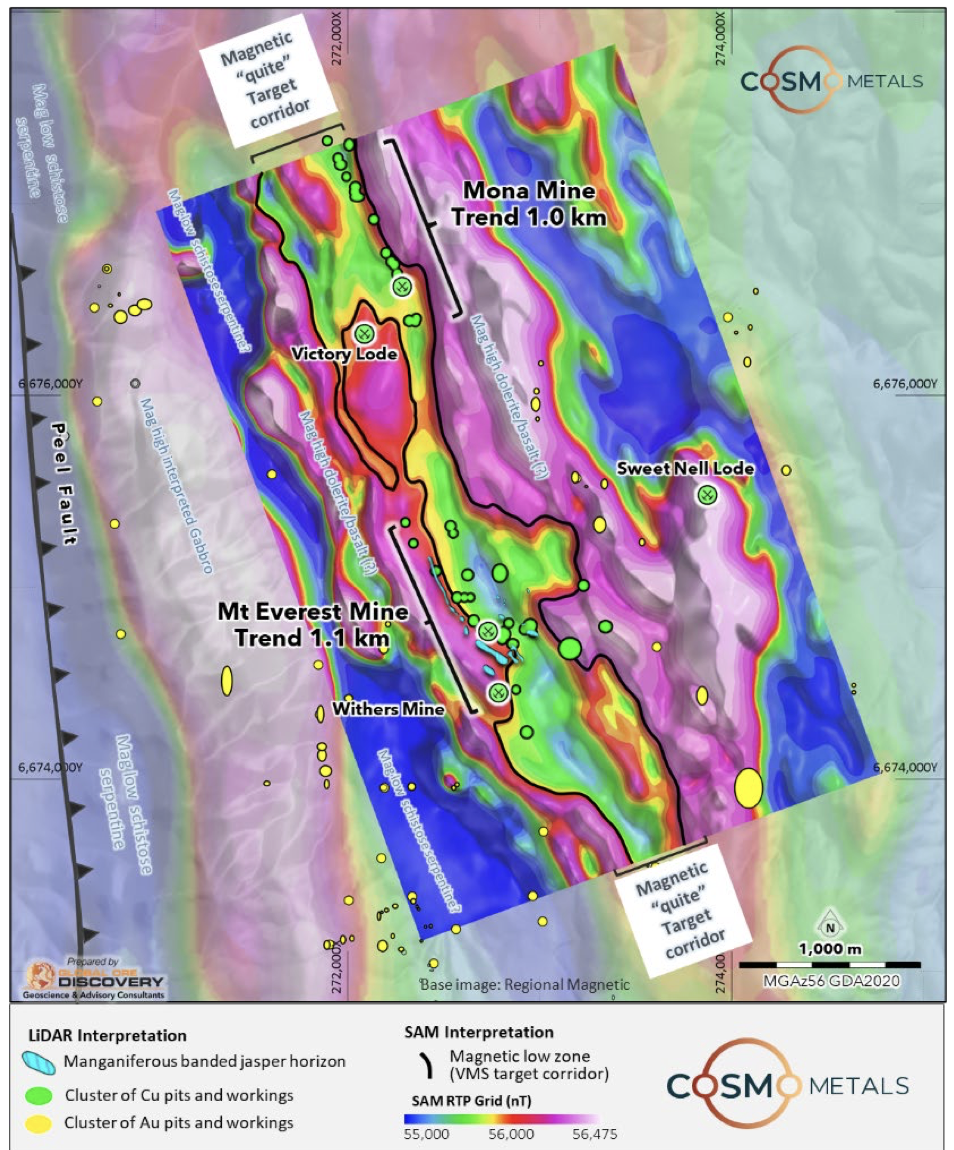
Mt Everest to Mona SAM magnetics with LiDAR interpretation highlighting +4km VMS Target Corridor.
The first target is the Victory Lode anomaly, described as a coherent, approximately 500 metres long copper zone in soil. Cosmo reported a peak copper value of 1,104ppm (0.11%) Cu, coincident with an arsenic anomaly and what it said was the strongest zinc anomalism in the area.
A second target was outlined as a potential feeder/stockwork zone to the east of Mt Everest. Cosmo said this area hosts the highest copper anomalism recorded in the survey, with soil results peaking at 1,990ppm (0.2%) Cu. The company added that elevated Cu-Zn values in rock-chip samples support the interpretation.
Cosmo compared the style of mineralisation it is targeting to Cyprus-style VMS systems, noting similarities to deposits seen across the Tethyan mineral belt in Europe and the Middle East.
Historic workings support the corridor concept
Within the broader target corridor, Cosmo referenced earlier reconnaissance rock-chip sampling collected adjacent to historic copper mines, which returned high-grade copper results from sulphide and supergene material.
Those earlier samples included assays of 3.9% and 8.19% Cu from partially oxidised sulphides, and 15.4% and 24.2% Cu from malachite-bearing supergene mineralisation.
Next steps
Ground truthing of both high-priority targets is scheduled for early February 2026, including the collection and analysis of additional rock-chip samples. In parallel, Cosmo is assessing suitable ground geophysical techniques to further refine the targets, with surveys planned as soon as contractor availability allows.
The company said the work is aimed at defining drill-ready targets within what it describes as a previously undrilled, high-conviction VMS corridor at Bingara.