
China’s evolution into a global biopharma innovation hub has moved well beyond a theoretical talking point. A new analyst note from PitchBook outlines how the country has built a durable advantage in early-stage asset generation — one that is already reshaping global licensing markets and changing the competitive context for biotech companies elsewhere, including Australia.
Rather than a simple story of “catch-up”, the report frames China as a market that has quietly assembled a full-stack development engine: original research, rapid clinical validation and scalable manufacturing, increasingly operating in concert. That combination is beginning to influence where global pharma looks first for new assets — and how those assets are priced.
Early-stage innovation has become the battleground
One of the clearest themes in the PitchBook analysis is the growing imbalance between early-stage supply and demand. While US and European biopharma markets remain constrained by funding, China is producing a rising volume of novel drug candidates across next-generation modalities.
Between 2019 and 2023, Investigational New Drug filings for “innovative drugs” in China more than tripled, supported by regulatory reforms, dense clinical trial networks and large patient populations. The practical outcome is speed: first-in-human trials can begin materially earlier than in Western markets.
That speed matters because early-stage validation increasingly sets the tone for downstream value. Global pharma groups, facing internal R&D pressures and looming patent cliffs, are showing a greater willingness to license assets earlier — particularly where proof-of-concept has already been demonstrated in humans.
Licensing markets are becoming more competitive
China’s growing role is especially visible in cross-border licensing. In 2025, deal flow remained active across a wide spread of clinical stages and modalities, with particular strength in antibodies, antibody–drug conjugates, metabolic disease programs and nucleic-acid-based therapies.
From an Australian market perspective, this introduces a more competitive dynamic. ASX-listed biotechs continue to operate in a globally connected ecosystem, but the peer set they are measured against has broadened. Chinese developers are now competing directly for the same licensing capital, often with faster clinical timelines and lower development costs.
The effect is subtle but important:
- licensing discussions are happening earlier
- benchmarks for clinical progress are rising
- differentiation is increasingly expected at the platform level, not just asset-by-asset
- Capital discipline is reshaping innovation
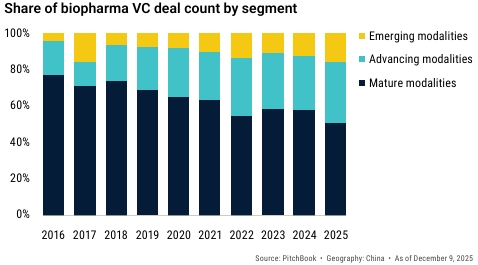
PitchBook also points to a structural shift in Chinese venture funding. While aggregate capital has fallen from its 2021 peak, domestic investors have stepped in as foreign participation has receded. At the same time, funding has tilted away from legacy “fast-follower” programs toward more complex and globally relevant science.
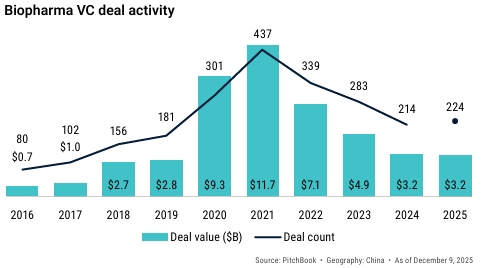
This recalibration reinforces a broader trend already familiar to Australian biotech investors: capital is concentrating around fewer, higher-conviction opportunities. Programs that lack clear differentiation — whether mechanistic, technological or clinical — are finding it harder to attract attention in an increasingly selective environment.
In practical terms, the bar is rising around:
- capital efficiency
- speed to meaningful data
- clarity of partnering strategy
Geopolitics adds friction, not a full stop
The report also addresses geopolitical risk, including the US BIOSECURE Act and broader policy efforts to reduce reliance on Chinese biotechnology services. While these measures introduce complexity — particularly around manufacturing and procurement — PitchBook’s view is that they are unlikely to derail China’s early-stage innovation momentum.
Instead, the more immediate effect may be felt in Western markets, where higher costs and regulatory uncertainty risk compressing pipelines further. For Australian companies operating across borders, flexibility in development pathways and supply chains is likely to become more valuable than rigid geographic alignment.
China’s expanding role does not diminish the relevance of Australian biotech, but it does change the context. As global dealmaking becomes more competitive and selective, early-stage excellence, rapid validation and genuine differentiation are increasingly central to value creation.