
In its December quarterly, Constellation Resources Ltd (ASX:CR1, FRA:0XX) said on-ground exploration across two Edmund-Collier SPA-AOs is expected to start in the current quarter following permitting approvals, with programs planned for soil gas sampling and inspection of historical mineral exploration holes for evidence of gas seepage.
CR1's total natural hydrogen (NatH2) footprint now covers 87,602km² across 9 SPA-AOs (Special Prospecting Authorities with an Acreage Option) over the Edmund-Collier, Yerrida and Ashburton basins.
The company described its natural hydrogen projects as a first-of-its-kind opportunity in Western Australia, targeting naturally occurring hydrogen across a large, underexplored basin system extending about 300 kilometres east–west and 40 kilometres north–south. It noted there has been no prior deep drilling across the basin system.
It added the SPA-AO applications are intersected by the Goldfields Gas Pipeline and located near major energy users, including iron ore operations assessing options for onsite green power generation and steel production.
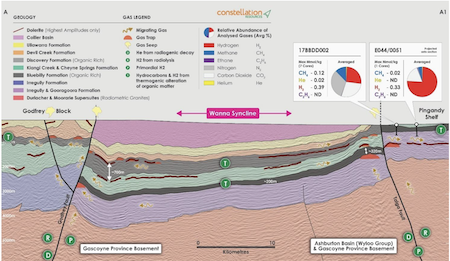
Edmund-Collier conceptual hydrogen system and reprocessed seismic line displaying anomalous crushed rock analyses from drillholes containing hydrogen, helium and natural gas (methane).
CSIRO studies identify hydrogen and helium in historical core
During the quarter, Constellation received results from CSIRO analysis of deeper historical diamond drillholes within the Edmund-Collier project area. The work identified a suite of gases trapped in pores and/or fluid inclusions, with hydrogen, helium and/or natural gases (methane and ethane) detected in nearly all submitted core samples.
The detection of hydrogen, helium and associated gases across multiple intervals supports the potential for gas generation and migration from basement and within the basin. The co-existence of hydrogen, helium, methane, carbon dioxide and ethane may indicate a common genetic origin linked to thermal maturation of organic-rich shales, potentially within the Blue Billy and Discovery formations.
Seismic reprocessing supports basin-wide source potential
Constellation said reprocessing and interpretation of the Geoscience Australia seismic line 10GA-CP2 indicates the organic-rich Blue Billy and Discovery formations extend across the Edmund-Collier Basin and may be capable of generating large-scale natural hydrogen, based on source rock and thermal maturity analysis.
Meanwhile, the company continues engagement with stakeholders, including native title groups and pastoral stations, and aims to begin activities on two Edmund-Collier SPA-AOs once stakeholder engagement and other conditions are finalised, including Department of Mines, Petroleum and Exploration requirements.
Constellation has submitted its Environmental Plan for approval ahead of initial on-ground survey work and intends to refine early-stage soil gas sampling locations using results from its CSIRO collaboration.
Ularring copper-gold: Chatham anomaly lined up for drilling
At the Ularring copper-gold project, Constellation reported additional soil sampling along the Meenar Shear defined a 1.3 kilometre x 0.45 kilometre gold-copper soil anomaly known as Chatham, which is scheduled to be drill tested in the current quarter with support from an Exploration Incentive Scheme grant.
The maiden Ultrafine+ soil program that defined Chatham comprised 436 samples on a notional 100 metre x 80 metre grid and returned peak values of 78ppb gold and 1,126ppm copper, along with associated silver, tellurium, tungsten and platinum group elements.
The company also noted a late-time VTEM electromagnetic “bullseye” anomaly sits beneath the Chatham soil anomaly, which it said may indicate a conductive sulphide-rich unit at depth.
Cash position at quarter end
Constellation reported a cash balance of $1.021 million at December 31, 2025. Net cash used in operating activities for the quarter was $502,000, while exploration and evaluation expenditure totalled $315,000 during the period.