
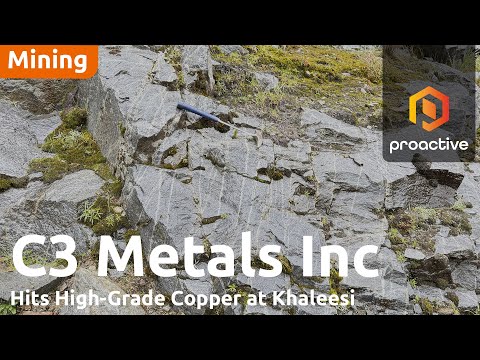
C3 Metals Inc (TSX-V:CCCM, OTC:CUAUF) earlier this week reported promising high-grade drill results from the second hole at its greenfield Khaleesi project, pointing to significant mineralization potential and structural complexity within the target area.
CEO Dan Symons said the hole returned a 51-metre intercept grading 0.5% copper and 0.31 g/t gold, equating to a copper equivalent of 0.86%. Within this was a standout 18-metre zone grading 1.85% copper equivalent.
Proactive: Last time you and I chatted, you were talking about the first hole at the Khaleesi project and the success that you saw in that first hole. Now, with hole number two, you're seeing the continuation of that.
Dan Symons: You know, it's really interesting. The second hole is much higher grade. It’s a narrow intercept—51 metres—but much higher grade at 0.5% for copper and much, much better gold values at 0.31 g/t, which equates to 0.86% copper equivalent. And within that, a very high-grade zone of 18 metres at 1.85% copper equivalent. So we're really happy with what we're seeing here.
It's a completely new mineralization style. The first hole was a broad intercept into a magnetite skarn. This second hole now is into porphyry-style veins overprinting garnet skarn, which is really, really positive. It’s exactly what we want to see because that means there have been multiple mineralization events through this hydrothermal system.
Is that the biggest thing you're learning from hole number two—that you feel like you're heading in the right direction?
Yeah, we definitely feel like we're heading in the right direction because we saw high-temperature copper sulfide minerals. So we're seeing bornite and chalcocite. Chalcocite is a very high-temperature copper sulfide, and usually, that’s going to mean one of two things. Either you're vectoring in already on the heat engine of the hydrothermal system, or there's been multiple pulses and you're getting what's called hypogene enrichment. In either case, it's both very good for grade, and we're really excited to see that.
So now it's about following up on this high-grade zone, getting multiple pierce points into it. And then at some point, we'll have to drill down it to see if we can get into the causative intrusive or the source of all this mineralization throughout the hydrothermal system.
You've done about 4,200 metres. You've got 6,300 that you were planning, so you've got a little more left to go. And there's still obviously holes that are going to be reported out. But I noticed in the news you talked about going back and doing some scouting holes. So is that what you're talking about for this particular area?
Yeah, exactly. In these areas where we've been collaring drill holes, there's limited and sporadic outcrop. You see outcrop, and you can see some copper at surface, and you're collaring drill holes there, and it lines up with good soil geochemistry and geophysical anomalies underneath. But 65–70% of the project area is covered by a thin layer of glacial till, which makes it completely blind at surface.
What we're finding now is that we have multiple drill holes where we've had reported assays, and the best part of the intercepts are actually underneath that blind area—the glacial till zone. So we're going to have to do some scout holes based on the geophysical data and the existing drill data we’re now starting to get back. If we are able to see mineralization under this till area, that opens up a much, much bigger target area for us.
It sounds like it's been exciting so far, but still some questions that need to be answered. Is that the way you're sort of mentioning it to your investors?
Look, there are always questions to be answered. It’s a brand new greenfield project. We've got two holes into it. This has never been drilled by anyone else previously. We discovered it, consolidated the ground, put it all together. We did all the work with the local community to gain social license. We worked to get the drill permits approved—which can take some time. Achieved that. Did all the soil geochemistry, the geophysical data, all the geological mapping before we ever drilled a hole.
And I think that's why it's paying off, and we're hitting so early into this. But to hit the type of mineralization that we've hit in the first two holes of this program—particularly the high grade we’ve hit today—I think it’s just an outstanding achievement for a greenfield project that had zero previous drilling. So we're really excited about it, but when you only have data back from two holes, you still obviously have a lot to learn.
Quotes have been lightly edited for style and clarity