
- FTSE climbs 12 points to 10,150
- Stocks up and gold down after US President's tariff climb-down
- UK budget deficit smaller than expected
- AB Foods, B&M, Computacenter and AJ Bell provide updates
4.55pm: Trump TACO provides small snack boost for stocks
The FTSE 100 finished Thursday’s session higher, up 12 points at 10,150, as investors welcomed Trump’s latest policy u-turn.
“Trump’s ability to escalate and then suddenly reverse course with no apparent hit to his reputation is remarkable, and provides opportunities for nimbler traders,” IG chief market analyst Chris Beauchamp said.
“Long-term investors just need the ability to shrug wearily and let the volatility run its course. Rotation continues apace in markets, as US small caps lead the way while tech lags behind, providing evidence of healthy digestion in markets.”
2.49pm: Wall Street stocks open in green
US stocks have opened higher, as expected.
The small cap Russell 2000 is leading the way, starting 0.9% higher, followed by the tech-powered Nasdaq, up 0.6%.
The Dow Jones and S&P 500 have risen 0.5% and 0.4% respectively.
Top risers on the S&P are Arista Networks, Northern Trust Corp and Datadog.
Meta Platforms is the top riser among the Mag 7, up 3%, while Alphabet and Microsoft are both up more than 1%.
Fallers on the Nasdaq are led by Micron, Intel, Netflix and Strategy.
2.10pm: US growth upgraded, but set to slow in 2026
US economic growth has been upgraded as data delayed by the US government shutdown continues to filter in.
Gross domestic product in the three months to September rose 4.4% compared to last year, Commerce Department data showed, up from its initial estimate of 4.3%.
It is the highest level of US GDP for two years.
This was due to “upward revisions to exports and investment that were partly offset by a downward revision to consumer spending,” the Commerce Department said.
In more timely data, US inflation held at 2.7% in December.
And initial jobless claims rose to 200K in the week ending January 17, up from 199K, but below the consensus forecast of 209K.
Continuing claims fell to 1,849K from 1,875K, also undershooting the consensus, which was 1,890K.
Economist Oliver Allen at Pantheon Macro says the GDP data upgrade is "little more than a rounding error, with tiny downward revisions to consumption and fixed investment more than offset by marginal upward revisions to the contributions from net trade and inventory-building".
He says the "bigger picture is that annualized GDP growth averaged a respectable 2.5% in the first three quarters of 2025, underpinned by growth of 2.2% in consumers’ spending".
Other timelier growth indicators suggest that households were "starting to tire in Q4, probably weighed down by weakness in the labor market, meager real income growth, and an already very low personal saving rate that leaves little scope for further dissaving to support strong growth in spending", he says.
"Few other major components of demand look poised to pick up the slack. We see quarterly GDP growth averaging more like 1½% over the next year or so."
1.15pm: Notes worth noting
There's some broker notes worth flagging today.
European defence shares wobbled this week after comments from President Trump at Davos revived thoughts about geopolitics and the trajectory of the war in Ukraine.
Analysts at JP Morgan said the market reaction underestimated the scale and durability of the defence spending cycle now underway, with speeches by Canadian leader Mark Carney and Trump reinforcing the view that global defence budgets were entering “the very early stages of a global defence spending upturn that could last for another decade”.
Carney, for example, said Canada planned to double defence spending by the end of the decade in ways that supported domestic industry.
Admiral Group Plc (LSE:ADM) was hit by a second broker downgrade in as many days after RBC lowered its rating on the UK motor insurer to 'sector perform' from 'outperform', warning that earnings momentum had turned negative.
The move follows a downgrade on Wednesday by Goldman Sachs, which also flagged challenges in the UK motor market.
RBC cited near-term uncertainty in the sub-sector and a shift in how the company funds its share scheme.
A few analysts have been tweaking their numbers for Haleon ahead of its final results next month.
Deutsche Bank reiterated a 'sell' rating, likewise warning of changes in consumer trends that may show up in the results.
Analyst Tom Sykes cited a shift in how consumers purchase over-the-counter health products, particularly in the US, will erode the FTSE 100 group’s margins over time.
Although recent gains in Haleon’s share price had been supported by favourable foreign exchange movements, particularly in emerging markets such as Russia and South Africa, this uplift may be temporary, the analyst said.
12.48pm: US futures higher
US stock futures point to a positive start on Wall Street, with Dow futures up 0.3%, S&P 500 futures ahead by 0.5%, and the Nasdaq leading with a 0.8% gain, as investors extend yesterday’s rally.
"The tariff risk is now on the back burner, and this week’s price action tells us that financial markets fear tariffs more than geopolitical risks," says market analyst Kathleen Brooks at XTB.
"The terms of the deal that Nato have agreed with the US around Greenland are unknown, but the Nato Secretary General said that it did not involve Greenland’s sovereignty [so] Greenland is not about to become the 51st US state."
Defense stocks were some of the weakest performers in Europe today, with Rheinmetall down 1.8%, Babcock lower by more than 1%, as the military threat to Greenland is lowered.
"We think this sell-off in defense names will be temporary, as defense is still one of the most powerful themes in European equities right now," says Brooks.
"Also, we do not know the terms of the US/ Greenland deal, which will still involve a ramp up of European defense spending in the coming years.
"Added to this, the existential threat to Nato still exists, and Trump could turn on his allies in the future.
"For now, that risk has been kicked down the road, but the fact that the gold price remains elevated, suggests that there is still demand for safe havens," she says.
Away from President Trump, the global bond market sell-off that was sparked by fears about fiscal expansion in Japan has continued to recover.
The US dollar and the Japanese yen continue to be the weakest currencies in the G10 FX space this week.
"Ahead today, the focus will be on whether US stocks can extend gains for another day after President Trump made the case for the ‘Buy America’ trade at the Davos summit on Wednesday," says Brooks.
There is also US economic data to watch later today, including the final reading of Q3 GDP and the core PCE report, the Fed’s preferred measure of inflation, for November.
11.55am: Westminster rumours lead to bond market spike
Gains for the FTSE 100 and 250 are being trimmed.
The blue-chip index is up less than 0.2% now, while the mid-caps are up 0.6%, having been up 0.8% and 1.4% in mid-morning.
Harbour Energy is the biggest faller on the 350, down 5.4% after its update.
Utilities, precious metals miners and defence are weighing.
A bit of a spike in the UK gilt yields is possibly at play here. Politics could be at work, with a report in the Times that a Labour MP is standing down, potentially to allow Manchester mayor Andy Burnham to return to the House of Commons.
Burnham is seen as the leading potential candidate to replace Sir Keir Starmer as Prime Minister.
Bond markets do not like change, especially as Starmer and Rachel Reeves have been so focused on trying to impress financial markets.
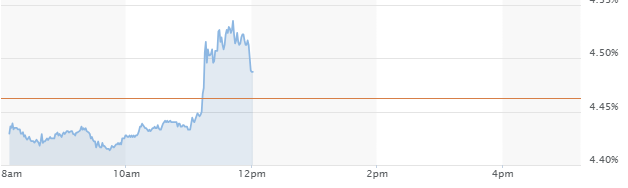
The yield on the 10 year UK government bond spiked after the article was published, but has already started to dissipate.
11.11am: The rise of the 'hectocorn' - a new IPO buzzword
Forget unicorns, 2026 is shaping up to be the year of the 'hectocorn'.
The term is apparently gaining traction, according to articles from Bloomberg and the Guardian, to describe privately held tech firms valued at over $100 billion, putting the tired old $1bn “unicorn” in the shade.
Several companies are reportedly eyeing public listings that could see them debut with hectocorn valuations:
SpaceX, Elon Musk’s aerospace venture, is one example, with a valuation touted anywhere from $800 billion to $1.5 trillion, though uncertainty surrounds the timing of any flotation.
ChatGPT developer OpenAI is another headline act, with a valuation that has reportedly soared to $500 billion, and some estimates placing a potential IPO at as high as $1 trillion.
Another hectocorns reportedly exploring an IPO is AI firms Anthropic ($350 billion) and Databricks ($134 billion), along with payments group Stripe, which rebounded last year to a valuation of $107 billion
Those between hectocorn and unicorn – decacorns, maybe – include London-based fintech Revolut ($75 billion), Australian design software startup Canva ($42 billion), crypto exchange Kraken ($20 billion), while unicorns thought to be eyeing listings in coming years include Uber's Estonian rival Bolt ($6 billion), UK neobank Monzo (£4.5 billion), defence tech startup Anduril ($30 billion), and another UK name Starling Bank (£4 billion).
If a handful of these hectocorns and decacorns float this year, it would provide a big boost to stock market sentiment and could help the governments on both sides of the Atlantic.
10.26am: TACO talk
Everyone's talking TACO this morning.
"Risk is firmly back after Trump’s about-turn," says market analyst Neil Wilson at Saxo, after the US President first ruled out the use of force to take Greenaldn, then later said he had decided not to impose tariffs after agreeing “the framework of a future deal with respect to Greenland" in talks with Nato Secretary General Mark Rutte.
"From the market point of view, it’s the classic TACO trade," says Wilson.
While this sounds positive, "there are a lot of known unknowns", he adds, paraphrasing former US defence secretary Donald Rumsfeld.
"The EU-US trade deal agreed last summer remains on hold. Issues of sovereignty remain undiscussed, and Denmark is cautious. Nato leader Rutte said the issue of sovereignty had not come up... Rutte is hardly the diplomatic or political voice of the EU, Denmark or any other sovereign European nation."
Russ Mould, investment director at AJ Bell, says "Donald Trump’s TACO bell has rung once again, much to the joy of financial markets".
He says as Trump is known for "chickening out of his threats", Asian and European markets have regained their poise as this pattern played out again.
Mould agrees that many unanswered questions remain. "It’s more about financial markets regaining balance than moving into top gear."
9.14am: FTSE and European stocks flying
After just over an hour, the FTSE 100 is up 80 points at over 10,218, while the FTSE 250 has gained 270 to reach 23,341.
The London benchmarks have been joined by those in Europe, with the Stoxx 600 up 1.2% and both the DAX and CAC up 1.3% in Frankfurt and Paris.
St James's Place is top of London's blue-chip leaderboard, up 3.9% without having issued any news. Perhaps it is a read-across from AJ Bell, which reported record inflows amidst heightened levels of customer activity during the past quarter.
Fallers are led by precious metals miner Fresnillo, down 2.4%, with Endeavour Mining down 1.7%.
Gold prices have dropped back after President Trump's Davos appearances dialled down geopolitical tensions. Spot gold has retreated to $4,830 an ounce, having topped $4,880 a day earlier.
Silver is continuing to trade sideways as it has this week, at just over $94/oz.
Oil prices are down, with Brent falling 0.7% to $64.75 a barrel.
8.48am: Future strengthens Gen Z appeal
Another deal, but shares in Future PLC (LSE:FUTR) have clicked 4.4% higher after it snapped up Gen Z digital publisher SheerLuxe Ltd for an initial £40 million.
The total consideration could rise to £80 million depending on future performance.
SheerLuxe, a digital 'people-led' fashion and lifestyle publisher, recorded revenue of £12.6 million and EBITDA of £5.1 million in the 12 months to September 2025, with an EBITDA margin of around 40%.
Future is also buying the publisher's BLUSH Talent MGMT Ltd sister company, which represents many of the SheerLuxe team.
Panmure Liberum analyst Johnathan Barrett says the acquisition he expects it to be "only very marginally accretive at earnings level" in the 2026 financial year.
Assuming 10% revenue growth rate with stable margin "seems reasonable and we think likely to mean only low-mid singe earn-out payments. This looks a logical acquisition positioned to avoid the uncertainty in B2C media market."
8.34am: Kitwave agrees takeover, price seems a little low
Shares in Kitwave Group PLC (AIM:KITW) have jumped 33% after the foodservice wholesaler agreed to a £251 million cash offer from US private equity firm OEP Capital Advisers.
Under the deal, shareholders will receive 295p in cash per share.
This represents a 33.5% premium to the closing price of 221p yesterday, but is below levels seen as recently as last year, when the shares topped 330p, and in 2024 when they traded above 300p for most of the year.
However, a profit warning was issued last summer due to extra short-term investment in a new depot, an increase in employer National Insurance contributions and lower sales volumes to the leisure sector.
8.15am:
The FTSE 100 has leapt higher in early trading, up 73 points to just shy of 10,211.
This is only around 15 of points away from the record close at the end of last week.
Financials, real estate, tobacco and utilities are leading the way in initial trades.
8am: Another profit warning from B&M
B&M European Value Retail SA (LSE:BME) has issued its third profit warning in four months as the discounter's new CEO struggles to turn around performance.
The discount retailer now expects adjusted EBITDA for the year to March of £440-475 million, down from previous guidance of £470-520 million, due to investments in pricing, stock clearance of discontinued lines, and the financial underperformance of Heron Foods.
Like-for-like sales at B&M UK declined 0.6% over the quarter but showed growth of 3.0% in December, compared to flat LFL sales in the first half.
Chief executive Tjeerd Jegen, who started last June, said the group entered the 'golden quarter' "sharper on price to reinforce our value proposition with our customers" and this price investment has continued.
He added: "These are investments in the long-term strength of B&M, but they do impact near-term financial performance."
7.41am: ABF adds meat to bone of profit warning
Primark owner Associated British Foods PLC (LSE:ABF) has fleshed out its trading performance over the festive period, revealing its clothing retail chain saw like-for-like sales fall 2.7%.
Group revenue came in at £6.76 billion for the 16 weeks to 3 January 2026, in line with expectations previously lowered at its 8 January profit warning.
Although Primark’s LFL sales fell, total sales rose 1% overall, thanks to space increases. The UK and Ireland saw total sales up 2%, with US sales up 12%, and mainland Europe down 1%.
7.24am: Budget deficit lower than expected
UK public sector net borrowing came in below expectations in December, according to figures from the Office for National Statistics just now.
The budget deficit was £11.6 billion last month, lower than the £13.0 billion forecast and slightly below £11.7 billion recorded a year earlier. November’s figure was also revised down to £10.9 billion.
However, broader measures of government cash requirements rose. The public sector net cash requirement (PSNCR) jumped to £16.9 billion, up from £10.3 billion, while central government net cash requirement hit £14.5 billion, up from £13.6 billion.
7.16am: FTSE 100 set to surge after Trump rows back on tariffs
The FTSE 100 is set to surge back higher on Thursday after Donald Trump dropped his tariff threats against the UK and seven other European countries, claiming he had agreed "the framework of a future deal" on Greenland.
London's blue-chip shares index has been called 62 points higher on the futures market, which would take the benchmark back to almost where it ended last week, after adding just over 11 points yesterday following Trump's rambling speech at Davos to close at 10,138.
Overnight, US stocks also rebounded from the previous day's losses, with the Dow Jones, S&P 500 and Nasdaq all jumping 1.2%.
Asian shares have followed suit but mostly to a lesser degree, with Japan's Nikkei leading the way, up 1.7%.
Market analyst Ipek Ozkardeskaya at Swissquote Bank said the rally in relief at Trump's U-turn "may sound pathetic, but this is how markets have functioned since last year: sell the punch, buy the pullback".
She noted that the gold price fell, but was not smashed, "a reminder that investors remain somewhat sceptical".
But zooming out, she says the "overall market mood has improved" but markets "will continue to react emotionally to US headlines – that won’t change. Uncertainty and sudden volatility spikes will remain on the menu this year."