
Sovereign Metals Ltd (ASX:SVM, OTC:SVMLF, AIM:SVML, FRA:SVM) has recovered a monazite product containing heavy rare earth elements from the tailings stream generated during rutile processing at its Kasiya Rutile-Graphite Project in Malawi.
The monazite concentrate was produced at Sovereign's upgraded Lilongwe laboratory facilities from material that would otherwise be discarded — specifically, the non-conductor tailings stream from electrostatic separation of a heavy mineral gravity concentrate derived from Kasiya ore.
Sovereign said producing a monazite concentrate would require no additional complex processing because it is recovered as part of the existing rutile processing flowsheet.
“This is an exceptional development that has the potential to fundamentally enhance Kasiya's strategic significance. With simple processing, our upgraded laboratory has recovered a valuable monazite concentrate product from the rutile tailings stream, with heavy rare earth content that the world's major producers simply cannot match,” SVM managing director and CEO Frank Eagar said.
“These are precisely the elements that matter most to nations seeking to protect and grow their critical mineral supply chains. Dysprosium and terbium enable permanent magnets to function in advanced technologies, including robotics, fighter jets, guided missiles, and naval propulsion systems. Yttrium protects jet engines and hypersonic vehicles from extreme temperatures. China imposed export controls on all three in April 2025, and Western supply chains are now acutely exposed.
“What makes this value addition particularly significant is that this product was recovered from our rutile processing tailings stream. We are not currently contemplating a complex, standalone rare earth operation. We have recovered critically strategic rare earths from what would otherwise be discarded — a by-product of the processing route we will use for rutile and graphite production.
“Kasiya's rutile will feed aerospace-grade titanium production. Our graphite is essential for battery anodes and traditional industrial applications. And now Kasiya has the potential to also deliver critical heavy rare earths. We have an exciting workstream ahead of us as the potential of the heavy rare earth minerals is delineated. The recent visit by the US State Department to our Malawi operations, combined with our Collaboration Agreement with IFC, reflects the strategic importance that governments and institutions are beginning to attach to Kasiya.”
Testwork points to elevated heavy rare earth distribution
Chemical analysis of magnetic concentrates from processed resource drilling samples was undertaken by Scientific Services South Africa, which Sovereign said confirmed “favourable rare earth oxide distributions” produced from the monazite concentrate.
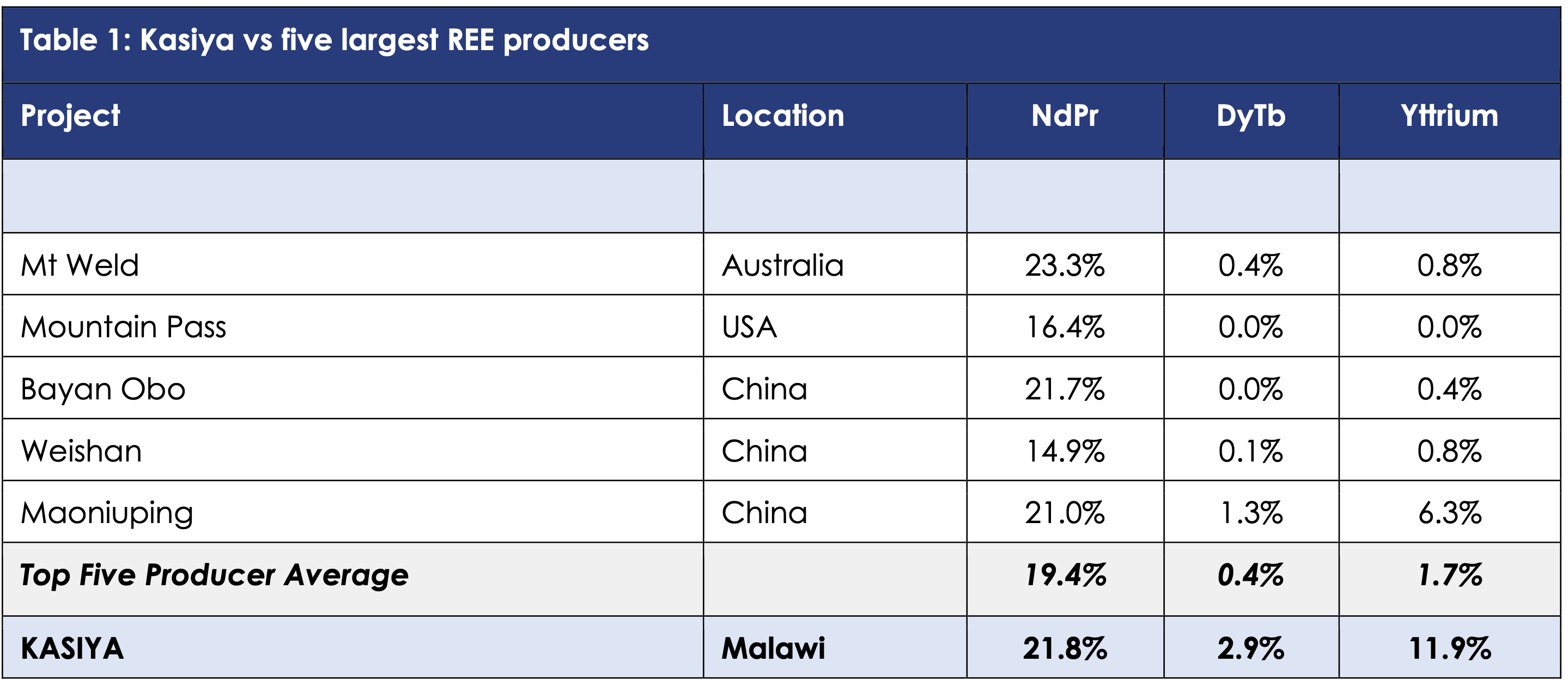
Preliminary analysis reported the monazite concentrate contains an average combined dysprosium-terbium (DyTb) content of 2.9%, with results up to 3.9%. The same work indicated average yttrium content of 11.9%, with results up to 17.3%. Sovereign also reported light rare earth content including 21.8% neodymium-praseodymium (NdPr).
Comparison with major global producers
The composition “sets Kasiya apart” from the largest global rare earth operations, with the company arguing the five biggest producers — which together account for more than 70% of global production — are dominated by light rare earth elements.
The five dominant global rare earth operations include three in China (Bayan Obo, Weishan and Maoniuping), Lynas Rare Earths’ Mt Weld mine in Australia, and MP Materials’ Mountain Pass operation in the US. All are heavily weighted toward light rare earths, particularly lanthanum and cerium, along with the magnet rare earths neodymium and praseodymium (NdPr).
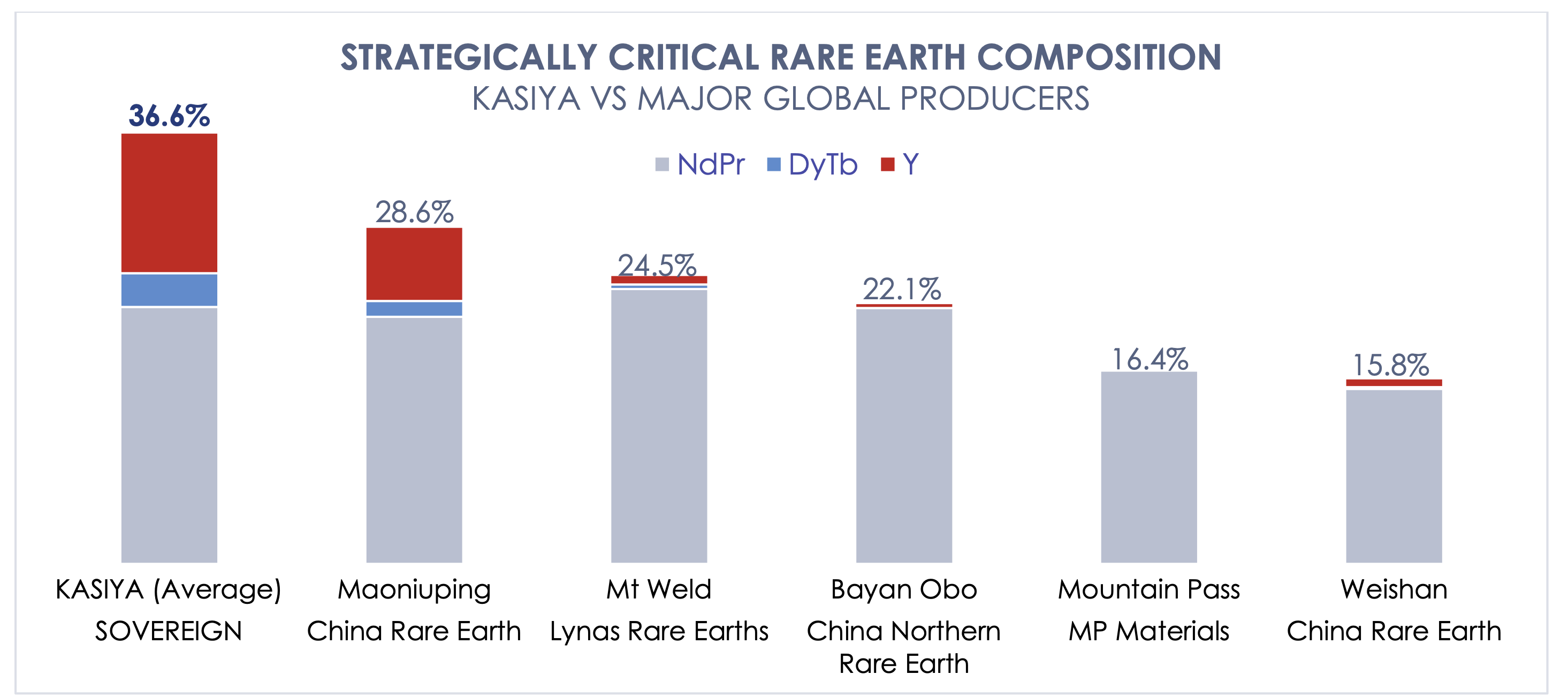
Strategic Rare Earth Composition – Kasiya vs Major Global Producers.
In contrast, the strategically critical heavy rare earths — dysprosium, terbium and yttrium — occur in much smaller proportions at these operations. Preliminary analysis indicates Kasiya’s monazite-hosted mineralisation contains approximately 7x higher levels of both DyTb and yttrium compared with the five largest producing mines. Mountain Pass, the only operating rare earth mine in the US, contains no measurable DyTb or yttrium.
Supply risks for heavy rare earths have intensified following China’s April 2025 export controls on dysprosium, terbium and yttrium, which triggered shortages for Western manufacturers. These pressures were reinforced in January 2026 when China announced tighter export controls on dual-use items to Japan. Despite more than 15 years of diversification efforts, Japan remains about 60% dependent on Chinese rare earth imports, with reliance for heavy rare earths approaching 100%. The US is also fully dependent on imports for yttrium.
Preliminary work shows Kasiya has one of the highest combined heavy rare earth profiles among known projects, while maintaining NdPr grades comparable with several rare earth developments that have attracted government support. Reflecting its strategic significance, the US State Department visited Sovereign’s Malawi operations in late 2025 as part of broader engagement with critical minerals projects in Africa.
Sovereign positioned DyTb and yttrium as critical to efforts by the US, Japan and the EU to secure rare earth supply chains for advanced technology, defence and industrial applications.
Potential third revenue stream flagged
A monazite by-product could add a third revenue stream to Kasiya for near-zero incremental cost, given it is recovered from an existing tailings stream.
The company cited indicative pricing for both contained oxides and concentrate, including:
- DyTb: Q4 2025 Europe prices of US$850,000/t for dysprosium and US$3,600,000/t for terbium.
- Yttrium: Q4 2025 price of US$270,000/t, which the company said was up 4,000% from Q1 2025, with the US importing 100% from China.
- Monazite concentrate: current selling prices of more than US$8,500/t delivered to China, according to the company.
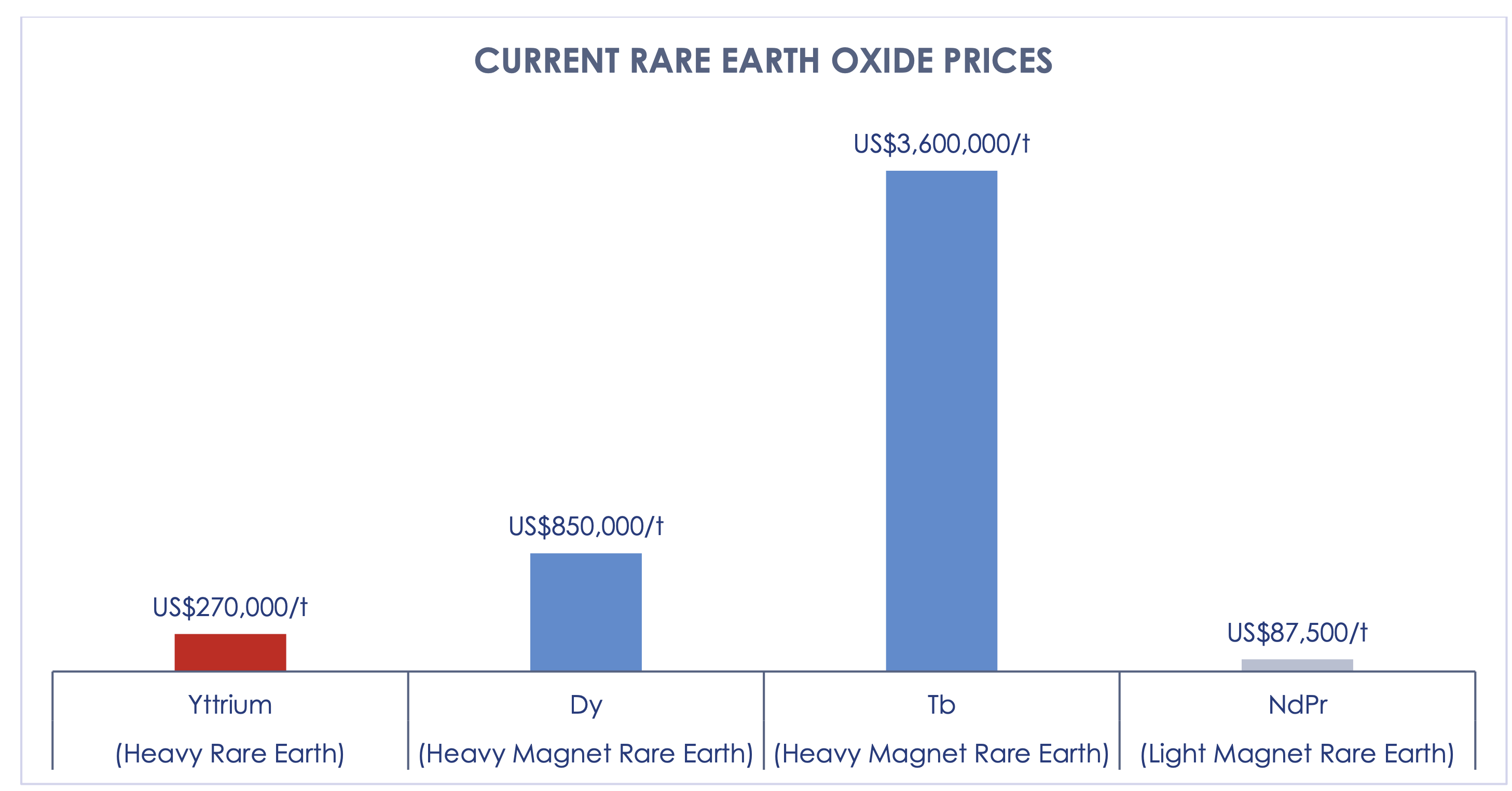
Current Prices of Rare Earth Oxides delivered to Europe.
Strategic focus sharpened by recent government interest
Kasiya’s strategic importance has been highlighted by a recent visit from the US State Department to its Malawi operations, alongside China’s reported restriction of heavy rare earth exports to Japan.
Next steps
Sovereign will progress further work to better define the monazite mineralisation at Kasiya, including:
- Detailed mineralogical studies to characterise the occurrence and distribution of monazite across the Kasiya orebody.
- Assessment of heavy rare earth concentrate recovery through the proposed Kasiya processing flowsheet.
- Evaluation of the potential scale and economics of rare earth production as a by-product.