
Standard Uranium Ltd (TSX-V:STND, OTCQB:STTDF, FRA:9SU0) VP exploration Sean Hillacre talked with Proactive about the company's upcoming drill program at the Corvo Project in Saskatchewan’s Eastern Athabasca Basin.
Hillacre outlined plans for the inaugural drill campaign on the project, which will target shallow, basement-hosted high-grade uranium across a 3,000-metre program. The work will involve 8 to 10 drill holes, with a focus on both historical targets and new zones identified through modern geophysics and prospecting.
The Corvo Project is being explored in partnership with Aventis Energy, marking the first drilling activity on the site in over 40 years. The company recently completed a large-scale ground gravity survey, covering over 5,000 stations along 29km of conductive strike, aimed at refining drill targets further. Hillacre noted that infrastructure preparation is already underway.
The program aims to keep costs low with a winter skid approach, projecting expenses of about $1.5 million – considered highly efficient in today’s exploration environment.
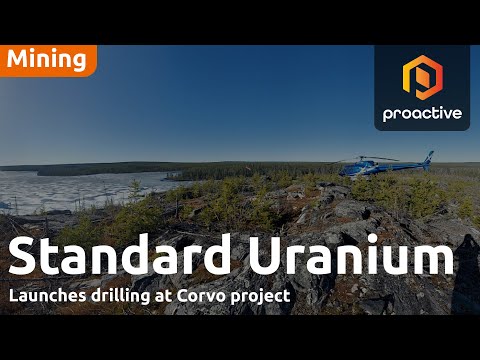
Proactive: Welcome back inside our Proactive newsroom, and joining me now is Sean Hillacre. He is the Vice President of Exploration for Standard Uranium. Sean, nice to see you again. Happy New Year.
Sean Hillacre: Happy New Year. Doing great.
Good to hear. I know the company is out with news now about your Corvo Project, and it's one we've talked about in the past, but it really is an intriguing project. So why don't you remind everyone a bit about the project and how this is going to work moving forward?
Sounds good. Corvo is one of our Eastern Athabasca Basin projects in northern Saskatchewan. It sits right on the edge of the current Athabasca Basin margin, so we're targeting shallow, basement-hosted high-grade uranium. We're looking for deposits similar to Eagle Point and Rabbit Lake. We're partnered with Aventis Energy on this project, and we’ll be drilling it for the first time in about 40 years. We picked it up a couple of years ago, and have been doing geophysics to get our drill targets ready. This year, we’re heading up to look for some basement-hosted uranium.
Let's talk about the drill program — you've finalized the plan and you're going to tackle a few different areas, right?
Yes, that’s right. We did prospecting and mapping in 2025 and uncovered some great surface showings. This project is unique because there's rock outcrop at surface. At one historical showing, called Manhattan, we got results up to 8.1% uranium right at surface. It’s never been drilled before, so that'll be a priority target in the first drill program in 2026. We'll also follow up on mineralization from historical drill holes from 1978 and 1979.
Getting on there this time with modern exploration — I know we've talked about how important that is. Using drilling alongside those updated tools really takes it to another level?
Exactly. We’ve been upgrading the geophysics for the past year and a half. We flew new electromagnetic and magnetic surveys early in 2025 and did a gravity survey later in the year — just completed it recently. That was part of the news released yesterday. We covered more than 5,000 gravity stations along 29 km of conductor strike length. This will help refine our drill targets. We're excited to get those results back this week. We’re also ahead of schedule — we’re up there right now pushing in the access road, looking to mobilize at the end of the month.
Lastly, I want to ask you about the Manhattan showing. You mentioned it's never been drilled. Is it that earlier drilling didn’t know it was there, or has modern geophysics just uncovered things they couldn't see before?
Great question. The historical drilling in the late '70s wasn’t near the Manhattan showing. That area was discovered later. The historical holes are along two main northeast-southwest structural corridors, with most drilling along the southernmost conductor. Manhattan is on a different, parallel conductor in the northeast. Some of the older drill holes returned uranium over good thicknesses, so we’ll follow up on those as well as test these new, high-grade surface areas.
Quotes have been lightly for clarity and style