
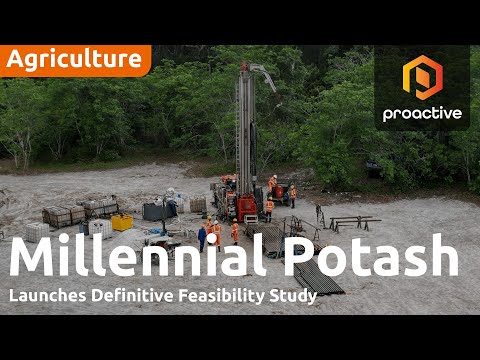
Millennial Potash Corp (TSX-V:MLP, OTCQB:MLPNF, FRA:XOD) chairman Farhad Abasov talked with Proactive about the launch of the definitive feasibility study for the Banio potash project in Gabon, marking a key transition from exploration into development.
Abasov explained that the project has been under development for nearly two and a half years, during which the company has significantly expanded its resource base.
The project now hosts approximately 6 billion tonnes of measured, indicated and inferred resources, representing an increase of nearly 300%, while still covering only about 5% of the overall property.
Abasov said the definitive feasibility study follows an earlier preliminary economic assessment that examined production of roughly 800,000 tonnes of potash per year, along with capital and operating cost assumptions.
He noted that the new study will involve a far more detailed assessment, including solution mining tests, hydrogeological and hydrological studies, trade-off analyses such as cold leach versus hot leach processing, and logistics planning, including port infrastructure.
Proactive: Welcome back inside our Proactive newsroom, and joining me now is Farhad Abasov, the chairman of Millennial Potash. Farhad, it’s great to see you again. How are you?
Farhad Abasov: Great to see you too. Great, thank you, and happy New Year.
It’s obviously a happy time for the company after hitting another key milestone — the launch of a definitive feasibility study for Banio. Can you remind us about the project and where it’s heading?
Our Banio potash project is in Gabon, West Africa, and we’ve been working on it for almost two and a half years. We’ve completed extensive drilling and exploration and increased our total resource by almost 300%. We now have six billion tonnes of measured, indicated and inferred resource, covering only about 5% of the property. After the second stage of drilling, we announced environmental and social impact studies late last year, and we have now launched the definitive feasibility study. This marks the transition from exploration to development.
What does a definitive feasibility study involve?
We completed a preliminary economic assessment about a year and a half ago looking at around 800,000 tonnes of potash production per year, including capex and operating costs. The definitive feasibility study involves much more work — solution tests, hydrogeological and hydrological studies, trade-off studies such as cold leach versus hot leach, and logistics planning including port infrastructure. By the end, we will have a much tighter cost structure and a clear technical plan for how the project will operate.
The news release mentions de-risking. What does that mean here?
It’s both technical and financial de-risking. Technically, we’re confirming how solution mining will work at Banio and how product will be shipped from Gabon. Financially, the US International Development Finance Corporation’s involvement is critical. Once the feasibility study is completed, the DFC wants to lead project financing, which could pave the way to full funding by late 2026 or early 2027.
What’s the timeline for publication?
We’re targeting the end of summer, possibly September — roughly eight or nine months from now.
Quotes have been lightly edited for style and clarity