
Red Mountain Mining (ASX: RMX) has reported a fresh tranche of high-grade antimony rock-chip results from the Oaky Creek prospect within its 100%-owned Armidale antimony-gold project in northeast New South Wales, with assays topping 34.3% Sb.
The latest grab sampling targeted the southern portion of the 1.2 km-long Oaky Creek North soil anomaly and returned 11 of 13 samples above 1.9% Sb, reinforcing Oaky Creek North as a standout surface expression of antimony mineralisation. The best result came from sample AAR239, which assayed 34.3% Sb (342,728 ppm Sb), described as weakly oxidised massive stibnite float. Other headline assays included 23.1% Sb from AAR237 (230,751 ppm Sb) and 19.1% Sb from AAR240 (191,143 ppm Sb).
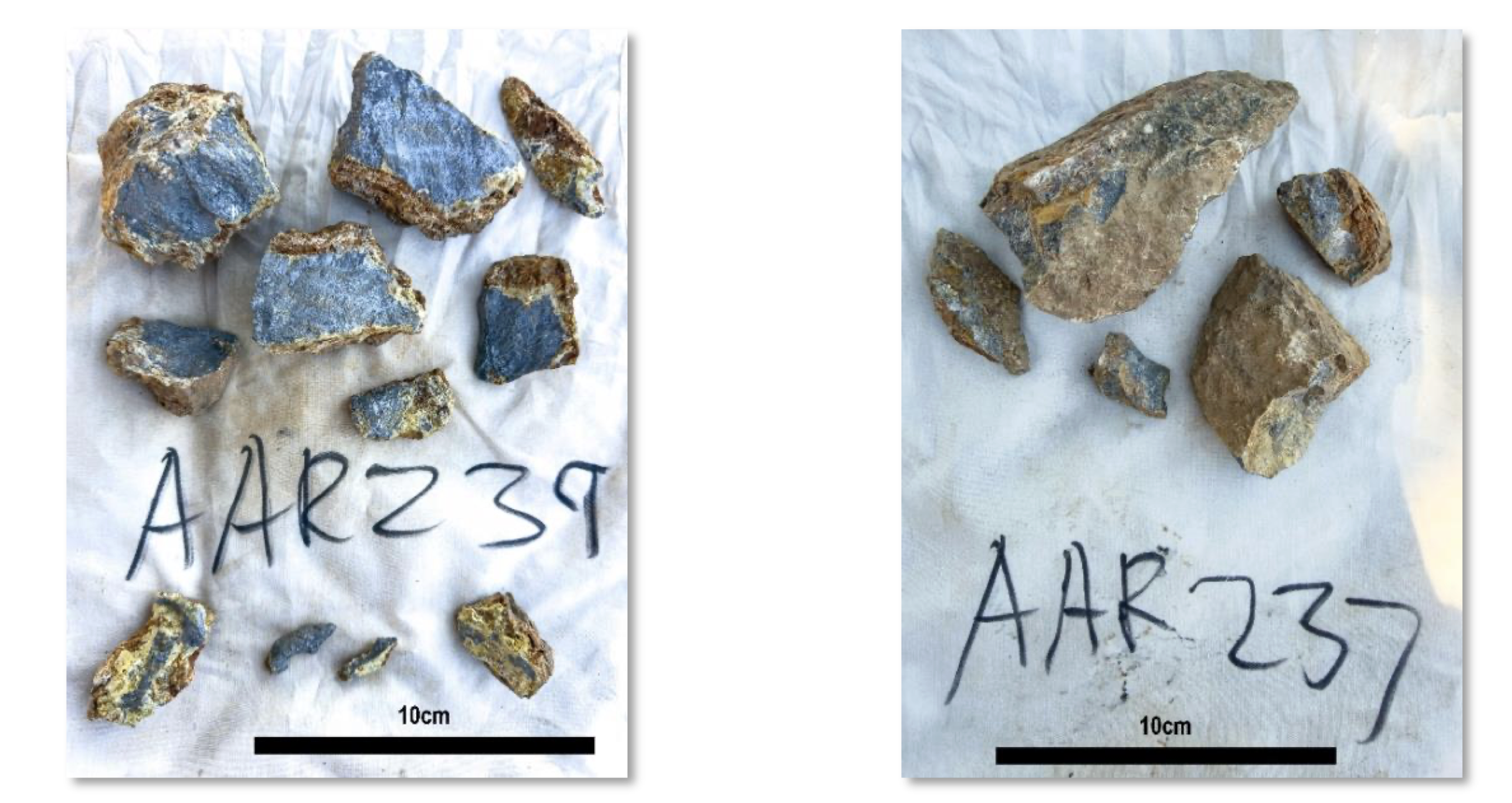
Figure 1: AAR239 which assayed 34.3% Sb. Figure 2: AAR23 7 which assayed 23.1% Sb.
Strike length grows to 1.6km
The new results extend the footprint of strongly mineralised rock chips at Oaky Creek North to a NNW-trending 1.6 kilometre strike length, adding weight to its interpretation that the prospect may represent a large-scale orogenic antimony-gold vein system at surface. The company is using the antimony-arsenic-gold association in the rock chips as further support for the target model.
Alongside antimony, the company reported anomalous pathfinder and precious metal values in the same sample suite. Most samples returned arsenic above 100 ppm, peaking at 467 ppm As (AAR246). All samples contained detectable gold, with two returning more than 100 ppb Au (0.1 g/t Au) including up to 202 ppb Au (0.20 g/t) in AAR246 and 142 ppb Au (0.14 g/t) in AAR245. Silver was generally low, reported at below 5 ppm Ag across the table, while tungsten ranged up to 202 ppm W in AAR246.
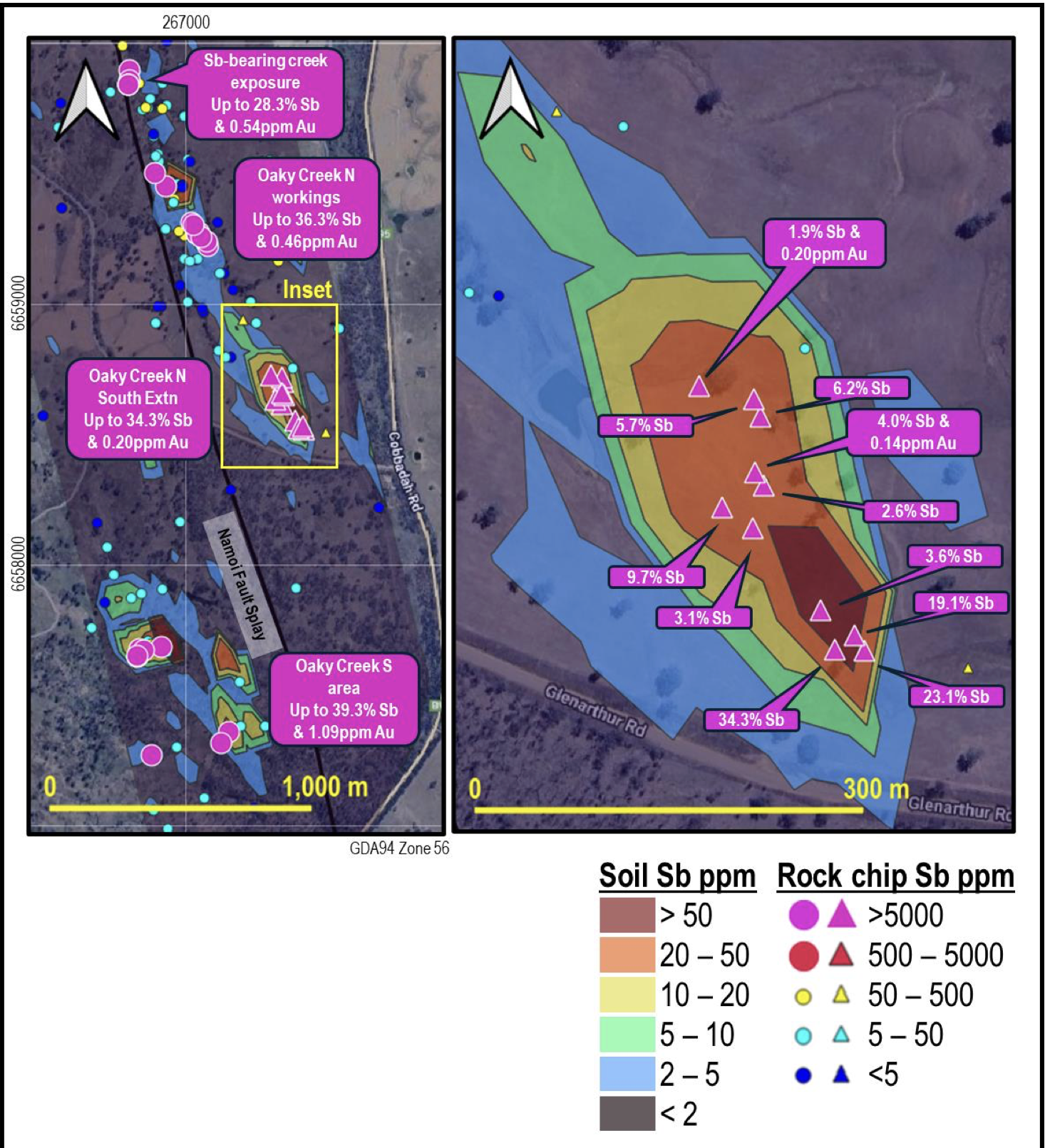
Summary of antimony rock chip and soil results for the Oaky Creek prospect, with peak rock chip values for antimony and gold listed for the four main mineralised areas. Existing rock chip samples are shown as circles while the newly received results are shown as triangles. (Right) Detailed view of the new antimony rock chip results from the southern end of the Oaky Creek North soil anomaly. Anomalous gold (>0.1ppm Au) values are also labelled.
Geological setting and historical workings
The Oaky Creek prospect hosts quartz-carbonate-stibnite veins and breccias within tightly folded and faulted Carboniferous metasediments, and includes historical shallow pits and shafts at both Oaky Creek North and Oaky Creek South.
Red Mountain noted that earlier work since acquiring the project in December 2024 has outlined a broader, district-scale system, with soil and rock-chip sampling interpreted to define an orogenic Sb-Au corridor over a 3-kilometre strike extent.
Next steps: tighter soils, geophysics and drilling plans
While the current announcement focuses on rock chips from Oaky Creek North, the company positioned the results within a broader exploration push at Oaky Creek, including a program of tighter-spaced hand auger soil sampling designed to refine drill targets.
The December 2025 auger campaign is part of a move to tighten the existing soil grid to 50 metre by 20 metre spacing, with assays expected early this quarter. Red Mountain said it aims to complete the auger program and receive all results before the end of Q1 2026, with the intention of defining multiple targets for drill testing during the first half of 2026.
The company also flagged a planned high-resolution airborne magnetic-radiometric survey across the tenement to sharpen structural interpretation and help generate additional orogenic antimony and/or gold targets.