
Firebird Metals Ltd (ASX:FRB, OTC:FRBMF) has completed installation and commissioning of proprietary cathode active material (CAM) equipment at its wholly owned China pilot plant, clearing the way for initial production of lithium–manganese-rich (LMR) cathode materials.
The milestone positions Firebird to begin initial LMR CAM production in February 2026, with customer sampling scheduled for the second half of the year to support technical engagement, evaluation and qualification programs.
Firebird said the commissioning validates its vertically integrated “ore to cathode” strategy, which spans manganese concentrate through to high-purity manganese sulphate monohydrate (HPMSM) and advanced CAM products, including LMFP, LMR and NCM chemistries.
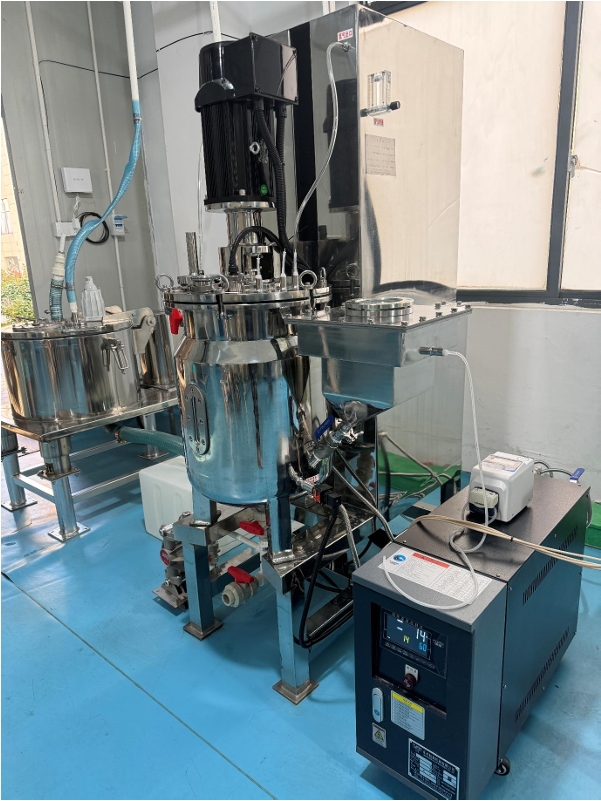
Recently commissioned LMR reactor vessel at Firebird's China pilot plant.
China pilot plant milestone
The newly commissioned equipment incorporates Firebird’s “proprietary synthesis know-how, energy-efficient process design and high-efficiency kiln platform”, the company said. It believes this combination can deliver manganese-rich cathode materials with materially higher energy density than conventional lithium iron phosphate (LFP), while significantly reducing reliance on nickel and cobalt.
LMR cathodes typically use at least 50% manganese substitution, enabling lower exposure to constrained and geopolitically sensitive nickel and cobalt supply chains, while retaining performance characteristics comparable to some high-nickel chemistries.
Firebird said the China pilot plant will be used to validate its LMR process at scale ahead of customer sampling and broader commercial discussions later in 2026.
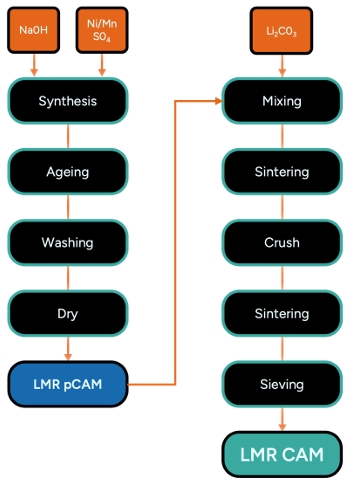
Firebird’s LMR CAM production process flow.
Strategic partner support de-risks development
The LMR development program is being co-funded by strategic partner Taza Metal Technologies, which has committed to cover 50% of LMR research and development costs.
Taza is one of only three companies outside China currently producing HPMSM, a key precursor material for manganese-rich cathodes. Firebird said the co-funding arrangement materially reduces its capital exposure while accelerating technical validation of its LMR platform.
Momentum for manganese-rich cathode chemistries continues to build globally, with major automotive original equipment manufacturers (OEMs) including Ford and General Motors signalling plans to commercialise LMR batteries for next-generation electric vehicles by 2030. Interest is also emerging beyond EVs, including in energy storage systems, electric vertical take-off and landing aircraft, and humanoid robotics.
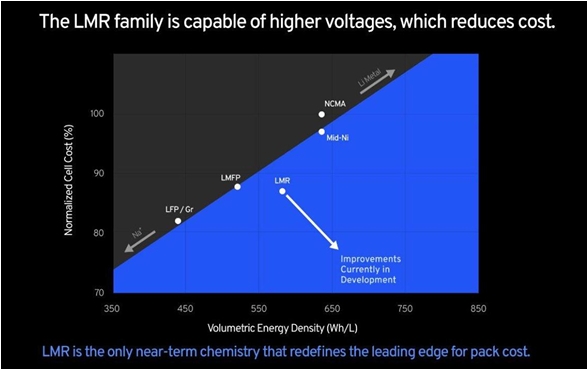
Slide from General Motor's presentation at the 25th Advanced Automotive Battery Conference (AABC) Dec 2025.
Australian demonstration plant next
In parallel with the China pilot plant work, Firebird is preparing to deploy the same equipment set and synthesis process at its Australian Demonstration Plant (ADP) in 2026.
The ADP is intended to provide a world-first capability to produce and demonstrate LMR, NCM and LMFP cathode materials within a single integrated facility. Product samples from the ADP are expected to be supplied to a range of Western customers seeking secure and sustainable battery material supply chains.
“Commissioning our LMR cathode active material equipment is a key milestone in delivering Firebird’s ore-to-cathode strategy and validating our integrated pathway from manganese concentrate through HPMSM to advanced CAM products,” CEO Ron Mitchell said.
“This program positions us to demonstrate the production of high-energy, manganese-rich cathode materials that can reduce reliance on nickel and cobalt while meeting the performance, safety and cost requirements of next-generation EV and energy storage markets,” he added. “Deploying this process at our Australian Demonstration Plant in 2026 will allow us to showcase LMR, NCM and LMFP CAM in a single facility and deepen engagement with global customers seeking secure, sustainable supply of advanced battery materials.”
Firebird holds a large manganese resource base in Western Australia but retains flexibility to source ore from third parties as it advances downstream battery materials development.