
Lithium’s price swings over recent years have exposed a deeper problem for the battery supply chain: production systems that are slow, capital-intensive and inflexible. As demand from electric vehicles and energy storage continues to grow, attention is turning to extraction technologies that can respond faster and operate across a wider range of environments.
A new report from IDTechEx argues that direct lithium extraction (DLE) is emerging as a credible answer to that challenge.
DLE technologies, long discussed as a cleaner and faster alternative to traditional methods, are moving closer to commercial relevance. In its newly updated report Direct Lithium Extraction 2026–2036: Technologies, Players, Forecasts, IDTechEx argues that DLE could reshape the lithium market over the next decade, helping lift total market value to around US$52 billion by 2036.
The case for change starts with the limitations of today’s dominant extraction routes.
Conventional lithium supply is struggling to scale
Hard-rock mining and brine evaporation remain the backbone of global lithium supply, but both face constraints that are becoming harder to ignore.
Hard-rock lithium deposits are geologically limited and concentrated in a small number of regions, while conversion into battery-grade material relies on energy-intensive processing and downstream infrastructure that is heavily centred in China. Brine evaporation, meanwhile, can take 12 to 24 months to produce lithium, tying up capital and land while offering relatively modest recovery rates.
IDTechEx notes that conventional brine evaporation typically recovers only around 40–60% of lithium contained in the brine. The process also depends on specific climatic and chemical conditions, which restricts large-scale production to three countries with “both the right climate and brine makeup”: Argentina, Chile and China.
These structural constraints matter more in a market that has already shown pronounced price volatility over the past five years. With lithium prices unlikely to return to a period of prolonged stability, producers are under pressure to find extraction methods that are not only scalable, but also resilient across market cycles.
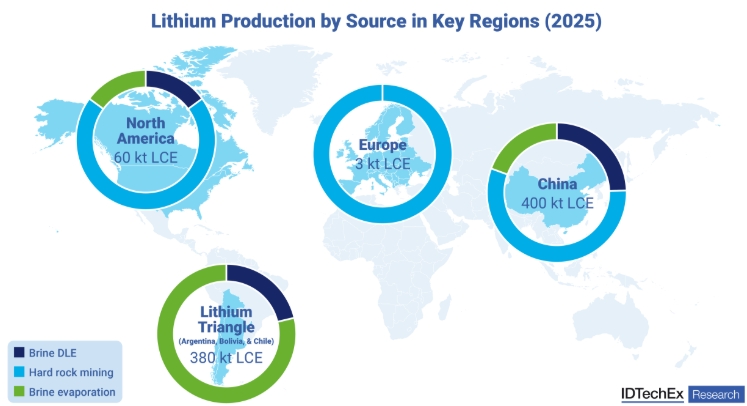
Sources of lithium production across the Americas, Europe, and China, Source: IDTechEx.
Why direct lithium extraction is gaining traction
DLE technologies aim to address those challenges by fundamentally changing how lithium is separated from brines. Rather than relying on evaporation ponds, DLE uses selective processes — including adsorption, ion exchange, solvent extraction, membranes or electrochemical techniques — to isolate lithium directly from solution.
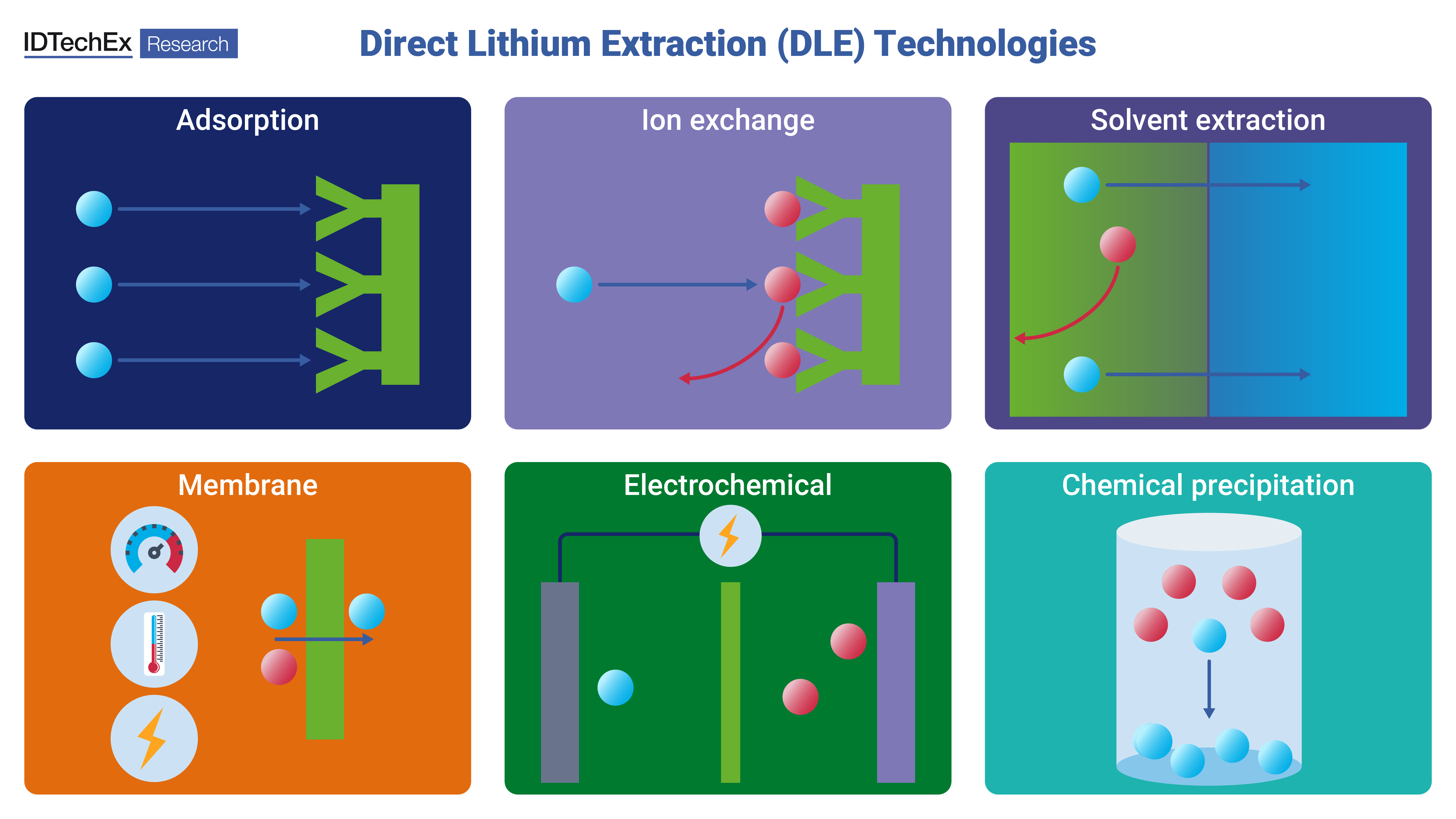
Direct lithium extraction technology types, Source: IDTechEx
The efficiency gains are significant. According to IDTechEx, DLE processes often achieve lithium recovery rates above 80%, far higher than conventional brine evaporation. Because lithium is selectively removed, far less brine needs to be extracted from the environment for each tonne of product, and the stripped brine can be reinjected rather than left to evaporate.
Production timelines are also dramatically shorter. Where evaporation can take years, DLE can operate on timescales of hours to days. That speed gives producers more flexibility to respond to changes in demand — a factor that could help dampen some of the boom-bust dynamics that have characterised lithium markets.
Where lithium can be produced is equally important. DLE does not rely on high evaporation rates or ultra-pure brines. It can tolerate higher levels of contaminants such as magnesium, boron and even hydrocarbons, and can operate economically at lithium concentrations as low as 50 mg/L. That opens the door to geothermal and oilfield brines that have historically been off-limits to lithium extraction.
A pathway to Western supply chain diversification
This flexibility has strategic implications beyond technology alone. IDTechEx highlights Europe and North America as regions likely to benefit disproportionately from DLE adoption, due to their abundant geothermal and oilfield brine resources.
Both regions are seeking to localise battery supply chains amid rising geopolitical and trade risks. Domestic lithium production has been a missing link, particularly given the concentration of conventional brine resources in South America and processing capacity in China.
By enabling lithium extraction from previously uneconomic resources, DLE could help address that imbalance. IDTechEx notes that the enhanced selectivity of DLE “creates opportunities for more brine types to undergo lithium extraction”, supporting domestic production at scale in regions that lack traditional lithium advantages.
For investors, this raises the prospect of new project pipelines emerging in jurisdictions that were previously considered peripheral to the lithium market — including geothermal-linked projects in Europe and oilfield brine developments in the United States.
Technology maturity remains uneven
Despite the promise, IDTechEx is careful not to frame DLE as a single, uniform solution. The report benchmarks multiple DLE technology pathways and finds wide variation in maturity, cost structure and operational risk.
Adsorption and ion-exchange technologies currently lead in terms of maturity and performance, while membrane-based and electrochemical approaches remain earlier-stage, with many projects still at lab or pilot scale. Electrically driven processes, in particular, face open questions around energy consumption, long-term electrode stability and scalability.
The report also flags higher up-front capital costs and ongoing R&D requirements associated with lithium-selective materials as a key barrier to widespread adoption. While operating costs may ultimately prove competitive, especially in high-cost or constrained environments, developers still need to demonstrate durability and economics at commercial scale.
A decade of testing — and potential transition
IDTechEx expects the coming decade to be decisive. While DLE is unlikely to displace hard-rock mining or brine evaporation entirely, it is forecast to take an increasingly prominent role as new projects come online and performance data accumulates.
“Direct Lithium Extraction 2026–2036: Technologies, Players, Forecasts” brings together these dynamics in a set of 10-year projections, breaking down lithium production and market growth by technology type, brine source and region. The analysis suggests that DLE’s impact will extend beyond incremental supply, influencing how quickly projects can be developed, where lithium can be produced, and how resilient supply chains are to market shocks.
For a lithium market still grappling with volatility, sustainability pressures and geopolitical risk, that shift may prove as important as any single price cycle.