
St George Mining Ltd (ASX:SGQ) has delivered another batch of standout diamond drilling results from its 100%-owned Araxá rare earths and niobium project in Brazil, extending thick, high-grade mineralisation from surface and reinforcing the case for a major upgrade to the project’s already world-class Mineral Resource Estimate (MRE).
The latest assays are led by a 128.6-metre intersection grading 4.87% total rare earth oxides (TREO) from surface in hole AXDD027, including 31.25 metres at 6.09% TREO, with the hole ending in high-grade mineralisation. Several additional holes returned similarly broad, high-grade intercepts, continuing a strong run of results from the company’s ongoing intensive drilling campaign.
Among the highlights, AXDD021 delivered 100.6 metres at 4.25% TREO from surface, including 19.6 metres at 8.16% TREO and a further 20 metres at 5.94% TREO. Hole AXDD032 returned 81.1 metres at 5.33% TREO from surface, while AXDD035 intersected 81.3 metres at 4.81% TREO, again starting at surface and including multiple higher-grade zones.
Importantly, many of the holes ended in mineralisation, indicating the system remains open at depth and beyond the limits of the current resource model, which is constrained to only the top 100 metres from surface.
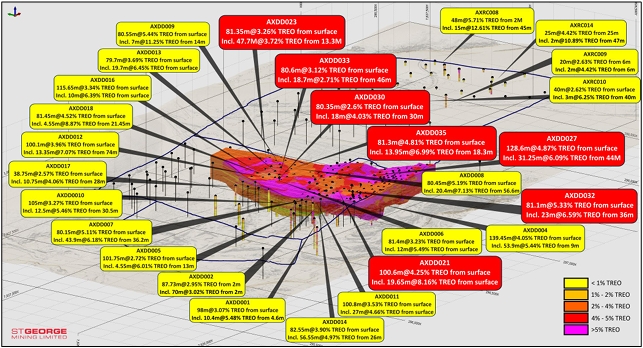
Oblique section showing the latest diamond drill holes as well as other significant drilling completed in the current campaign. The latest drill holes with red labels.
Consistent high grades support resource growth
St George said the consistency of thick, high-grade mineralisation across multiple drill holes — particularly AXDD021, AXDD027, AXDD032 and AXDD035 — continues to validate the robustness of the Araxá geological model.
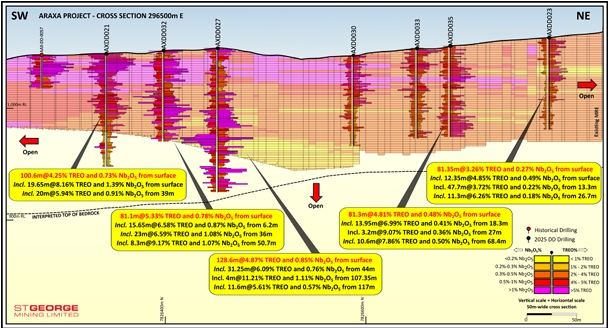
Section showing high-grade TREO intercepts (cut-off 1% TREO) and high-grade Nb2O5 intercepts (cut off 0.2% Nb2O5) along with the existing MRE outline, showing the westward expansion of the existing MRE.
The results confirm extensive continuity of rare earths mineralisation in areas that were previously sparsely drilled, supporting confidence in both the existing resource and the potential for substantial growth through further drilling.
AXDD027 was highlighted as especially significant, representing one of the thickest high-grade intercepts drilled to date and extending mineralisation beyond the current resource envelope.
Strong niobium mineralisation from surface
The latest assays also reinforced Araxá’s position as a globally significant niobium asset, with broad, high-grade niobium intervals commencing from surface across multiple holes.
Notable intercepts include 128.6 metres at 0.85% Nb₂O₅ from surface in AXDD027, including 10.75 metres at 2.61% Nb₂O₅, and 100.6 metres at 0.79% Nb₂O₅ from surface in AXDD021. Niobium grades reached as high as 3.57% Nb₂O₅ within broader mineralised intervals.
The company said the strength of the niobium results reflects Araxá’s location within the Barreiro Carbonatite, adjacent to the operations of CBMM, the world’s leading niobium producer.
Mineral system remains open
With most drill holes ending in high-grade mineralisation — including AXDD027 finishing with 11.6 metres at 5.61% TREO — St George believes there is strong potential to define significant mineralisation below the current depth of the MRE, as well as laterally beyond the existing boundaries.
Drilling is continuing around the clock with three diamond rigs on site, and assays are pending for a further 28 holes, with the next batch of results expected later this week.
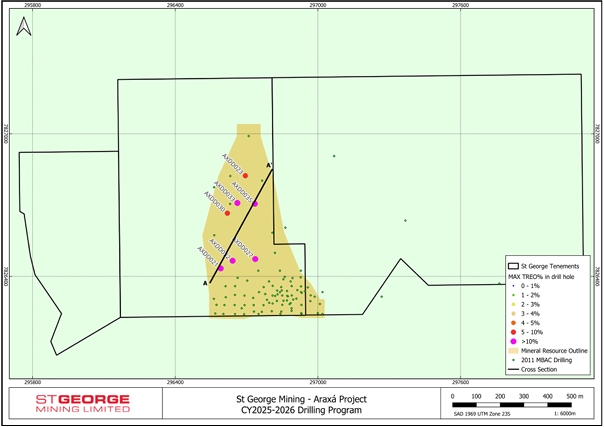
Plan view map of Araxá area showing the location of the diamond drilling relative to the MRE.
Attractive magnet rare earths profile
St George said the latest results maintain a favourable magnet rare earths profile, with neodymium and praseodymium (NdPr) consistently making up around 20% of TREO and reaching as high as 29% in AXDD030. This supports Araxá’s potential to become a strategic source of rare earths used in permanent magnets for electric vehicles, wind turbines and defence applications.
Executive chairman John Prineas said the ongoing drilling was “transforming the scale of the MRE” at Araxá.
“With a world-class resource already confirmed and a location in an established mining region with existing infrastructure and supportive community stakeholders, the Araxá Project stands out amongst its peers as having potential for an expedited pathway to development,” he said.
Araxá currently hosts an MRE of 40.6 million tonnes at 4.13% TREO and 41.2 million tonnes at 0.68% Nb₂O₅, and St George said it believes the latest results point to meaningful upside as drilling continues.