
Dundas Minerals Ltd (ASX:DUN) has agreed to acquire an 80% interest in the district-scale Romano Project owned by Cazaly Resources, a gold exploration package in Western Australia’s north-eastern Goldfields.
The deal expands Dundas’ exposure to under-explored frontier terrain within a proven gold province and aligns with its strategy of targeting large-scale gold systems in under-tested regions.
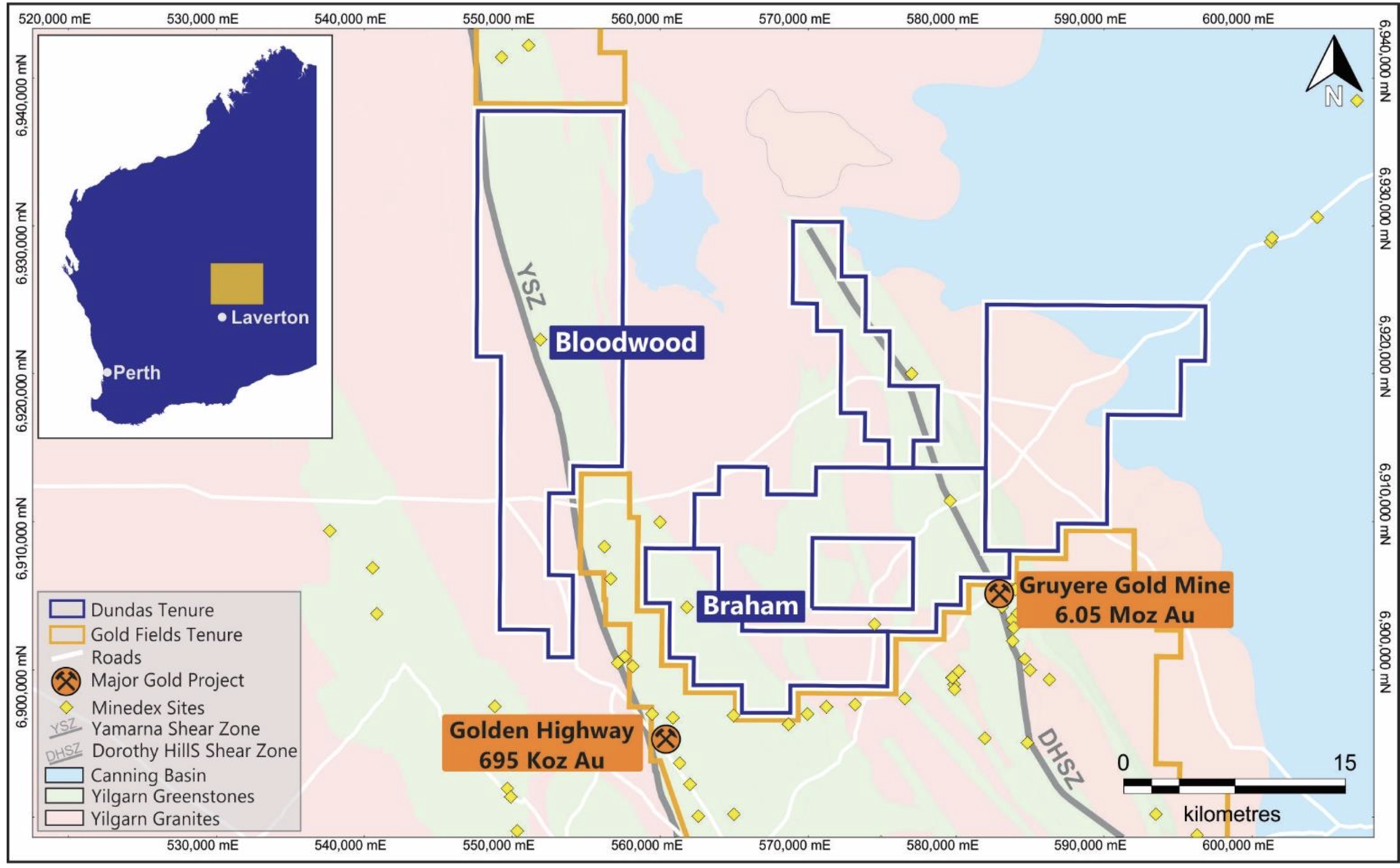
Location map showing the Romano Project tenure, key gold-bearing structures and mineral deposits.
Key highlights
- ~800 km² contiguous gold exploration landholding in Western Australia
- Located on the eastern margin of the Yamarna and Dorothy Hills Shear Zones
- Situated adjacent to the operating Gruyere gold mine, within a recognised gold-producing region
- Highly under explored terrain relative to established Goldfields districts
- Multiple priority targets identified through historical drilling and geochemical datasets
- Bloodwood prospect returned historical results including 12 m @ 3.3 g/t gold from 20 m within a 5 km gold-in-soil anomaly
- Brahman prospect returned historical drilling results of 2 m @ 3.9 g/t gold including 1 m @ 7.01 g/t gold
- Structured earn in allows Dundas to earn 80% ownership through staged exploration expenditure
The Romano Project covers about 800 km² on the eastern margin of the Yamarna and Dorothy Hills Shear Zones and sits adjacent to the operating Gruyere gold mine. Dundas cautioned that proximity to an operating mine is not indicative of mineralisation and that no geological or mineral continuity has been established. However, the broader Yamarna region is recognised for hosting large-scale gold systems.
Historical exploration
Previous operators have completed historical exploration across the tenement package, identifying multiple priority targets. At Bloodwood, historical aircore drilling defined a coherent gold anomaly extending about five kilometres, supported by aircore and diamond drilling. At Brahman, historical drilling intersected broad zones of gold mineralisation, which Dundas believes supports the target’s prospectivity and justifies systematic follow-up work.
Managing Director Jonathan Downes said, “Many of Australia’s recent major mineral discoveries, including Gruyere, Hemi and Nova have been made in frontier terrains or on the margins of historically mined districts.
"In my opinion, the Romano Project provides Dundas with exposure to this same geological opportunity in a region that remains significantly underexplored. The proximity to the Gruyere gold mine highlights the prospectivity of the broader Yamarna region, while historical work has already identified multiple targets that warrant systematic follow up.”
Transaction terms
Under the transaction terms, Dundas may earn an 80% interest in the Romano Project through staged exploration expenditure. The earn-in requires $2,000,000 of exploration expenditure within two years, providing Dundas with a defined pathway to advance the project while managing capital deployment.
Dundas said the acquisition complements its Kalgoorlie region portfolio and supports its broader exploration strategy focused on disciplined capital deployment, technical rigour and the identification of large-scale gold systems capable of supporting future development.