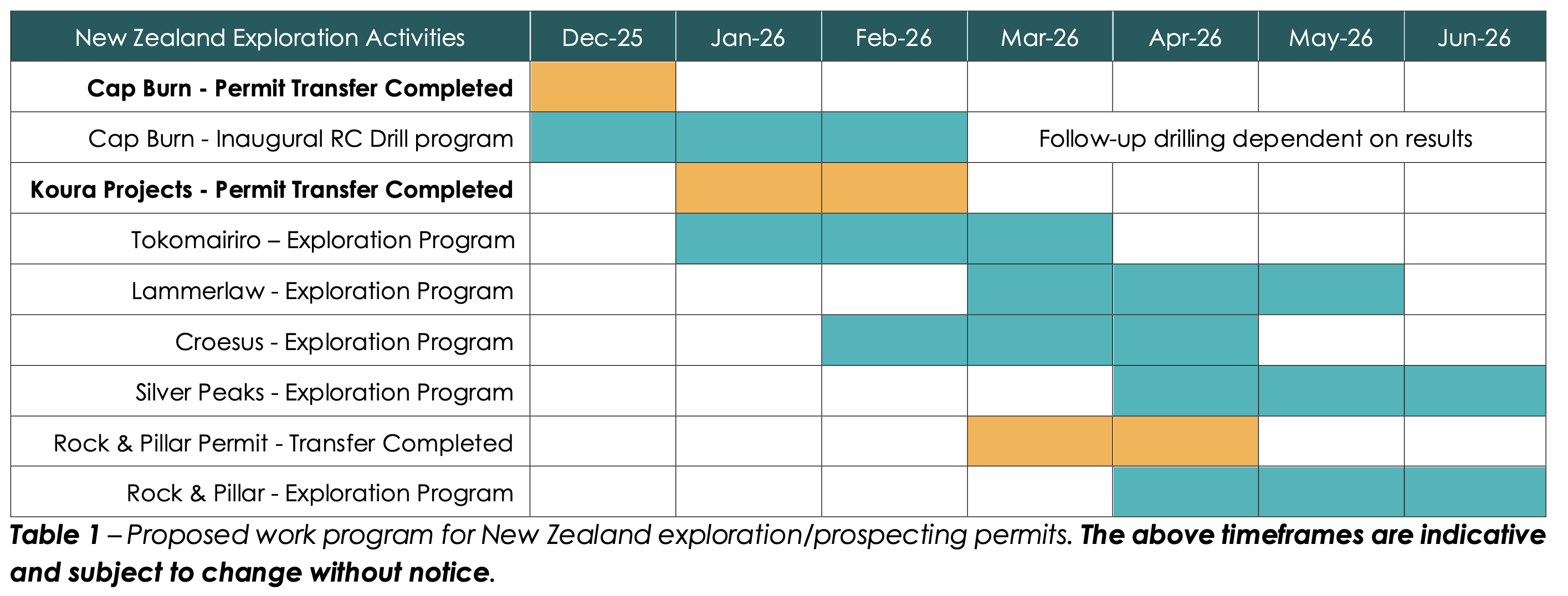
Critical Resources Ltd (ASX:CRR) has completed its first reverse circulation drilling program at the Cap Burn Gold Project in Otago, New Zealand, with 11 holes drilled for 725 metres across roughly 1 kilometre of strike.
The program was designed as a low-impact, first-pass test of down-plunge mineralisation beneath a large arsenic-in-soil anomaly, using existing access tracks to efficiently assess the target area.
Drilling intersected the interpreted Cap Burn fault structure in every hole, confirming the geological model. Several holes recorded stockwork-style quartz veining and sulphide mineralisation within the targeted Textural Zone 4 (TZ4) schist unit.
The exploration concept focuses on gold mineralisation hosted within TZ4, associated with foliation-parallel shear zones. Drilling was aimed at testing extensions beneath the surface geochemical anomaly and evaluating structural continuity at depth.
Strategic position in the Otago gold belt
Cap Burn is located on the northern margin of the Otago Schist Belt, a region that hosts several established and emerging gold systems, including the Macraes operation and the Bendigo–Ophir project.
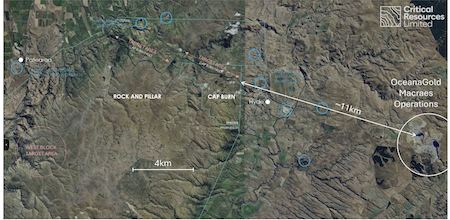
Cap Burn Project location ~11 km from OceanaGold’s Macraes Gold Operations with major and minor interpreted structures.
The project area covers a large arsenic-in-soil anomaly exceeding 1km², aligned with an electromagnetic boundary interpreted as the trace of the Cap Burn Fault. The structural setting is considered comparable to key mineralised fault systems elsewhere in the Otago district.
Assays pending and next steps
All drill samples have been submitted for laboratory analysis, with assay results expected in mid-February 2026. The results will be used to refine the geological model and guide follow-up drilling along the broader Cap Burn Fault system, which extends for about 10km.
In parallel, work is progressing on permit transfers across the wider New Zealand portfolio, with field mapping and geochemical surveys planned to generate additional targets once approvals are finalised.