
Alkane Resources Ltd (ASX:ALK, OTC:ALKEF) has more than doubled the tested depth of gold mineralisation at the Storheden deposit, part of its Björkdal operation in northern Sweden, after drilling intersected gold-bearing quartz veins down to 464 metres below surface.
The results materially extend the known footprint of Storheden, which sits about 600 metres north of the producing Björkdal underground mine, and strengthen the company’s view that the two systems converge at depth.
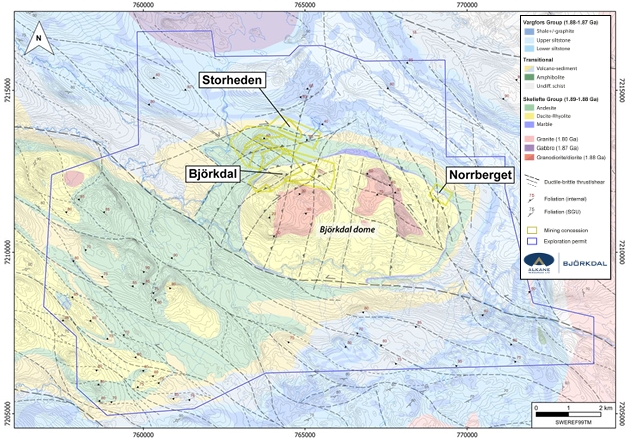
Regional geological map showing the locations of exploration focus and the contiguous tenements around the Björkdal dome.
Depth drilling and strike extensions
Two recent drilling campaigns targeted depth extensions and strike continuity below the initial 2025 inferred resource of about 99,000 ounces at Storheden. Alkane said mineralisation has now been confirmed more than twice as deep as previously tested, with no indication of grades diminishing at depth.
Gold-bearing veins have also been extended along strike to more than 2.7 kilometres through drilling to the east and west, leaving the system open in multiple directions.
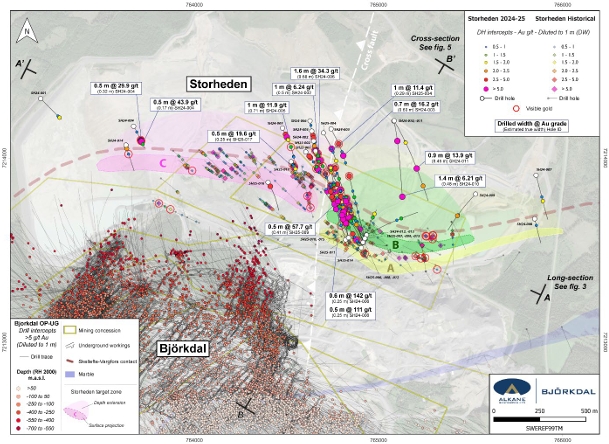
Björkdal-Storheden overview map highlighting the 2024 and 2025 Storheden drilling campaigns.
Assay highlights from the depth testing campaign included:
- 34.3 grams per tonne gold over 1.6 metres at 470 metres’ depth
- 16.2 g/t gold over 0.7 metres at 475 metres
- 14.0 g/t gold over 1.2 metres at 317 metres
Shallower resource-extension drilling in 2025 returned several high-grade narrow intersections, including:
- 142.0 g/t gold over 0.6 metres
- 111.0 g/t gold over 0.5 metres
- 57.7 g/t gold over 0.5 metres
These results were generated from closer-spaced and oriented core drilling aimed at better defining the geometry and continuity of the vein system.
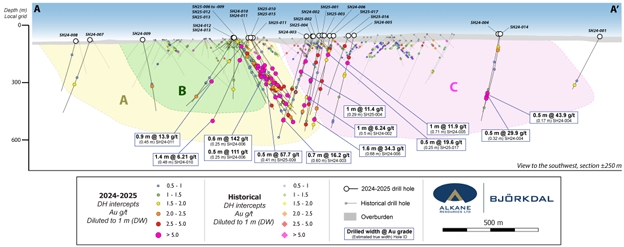
Long Section along confirmed Storheden mineralisation in relation to recent drilling results. Selected significant intercepts are annotated.
Strategic importance for Björkdal
Alkane managing director and CEO Nic Earner said the results reinforce the company’s view that the “wider Björkdal system is vast and underexplored”.
“Our focus for Björkdal is bringing higher-grade ore through the processing plant by replacing low-grade stockpile feed with underground ore,” he said. “Storheden presents an opportunity to create a distinct production area alongside those already in production and achieve this goal.”
Björkdal has produced around 1.66 million ounces of gold since operations began in 1988 and currently hosts measured and indicated resources of 20.35 million tonnes at 2.14 g/t gold, containing about 1.40 million ounces.
Alkane noted that Storheden shares the same Björkdal-style quartz veining, hosted in favourable volcanic units, and geological interpretation suggests the two systems are connected at depth through a common fluid source.
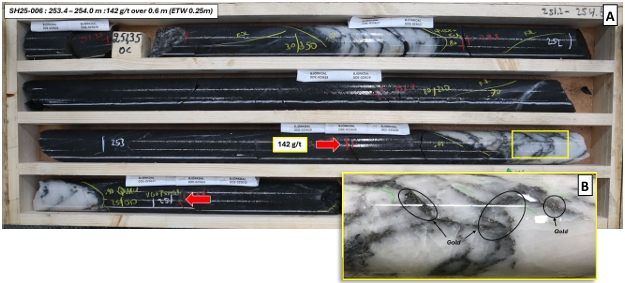
Drill core photos from SH25-006 showing an intercept grading 142 g/t gold over 0.60 m (ETW 0.25 m) (A) and a close-up of mineralised quartz vein (B).
Resource growth and next steps
The deeper 2024 drilling was not included in the current Inferred resource estimate due to spacing and timing, meaning the mineral inventory at Storheden has yet to be updated to reflect the latest results.
Interpretation work is ongoing, with Alkane planning to restart drilling in January 2026 to continue testing priority zones where structural and lithological conditions appear most favourable for thick, high-grade veining.
In parallel, exploration will continue across the eastern and northern extensions of the broader Björkdal system, which Alkane said shows no signs of diminishing gold endowment.
The company said the proximity of Storheden to existing underground infrastructure strengthens its potential to become a future mining area as part of the Björkdal operation.
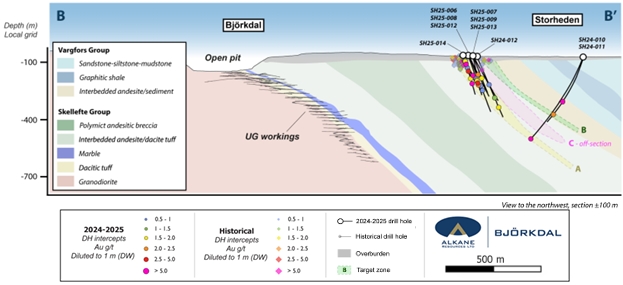
Cross section looking WNW showing the geographic relationship between the Björkdal deposit and mine to the left and the emerging Storheden system to the east.