
St George Mining Ltd (ASX:SGQ) has reported its thickest and highest-impact drill intercept to date at the Araxá rare earths and niobium project in Brazil, continuing a run of results that are reshaping expectations around the size and continuity of the already world-class resource.
The latest diamond drilling returned a standout intersection of 139.45 metres at 4.05% total rare earth oxides (TREO) and 0.55% niobium pentoxide (Nb₂O₅) from surface in hole AXDD004, including 53.9 metres at 5.44% TREO and 0.79% Nb₂O₅ from 9 metres. It marks the thickest high-grade intercept recorded so far at Araxá and reinforces the scale of mineralisation starting at surface.
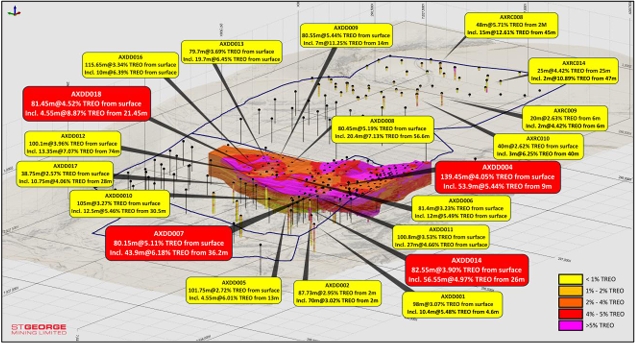
Oblique section showing some of the latest diamond drill holes as well as other significant drilling completed in the current campaign. The latest drill holes are shown with red labels.
Broad, high-grade mineralisation from surface
Assays from a further nine diamond holes delivered similarly broad, high-grade mineralisation from surface, underscoring the consistency of the system. Highlights include:
- 80.15m at 5.11% TREO and 0.76% Nb₂O₅ from surface in AXDD007
- 82.55m at 3.90% TREO and 0.59% Nb₂O₅ from surface in AXDD014
- 81.45m at 4.52% TREO and 0.56% Nb₂O₅ from surface in AXDD018, including 4.55m at 8.87% TREO
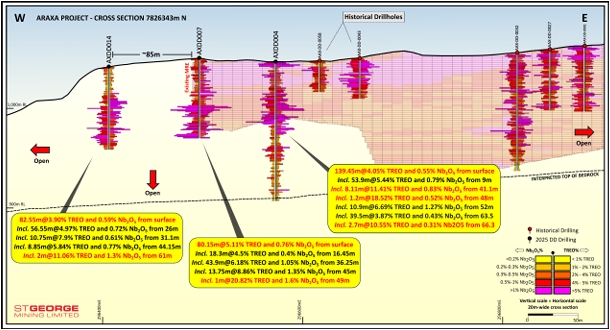
Section showing high-grade TREO intercepts (cut-off 1% TREO) and high-grade Nb2O5 intercepts (cut off 0.2% Nb2O5) along with the existing MRE outline, showing both in-fill drilling and the westward expansion of the existing MRE.
The mineralisation remains rich in magnet rare earths, with a neodymium-praseodymium (NdPr)-to-TREO ratio of around 20%, consistent with the existing mineral resource estimate (MRE).
St George said the extensive high-grade intervals, both inside and outside the current resource envelope, point to the potential for a substantial increase in total resource tonnage. Araxá is already the largest and highest-grade carbonatite-hosted rare earths resource in South America and the second-highest grade rare earths resource in the Western world.
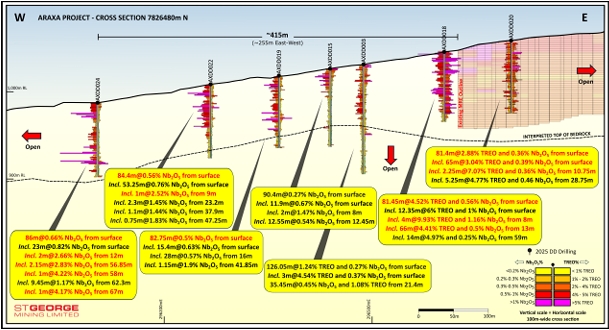
Section showing high-grade TREO intercepts (cut-off 1% TREO) and high-grade Nb2O5 intercepts (cut off 0.2% Nb2O5) along with the existing MRE outline, showing the westward expansion of the existing MRE.
Mineral system remains open in all directions
Importantly, drilling continues to show the mineral system is open laterally and at depth, with expansion drilling under way around the clock and now scheduled to continue indefinitely into 2026.
Executive chairman John Prineas said the results “continue to confirm world-class mineralisation, demonstrating exceptionally high grades over huge true widths” and strengthening confidence in a material expansion of the Araxá MRE.
“Significantly, drilling continues to show that the mineral system is open and extends beyond the current defined limits,” Prineas said. “That makes our decision to extend the drill program into 2026 an easy one — the opportunity to grow the resource and add substantial value to the project.
“The resource at Araxá commences from surface — a real point of difference between our deposit and other emerging niobium and rare earths developers,” he added.
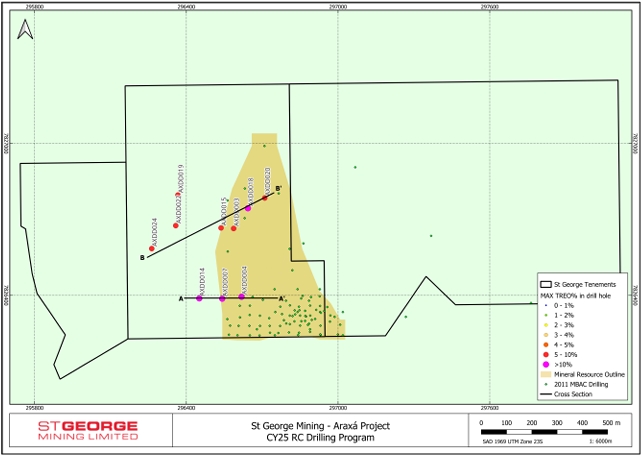
Plan view map of Araxá area showing the location of the diamond drilling relative to the MRE.
Pyrochlore discovery adds geological confidence
Beyond the assays, St George also flagged a significant technical milestone with the identification of primary pyrochlore mineralisation within carbonatite units in drill core. Pyrochlore is the key host mineral for niobium, and its presence provides direct confirmation of a stable magmatic source for mineralisation.
The company said this primary mineralisation underpins the development of the high-grade supergene enrichment zones at Araxá, formed as tropical weathering concentrates chemically resistant pyrochlore in the regolith. The coarse-grained nature of the pyrochlore also points to potentially favourable metallurgical characteristics.
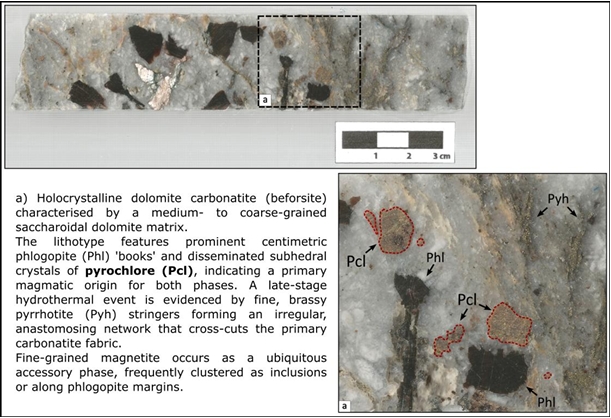
Pyrochlore occurrence within carbonatite, intercepted in drillhole AXDD019 at the depth of 79.1m.
Notably, the pyrochlore-bearing intercept lies outside the current MRE, supporting further exploration targeting primary carbonatite and expanding the project’s economic footprint.
A de-risked, globally significant project
St George acquired 100% of the Araxá project in February 2025. Located in Minas Gerais adjacent to CBMM’s world-leading niobium operations, the project benefits from established infrastructure, a skilled workforce and strong government support, including participation in Brazil’s MagBras initiative.
A maiden MRE announced in April 2025 outlined 41.2 million tonnes at 0.68% Nb₂O₅ and 40.6 million tonnes at 4.13% TREO, providing a strong foundation that ongoing drilling now appears set to significantly expand.