
Far East Gold Ltd (ASX:FEG) has moved quickly to extend drilling at its Sua Prospect in Indonesia after fresh high-grade gold results reinforced the scale and continuity of mineralisation within the Idenburg Gold Project.
The company has approved a five-hole, 1,360-metre extension to its current diamond drilling program, following strong assays from the first four holes of an initial 10-hole campaign. Those results confirmed high-grade — and in places bonanza-grade — gold across multiple stacked quartz veins, with mineralisation remaining open both down-dip and along strike.
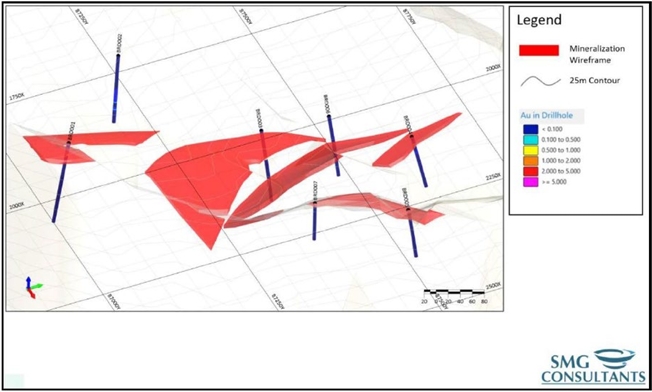
Oblique view of stacked mineralisation wireframes and historic drillholes at the Sua Prospect used in the current JORC (2012) inferred mineral resource estimate.
The extension will focus on step-out drilling beneath recent intercepts, targeting depth extensions of the high-grade shoots already identified at Sua.
Fast follow-up after high-grade hits
Far East Gold on Monday reported that all of the first four holes drilled at Sua (KSD023–KSD026) intersected high-grade gold mineralisation, validating historic drilling and extending known mineralised zones. Several of the intercepts confirmed the presence of deeper high-grade veins that were not fully defined by earlier programs.
Read more: Far East Gold confirms and extends high-grade gold zones at Sua Prospect
With assays from the remaining six holes still pending, the board said the strength of the early results — combined with improved structural understanding from drilling and 3D modelling — justified expanding the program without delay.
The five additional holes (PKSD011–PKSD015) will be drilled as roughly 100-metre down-dip step-outs beneath recent Far East Gold holes, testing continuity and plunge within the stacked vein system that hosts the gold.
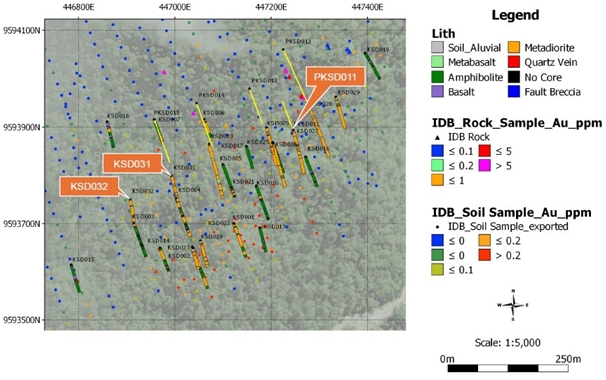
Plan of the Sua Prospect showing historic drillholes, FEG drillholes KSD023–KSD032 and planned extension drillholes PKSD011–PKSD015, with rock and soil sample gold values.
A system with pedigree
The Sua Prospect has a well-established history of high-grade gold intersections. Historic diamond drilling completed in 2005 and 2006 returned mineralisation in 19 of 22 holes, including standout results such as 7.5 metres at 13.6 grams per tonne gold, 3.0 metres at 35.0 g/t gold, and near-surface intercepts grading up to 105 g/t gold.
Far East Gold’s current drilling has been designed to twin those historic holes, step out beyond the existing resource footprint and refine the geological model of the Sua–Afley shear zone. The early results have confirmed that gold is hosted in a system of stacked, north-dipping quartz veins, with mineralisation extending beneath both historic and recent drilling.
The company said the high-grade zones intersected to date remain open in multiple directions.
Metallurgy and resource upside
Historic metallurgical test work at Sua indicated 50–60% of gold is recoverable by gravity, with overall recoveries exceeding 90% using conventional carbon-in-leach (CIL) or resin-in-leach (RIL) processing, providing early confidence in the project’s processing characteristics.
Sua sits within Far East Gold’s Idenburg Gold Project in Papua Province, which hosts a JORC (2012) inferred mineral resource of about 540,000 ounces of gold at an average grade of 4.1 g/t. Of that total, around 296,000 ounces at 3.7 g/t are attributed to Sua.
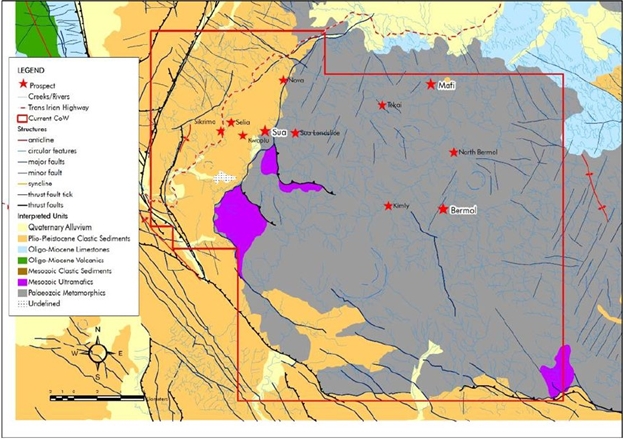
Geology of the Idenburg Inlier showing the Sua–Afley Shear Zone and prospects within the Contract of Work area.
Results from the ongoing drilling — including the extension program — will be incorporated into the geological model and assessed for potential resource growth and classification upgrades.
Far East Gold said drilling of the first extension hole is expected to begin shortly once final approvals are in place, with further assay results from the initial program due to be reported as they are received.