
Fortuna Metals Ltd (ASX:FUN) has confirmed a rutile discovery at its Mkanda project in Malawi after reporting high-grade results from the first batch of hand auger drill samples.
Natural rutile, a high-grade titanium feedstock used in titanium metal and titanium dioxide pigment production, is currently selling for about US$1,100–1,700 per tonne. Industry forecasts suggest the titanium market could grow from an estimated US$30 billion in 2025 to about US$54 billion by 2034, representing a compound annual growth rate of 6.5%.
The initial 10 holes, drilled to a maximum depth of 10 metres, all finished in rutile mineralisation and remain open at depth. Notable intercepts include:
- 10 metres at 1.66% rutile from surface, ending in 1.59% rutile (hole MHA0023)
- 10 metres at 1.32% rutile from surface, ending in 1.87% rutile (MHA0020)
- 10 metres at 1.23% rutile from surface, ending in 1.03% rutile (MHA0046)
- 5 metres at 1.35% rutile from surface, ending in 1.23% rutile (MHA0058)
Peak sample grade from the batch was 2.21% rutile in MHA0023. Four of the 10 holes ended in mineralisation above 1.0% rutile and nine ended above 0.5%.
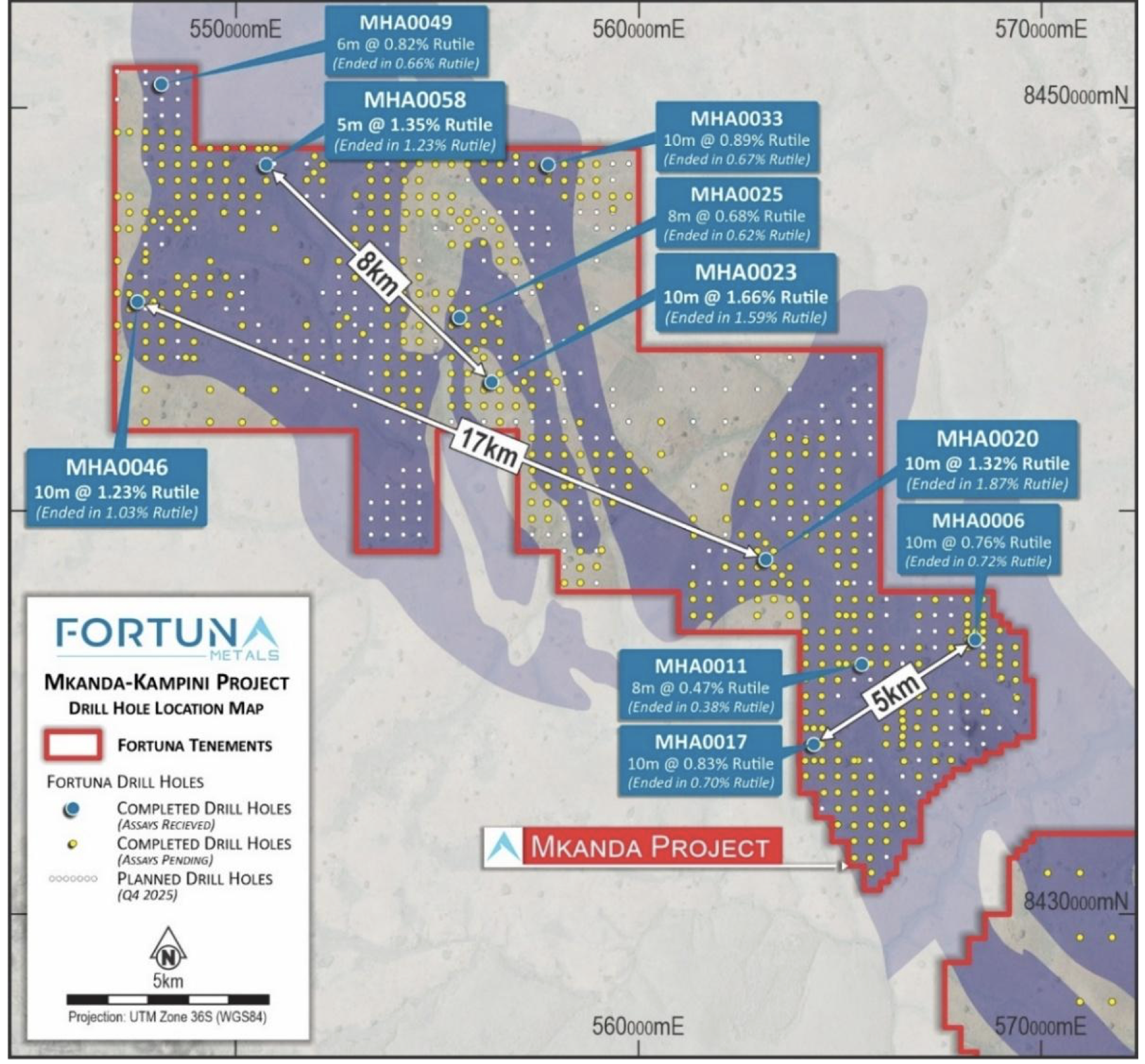
Rutile results across Mkanda project showing high-grade over wide areas.
“These exceptional high-grade rutile results mark a defining moment of a potential world-class rutile discovery just south of Sovereign Metals Kasiya deposit. The high-grade and widespread results are exactly what we were hoping for, highlighting the significant potential for rutile mineralisation to occur over large areas of the Mkanda project from surface which currently also remains open at depth.
“We are looking forward to starting Aircore and push tube drilling as soon as possible in early 2026. This will allow us to determine rutile mineralisation continuity to the saprock boundary at plus ~20m. This would be in line with the Kasiya deposit which averages ~20-30m depth to saprock and significantly increases the resource potential and overall project economics.”
Large first-pass drill coverage
The Mkanda and neighbouring Kampini projects cover 658 square kilometres immediately south of Sovereign Metals’ Kasiya rutile and graphite deposit on the Lilongwe Plain.
At Mkanda, Fortuna has now completed 544 hand auger drill holes on nominal 800 metre and 400 metre grids across about 180 square kilometres, to an average depth of 8 metres. The wide-spaced drilling is designed to define higher-grade rutile trends ahead of infill and step-out programs planned for 2026.
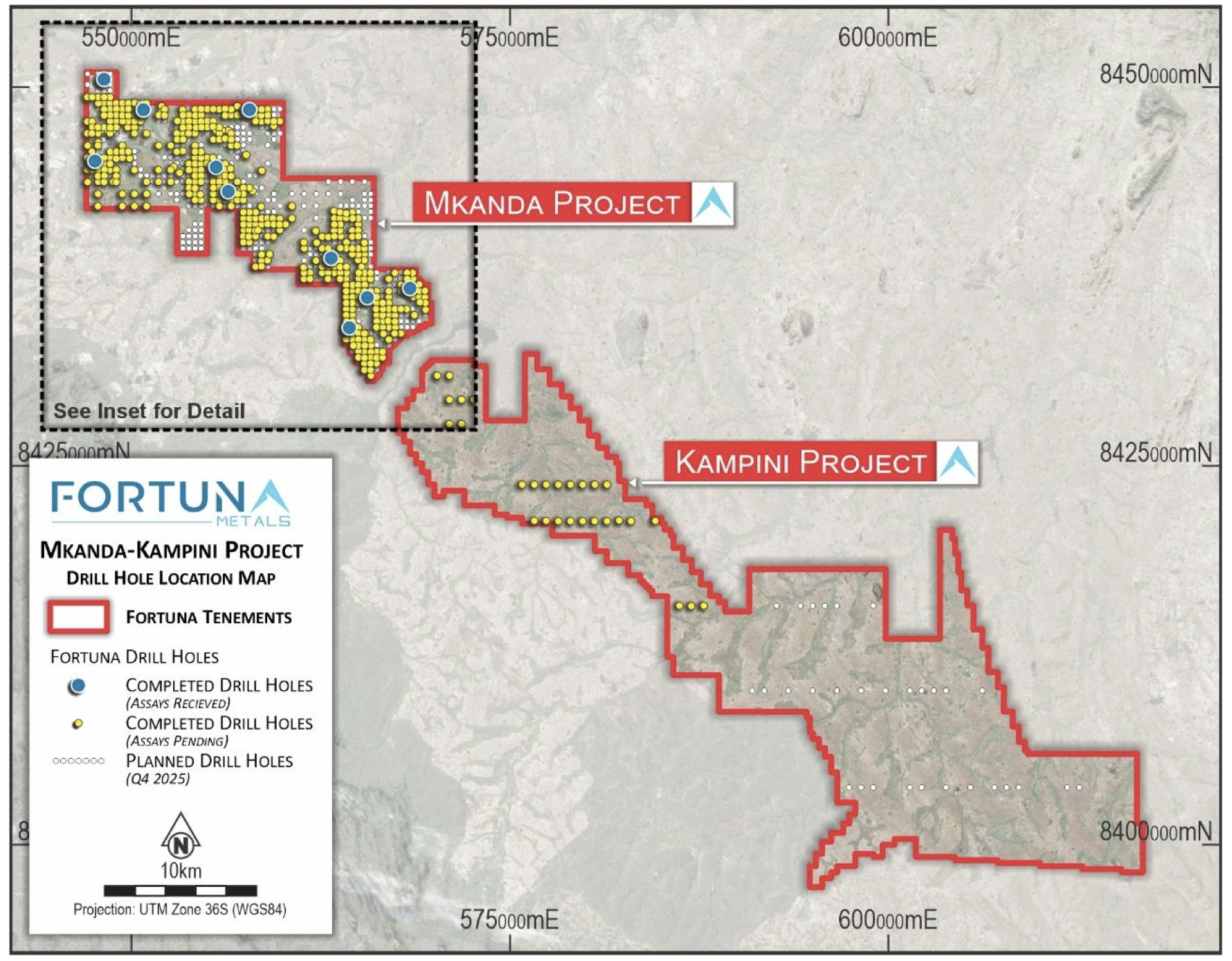
Drilling completed (yellow dots) and drilling planned for Q4, 2025 on 400 and 800m grids (white dots).
A second phase of drilling is underway, combining further 800 metre reconnaissance lines with 400 metre infill drilling, a spacing consistent with that used to support an inferred resource at Kasiya.
Deeper aircore drilling and in-country lab
Because hand auger drilling typically terminates at the perched water table, Fortuna plans to introduce aircore and push-tube drilling from around April–May 2026 to reach the saprock boundary at approximately 20–30 metres' depth, in line with the interpreted mineralised profile at Kasiya.
To improve assay turnaround times, the company is establishing an in-country sample preparation laboratory in Lilongwe, fitted with two Gemini wet shaking tables for heavy mineral separation before final analysis at external laboratories. Commissioning is targeted for early 2026.
Graphite upside and assay pipeline
All 63 holes from the first phase are also being submitted for graphite analysis, reflecting the dual rutile–graphite potential of the project area, where coarse flake graphite has previously been observed.
Results for both rutile and graphite are expected during the March quarter of 2026.