
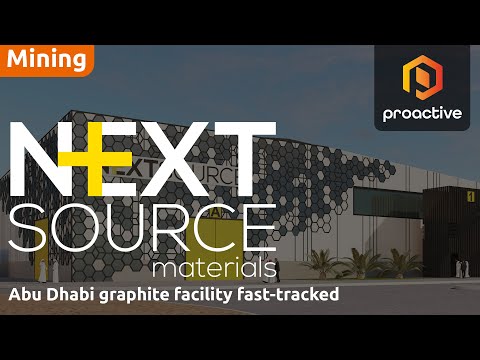
NextSource Materials Inc. (TSX:NEXT, OTCQB:NSRCF) CEO Hanré Rossouw talked with Proactive about the company’s latest progress at its Abu Dhabi graphite processing facility.
The discussion followed a recent site visit which included local and international investors, and potential financing partners.
Proactive: Hanré, very good to speak with you. You hosted a site visit at your Abu Dhabi facility at the end of November, including potential financing partners. So really, a continuation of the progress you've been showing. What were the key takeaways from the visit?
Hanré Rossouw: Thanks for the opportunity to share a bit of an update today. We were excited by the very good attendance. We had a combination of local and international investors keen to progress further due diligence at the site. We were able to share more updates around progress on the engineering and design and also had the opportunity to take people to our existing property. Maybe just to stress the importance for us in securing that property – it already has a constructed warehouse. That really makes this not a construction project, but an installation project, and significantly shortens the timeline of delivery. That was a great opportunity to share with potential investors.
What concrete milestones must be met next to secure final-stage funding? And how confident are you in delivering first production by the fourth quarter of 2026?
The key part is the completion of the engineering design. A great aspect of the site visit was being able to share the work in progress with investors. We had groups of people walking around the site and, using their phones, they could see 3D modelling of the equipment being installed. It’s still a virtual glimpse, but now in the final stages of getting completed. That work will inform the finalisation of funding. So, the two critical milestones in the next two to three months are the completion of the engineering design and securing funding.
You secured a multi-year offtake with Mitsubishi Chemical for 9,000 tonnes a year. How quickly do you expect to contract the remaining capacity of the facility, and what is the status of additional offtake negotiations?
That’s an important component we are engaging in parallel. Just as a reminder, the first phase of the construction has 14,000 tonnes of capacity. We’ve already secured 9,000 tonnes through this key contract with Mitsubishi. That underpins the economics. For the remaining 5,000 tonnes, we’re in advanced discussions – not only for that but also for another 16,000 tonnes in the second phase. That could mean that the first phase might even be made a bit bigger. The complete building is 60,000m² – about 12 rugby fields – so we already have the full footprint for the first two phases. We don’t need additional space and can adjust the phasing according to the offtakes we’re securing.
You’ve highlighted expedited permitting and world-class infrastructure in the UAE. From an investor perspective, what specific cost or schedule advantages does the industrial city of Abu Dhabi location provide compared with other jurisdictions?
A key part of our recent visit was representation from the Abu Dhabi Investment Office, which helped unpack all these advantages. As you mentioned, we have world-class logistics. The Industrial City of Abu Dhabi is a dedicated region specifically outlined for industrial production. That gives you the ability for pre-permitted construction. The area is already permitted for heavy industry, and what they call a civil defense permit – your effective permit to operate – is only required after construction. That’s a key differentiator in Abu Dhabi. Additionally, we’ve got a whole ecosystem of potential offtakers. A lot of our production will be a byproduct of ultra-fines of graphite. Industries like refractory and oil and gas heavily use graphite-type products, which gives us the ability to grow our business in the region.
You describe the facility as a cornerstone of your global vertical integration strategy. What are the next steps that will position you for long-term market share outside of Asia?
First, we’re focused on getting this project delivered. The important aspect of vertical integration is that we’ve got the Molo mine to provide feedstock to this facility. From a risk mitigation perspective, we are also testing third-party feedstock. That gives us the ability to right-size smaller than the ultimate size of the facility, but also ensures flexibility. In a world where China dominates the graphite supply chain – nearly 100% of midstream processing is done in China – we have a significant first-mover advantage to establish this world-class facility outside of China.
Quotes have been lightly edited for style and clarity