
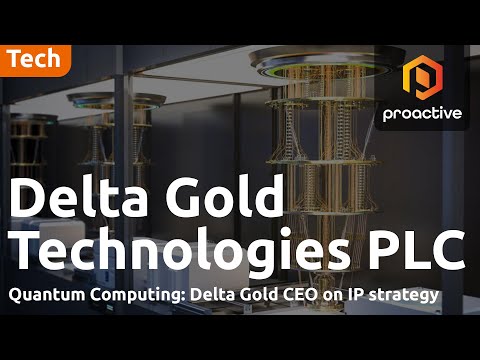
Delta Gold Technologies PLC (AQSE:DGQ) earlier this week discussed its ongoing research in quantum computing and the company’s commercial strategy following its recent listing on the Aquis Stock Exchange.
The company is pursuing a novel approach to building qubits, the core component of quantum computers, by using nanoscale gold. It highlighted that qubit creation is still a fundamental challenge in the sector, and its solution focuses on achieving both scalability and stability.
It has a three-year research partnership with the University of Toronto, with Professor Harry Ruda, a cited expert in the field, the lead investigator, joined by two postdoctoral fellows relocating to Toronto to work on the project.
The company told investors that approximately CA$1 million (£600,000) is being spent annually under this agreement, which secures the right to 100% of the intellectual property developed. The capital raised through the IPO, which totalled £2.50 million, is being deployed toward this programme and associated patent filings.
Michael Jones, CEO of Delta Gold, said the company is open-minded about its commercial pathway, with opportunities for licensing, partnerships, or direct applications.
Proactive:
Hello you're watching Proactive. I'm joined by Michael Jones, the CEO of Delta Gold Technologies PLC. Michael, very good to see you in the studio.
For viewers new to Delta Gold, how would you describe the company and the problem you're trying to solve in quantum computing?
Michael Jones:
Quantum computing is very interesting because there are companies that talk about having a quantum computer. And yet the very core part of the quantum computer is a qubit. And how to make a qubit — it's not actually settled. The physics is still in debate. The key thing is the qubit has to be both stable and scalable. Lots of companies are working on different science to create that. So it's still very much early in quantum computing days. We have a particular way of creating a qubit that we think is very innovative, and that's what we're working on.
Proactive:
In fact, your technology centres on nanoscale gold. What's uniquely promising about this material for quantum applications?
Michael Jones:
Well unfortunately I can't tell you for two reasons. I'm not a quantum physicist, and quantum is quite hard to understand. And second, it's part of our intellectual property.
It's actually a good thing I don't understand all of it. In a basic computer, you can have a zero or a one. In a quantum computer, you can have a zero, a one or something in between, at the same time. That ability to create multi-settings gives the quantum computer its power and its ability to calculate iterations much faster than a regular computer, tens or hundreds of thousands of times faster.
So creating a stable, scalable qubit is very unique. And gold has a particular property that gives it that potential.
Proactive:
What are Delta Gold's unique selling points?
Michael Jones:
We have some of the best people in the world working on this. Quantum physics and computing are exciting fields. Big companies like Microsoft, Amazon, Rigetti are spending billions a year on quantum computing. We happen to have some of the brightest people working on our solution. In fact, Professor Harry Ruda, our principal investigator at the University of Toronto, is chairing the Global Conference on Quantum Computing in Bern this summer. He's a true global leader.
Proactive:
What does your partnership with the University of Toronto give you that you couldn't build in-house?
Michael Jones:
That expertise. We're able to attract top academic talent from around the world. Two postdoctoral fellows are even moving with their families to Toronto because of the uniqueness of our idea and the opportunity to study under Professor Ruda. He's authored thousands of papers and been cited over 2,800 times. Also, working with the university gives us access to resources like electron microprobes and other equipment — a real benefit for a small company.
Proactive:
You’ve just listed on the Aquis Stock Exchange with a market cap of about £5.9 million and raised £2.5 million. How do you plan to deploy that capital?
Michael Jones:
Interestingly, the stock is up about 50% since the IPO, so we’re now over £10 million. The capital is to drive research. We have a sponsorship agreement with the University of Toronto and spend about CA$1 million, or £600,000 a year, on research. That programme is laid out over three years and earns us the right to 100% of the intellectual property. So, part of the expenditure will be around securing that IP, filing patents, and protecting it.
Proactive:
You've described Delta Gold as an IP-driven business. What does commercial success look like? Licensing, partnerships?
Michael Jones:
All of those. The company could become interesting to larger players as our science develops. We’re open-minded about how to monetise. The first step is to develop the IP, protect it, and see who’s interested. Quantum computing spans sectors — military, big data, encryption, banking, medical modelling — the power of the quantum computer cuts across industries. That gives us a lot of opportunity to look for partners or licensees.
Proactive:
Give us your investment case.
Michael Jones:
We’re a relatively small market cap. We have some of the best people in the world working in a high-growth area. We're quite unique. It's hard to get this expertise. It’s a way to get direct quantum computing exposure at a modest market cap.
Proactive:
And quite a bit of your stock is locked up for 12 months. What should this tell investors?
Michael Jones:
Absolutely. Our largest seed shareholder and the founders are locked up. About 49% of stock is locked up for a year, and the founders for over two years on a phased release. We all very much believe in what we’re doing. The exciting part comes as we crystallise the IP and look for licensing or partnerships. We've got a steady flow of business news. One exciting development is building a centre of excellence in quantum research, bringing top researchers globally to collaborate — something rare in academia.
Proactive:
You're early in a three-year research project. What milestones should investors look out for?
Michael Jones:
First, we’ll talk more about the team we’ve secured. That announcement is coming in the next week or two. Then, in 3–4 months, we’ll detail collaborations with global universities. In about a year, you should see patent filings and more public detail about the technology.
Proactive:
Well, I hope you'll keep us posted on your progress. Thank you very much for coming on today.