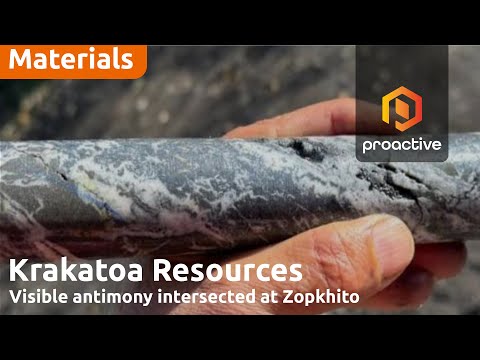
Krakatoa Resources Ltd (ASX:KTA) has confirmed extensive visual antimony mineralisation from both underground and surface drilling at its Zopkhito Antimony-Gold Project in Georgia, underscoring the project’s strong early momentum as the company advances toward a maiden JORC Resource in 2026.
The company has now completed its first full drilling program at Zopkhito, with 16 of 18 underground adit core holes and 12 of 15 surface diamond holes intersecting visible stibnite. Both programs also recorded arsenopyrite-dominant halos, which historically have been associated with gold.
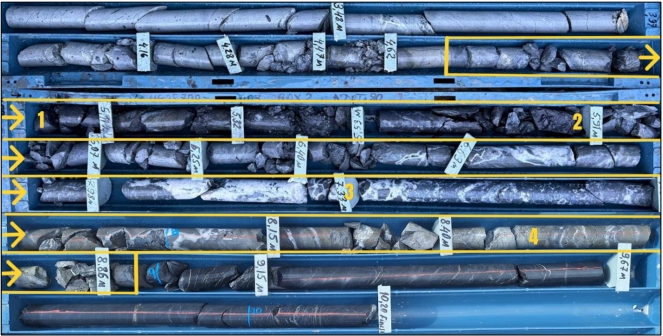
Photo of the mineralised antimony zones (yellow box) within drillhole UG25ZOP003 (wet) showing area from reference point 1 to 2 as a massive stibnite (>80%) zone and a zone of quartz – sulphide - stibnite breccia (noted by 3) and antimony veinlets 4. Drilling prior to the antimony zone is enriched in arsenopyrite sulphide alteration which may contain gold. Assays are pending for this hole and are expected in December 2025 to January 2026.
“We are delighted with the successful completion of our first drilling program at Zophkito, which marks a major step forward for Krakatoa,” executive chairman Colin Locke said.
“Visual intersections of stibnite provide confidence in receiving high-grade antimony results, coupled with the strong indications of gold mineralisation, reinforcing the project’s potential to become a strategic asset in Europe’s critical minerals chain,” Locke said. “With assays due shortly and all the data to feed into converting the existing foreign resource estimate to a maiden JORC Resource in 2026, momentum across the project continues to build.”
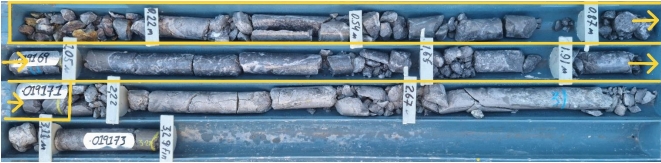
Photo of the mineralised antimony zones (yellow box) within drillhole UG25ZOP018 (dry) showing area within the zone with semi-massive stibnite (~25%) with minor quartz intermixed over entire 2.14m zone. Drilling prior to the antimony zone is enriched in arsenopyrite sulphide alteration which may contain gold. Assays are pending for this hole and are expected in December 2025 to January 2026.
He added that a recently secured 12-month extension to the project option period allows Krakatoa to “realise Zopkhito’s full potential” while maximising next season’s longer drilling window.
Strong early signs ahead of assays
Zopkhito currently carries a foreign resource estimate of 225,000 tonnes at 11.6% antimony and 7.1 million tonnes at 3.7 g/t gold. The 2025 drilling campaigns — the first completed by Krakatoa — are designed to validate historic datasets and collect the high-quality core needed to underpin a JORC-compliant update.
Underground drilling used a portable 41-millimetre coring system to test shallow mineralised zones in and around Adit #80. All 18 holes intersected arsenopyrite halos, with 16 returning visible stibnite — a key indicator of antimony mineralisation. Krakatoa says these results are considered indicative only, with detailed logging and assays to follow.
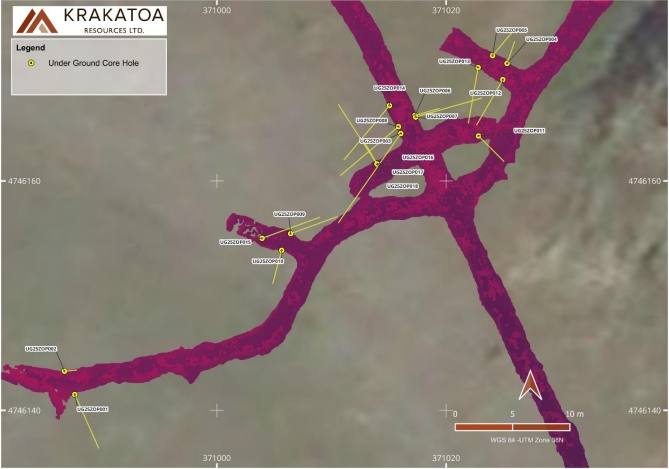
Plan view showing the locations of the underground core sampling drill holes in relation to the adit. LiDAR surface profile.
Surface drilling also delivered encouraging results. Of 18 planned diamond holes, 15 reached target depth before winter conditions halted operations, and 12 of those intersected antimony-rich quartz veins.
Assay results for both programs are expected between late December and January.
Laying the groundwork for growth
The option period extension provides Krakatoa with an additional 12 months to advance drilling, refine geological models and complete transaction milestones. With site-access preparation now complete, the 2026 field season will include a longer, uninterrupted drilling window beginning in Q2 2026.
Krakatoa’s next steps at Zopkhito include:
- Assays pending: First laboratory results due in late December–January.
- Expanded drilling: Phase 2 drilling planned for 2026, targeting extensions between adits and into new vein zones.
- JORC milestone: Ongoing drilling and assays will feed into the company’s maiden JORC Resource estimate.
- Strategic positioning: Progress at Zopkhito supports Europe’s push to diversify supply of critical minerals such as antimony.
A rare critical minerals opportunity
Antimony is listed as a critical mineral in both the EU and US, used in advanced batteries, flame retardants, semiconductors and defence applications. With China controlling roughly 90% of global production, Western markets are seeking new, secure supply lines.
Zopkhito’s location in Georgia gives Krakatoa access to established infrastructure, favourable trade agreements and proximity to European end-users — factors that position the project as a potentially significant new entrant in the region’s supply chain.
Locke said Zopkhito offers investors exposure to “one of the few emerging projects capable of delivering secure, high-value antimony and gold into Western markets — a position we believe will translate into substantial value for our shareholders”.
Drilling is scheduled to resume in Q2 2026, with a steady flow of updates expected as assays are received and Zopkhito advances towards its maiden JORC Resource.