
Lightning Minerals Ltd (ASX:L1M) is moving quickly to build on strong early results at its Mt Turner Gold Project in North Queensland, with planning now under way for an aggressive Phase 2 drilling program of up to 7,000 metres.
The campaign — a mix of reverse circulation (RC) and diamond drilling — aims to expand mineralisation along the 14-kilometre Drummer Fault after Phase 1 drilling confirmed a large-scale gold, silver and base metal system extending over 12 kilometres. Eight of the nine initial holes delivered significant mineralised intervals, including multiple high-grade epithermal zones and several new targets.
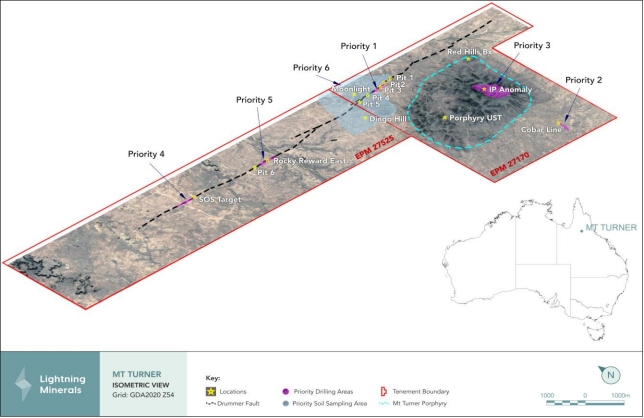
Isometric view of Mt Turner Project demonstrating Phase 2 drilling and soil sampling priority areas.
Managing director Alex Biggs said the company was encouraged by how rapidly Mt Turner is taking shape.
“We are still in the very early stages of drilling at Mt Turner, yet Phase 1 has delivered outstanding results that confirm a large mineralised system and highlight multiple new targets,” Biggs said. “Our priority in Phase 2 is to extend the high-grade zone at Pit 3, where our first hole intersected 20.4 metres at 2.4 g/t Au, including 1.8 metres at 10.6 g/t Au from a shallow depth of 62 metres.
“Demonstrating continuity of this mineralisation along strike and down dip has the potential to rapidly build scale,” he added. “Mt Turner is emerging as a highly prospective, target-rich project with compelling gold and base-metal potential.”
Phase 2 drilling is fully funded after Lightning secured A$2.5 million in a recent capital raise.
Read more: Lightning Minerals to advances exploration following $2.5M capital raise
Strong first-pass results set up clear priorities
Phase 1 drilling confirmed shallow orogenic gold with high-grade epithermal zones, highlighted by:
- 20.4 metres at 2.4 g/t gold (including 1.8 metres at 10.6 g/t) from 62 metres at Pit 3 (Drummer West)
- 8 metres at 1.4 g/t gold from 77.8 metres at Pit 5 (Drummer Girl)
- 3.9 metres at 3.6 g/t gold (including 1 metre at 10.7 g/t) from 90 metres at Drummer Girl
Rock chips up to 21.9 g/t gold have extended mineralisation along strike to 12 kilometres.
The company has set Pit 3 as its first priority, where 600 metres of strike and down-dip extensions will be tested in Phase 2. Drummer Girl — also hosting high-grade epithermal gold — will see additional step-out drilling supported by a soil sampling program targeting structural links between Pit 3, Pit 5, Dingo Hill and the historical Moonlight Vein workings.
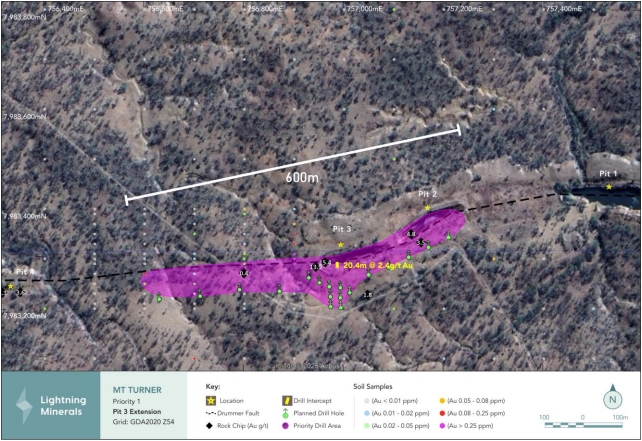
Target 1 - Pit 3 (Drummer West) drill plan with previous mineralised drilling intersection.
Follow-up zinc and silver drilling at Cobar Line
The Cobar Line prospect delivered thick, high-grade zinc and silver intersections during Phase 1, validating Lightning’s broader exploration thesis. Highlights included:
- 17.2 metres at 6.2% zinc, 1.4% lead and 10.3 g/t silver from 32 metres
- 12.4 metres at 6.2% zinc, 1.4% lead and 24.2 g/t silver from 17.6 metres, including 0.6 metres at 19.7% zinc, 8.4% lead and 150 g/t silver
Phase 2 will seek to grow this mineralisation while also testing for associated near-surface epithermal gold.
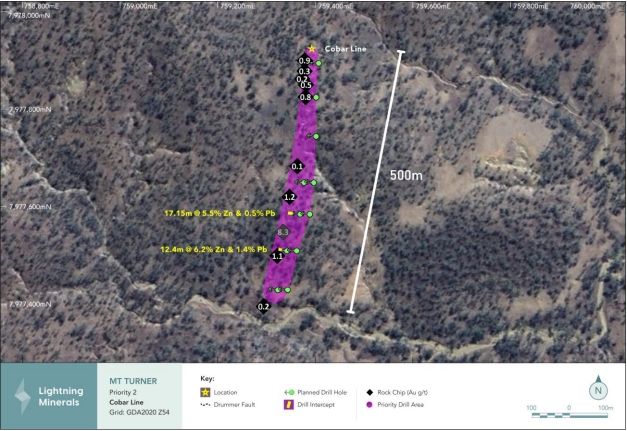
Target 2 - Cobar Line drill plan with previous mineralised drilling intersection.
Porphyry potential receives first effective test
Lightning will also drill a reconnaissance hole into a compelling IP anomaly linked to the Mt Turner Porphyry system — a 6-kilometre-diameter hydrothermal complex interpreted to host classic porphyry metal zonation. Despite its scale, the system has never been systematically drill-tested.
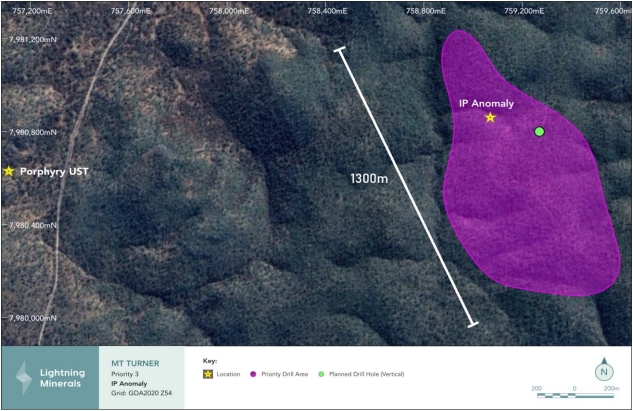
Target 3 – Mt Turner Porphyry IP anomaly area and planned reconnaissance drill hole.
Further targets include the SOS prospect, where 21.9 g/t gold rock chips point to near-surface potential, and Pit 6 (Rocky Reward), where soil anomalies suggest strike extensions east of previous drilling.
Broader footprint expanding
The company is also advancing soil geochemistry at its Boree Creek copper–gold project in the Lachlan Fold Belt, refining targets around the Dairy Hill porphyry system.
Lightning expects Phase 2 drilling at Mt Turner to begin in Q1 2026, with final collar design and sequencing to be confirmed in the coming weeks.