
International Graphite Ltd (ASX:IG6) has released the results of a techno-economic evaluation (TFE) for its proposed expandable graphite facility (EGF) in Germany, and the numbers show a simple, low-cost project with strong potential margins.
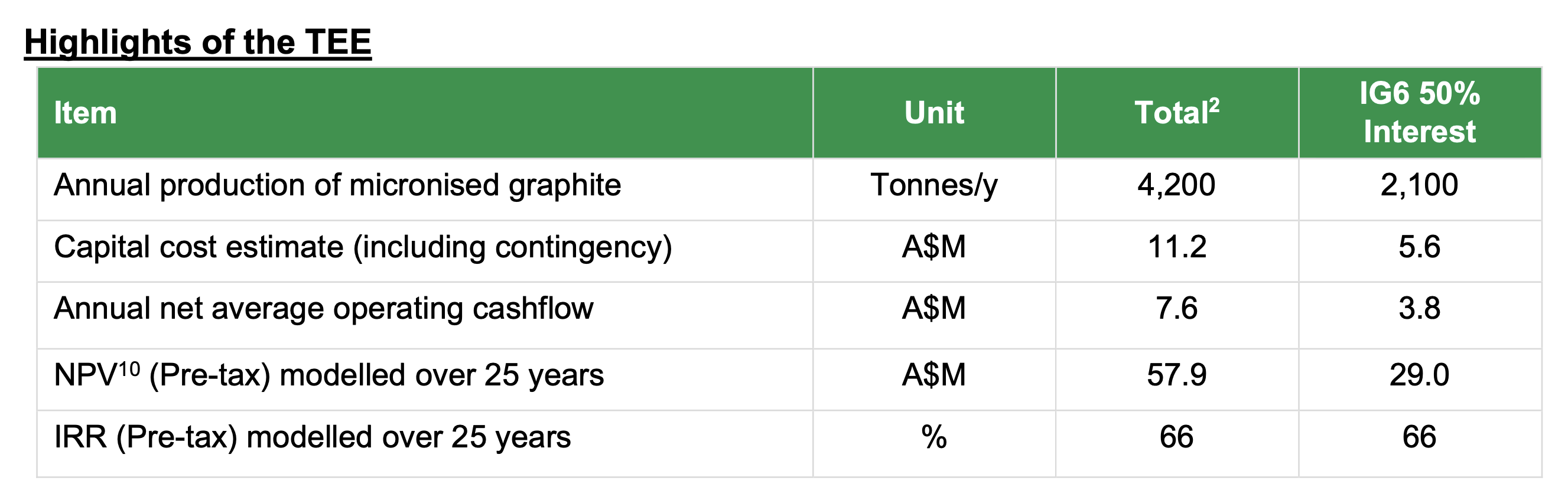
The company plans to build the plant as a 50/50 joint venture inside the Bitterfeld-Wolfen chemical park, an established industrial area that already has the infrastructure needed for processing. Because of this, the required capital investment is small — about A$11.2 million in total, with A$5.6 million attributable to IG6.
For a specialty graphite plant, this is considered very low capex.
According to managing director and CEO Andrew Worland, securing a foothold in Europe is a key step in the plan to establish a globally significant graphite processing and speciality materials business.
In return for that modest spend, the facility is expected to produce 4,200 tonnes per year of micronised graphite, half of which will be credited to IG6. Average annual operating cashflow is estimated at A$7.6 million, or A$3.8 million for IG6.
Across the full project life, the study generated a pre-tax NPV10 of A$57.9 million and an internal rate of return of 66%, underlining the project’s high-margin nature. The investment is expected to pay back in under 2 years once full production is reached.
“The TEE verifies our approach that strong financial returns are capable of being generated from low capital cost graphite processing facilities with far lower execution risk and dilution to shareholders as a pre-curser to building new mine supply from our Springdale Graphite Project in Western Australia,” Worland said.
“For a capital cost estimate of ~$11.2 million (~€6.3 million) payback at full production would be less than two years.
“The company planned to arrange construction financing in the first half of 2026 with production scheduled to commence in mid-2027,” he said.
Simple, conventional processing
The chemical process itself is conventional.
The plant will buy graphite concentrate from third parties and treat it with a mix of nitric and sulphuric acids to produce expandable graphite.
This straightforward flowsheet helps keep operating risks and costs low.
Part of a bigger graphite business in 2027
The EGF fits into a wider strategy to build a vertically integrated graphite business that sells higher-value processed products rather than raw materials.
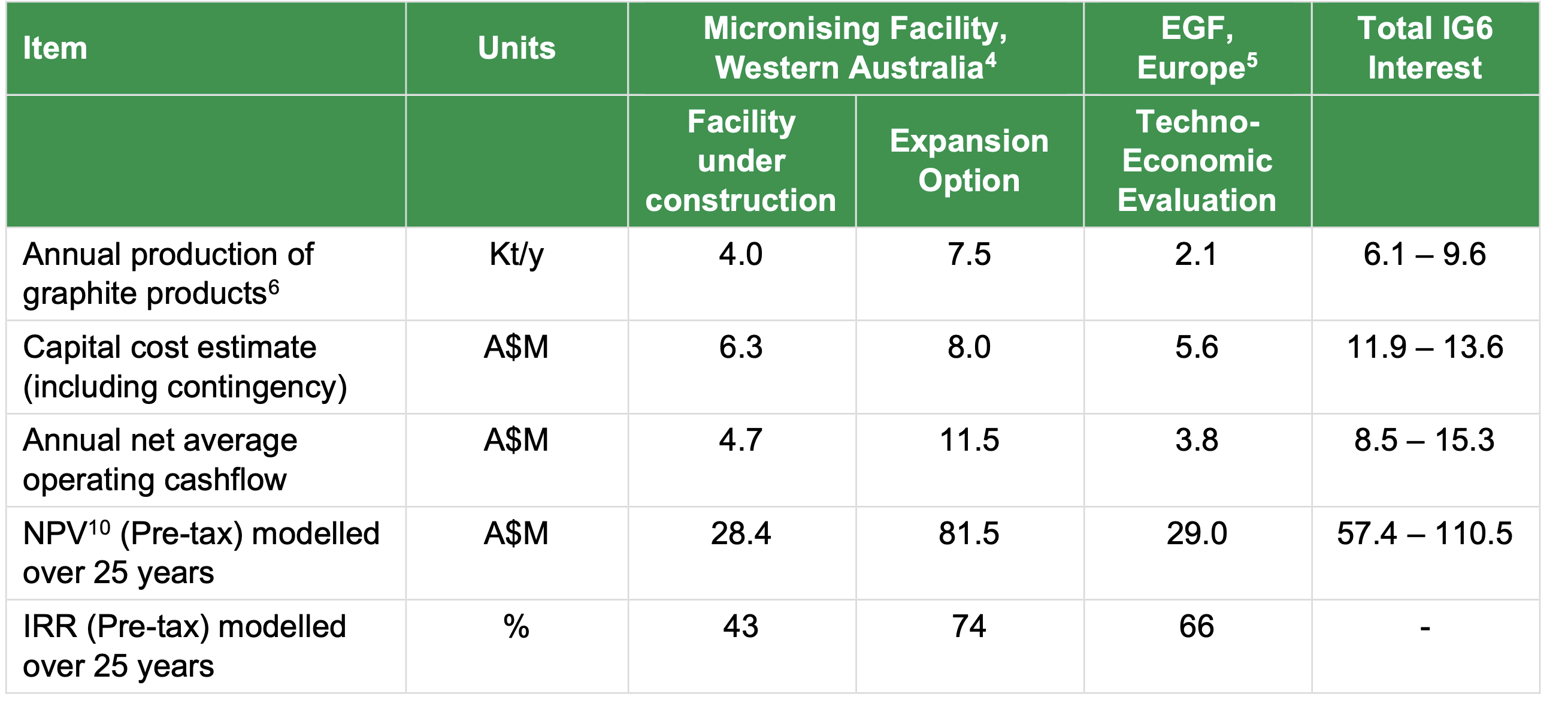
Alongside the Collie Micronising Facility being developed in Western Australia, IG6 expects to have capacity for around 12,000 tons per year of micronised and expandable graphite products by 2027.
Combined, these two operations are forecast to deliver A$10–20 million in annual net operating cashflow for less than A$20 million in total capital investment.
The EGF offers a practical, low-dilution growth step that can generate meaningful cashflow without the large upfront capital usually associated with mining developments.
By keeping the initial investment small and using proven technology, IG6 aims to capture the strong margins available in the expandable graphite market while maintaining manageable risk.
About the TFE
The TEE assesses the expected performance of the expandable graphite (EGF) production process by integrating technical, economic and risk analyses. Capital and operating cost estimates have been prepared at accuracy ranges of ±35% and ±30% respectively.
Design of the new processing facility will be guided by ongoing testwork using feedstocks from East Africa, Madagascar, the Skaland mine and concentrates from the Company’s Springdale Graphite Project, along with access to proven processing technology for which IP rights have been secured and product specifications advised by independent market specialists. A non-binding concentrate supply agreement with an international trading house currently provides third-party feed for testwork.
The proposed EGF plant is designed for a nominal production capacity of 3,500–4,500 tonnes per year at 85% availability, using a conventional chemical intercalation process and leveraging established infrastructure within the Bitterfeld-Wolfen Chemi-Park industrial estate in Germany.
Expandable graphite is produced by inserting acid-based intercalating agents between graphite layers; when heated, these compounds rapidly vaporise, expanding the material by up to 300× in seconds to form a lightweight, insulating carbon structure.
The facility is expected to reach design operating parameters within the first three months of commissioning. Actual first-year output will depend on market conditions, customer qualification processes and product performance.
Financial outcomes are highly sensitive to expandable graphite pricing. The TEE assumes feedstock grades of 94–95%, upgrading to 97–98% through processing, with higher-grade inputs enabling entry into higher-value markets. Expandable graphite prices have shown steady growth since mid-2022.