
- FTSE 100 down 3 points at 9,642
- BAT leads fallers after mixed trading update
- Consumer spending softened last month - Barclaycard and BRC data
5.05pm: Footsie little changed
The FTSE 100 finished the day just below the flatline as traders await the Fed’s rate-cutting decision on Wednesday. The index closed down 3 points at 9,642.
IG chief market analyst Chris Beauchamp noted that the 48 hours before a Fed decision are rarely a good time to make short-term investment decisions.“The week so far has been indecisive at best, but early trading in the US has seen some tentative buying,” Beauchamp said.
“Trump’s decision to allow Nvidia to hawk its most sophisticated chips to China gave the stock a boost overnight, but that bounce is fading. Meanwhile Trump’s Fed pick Hassett has been banging the drum for the US economy, but it seems investors would rather focus on the existing Fed chair, at least until after tomorrow’s decision.”
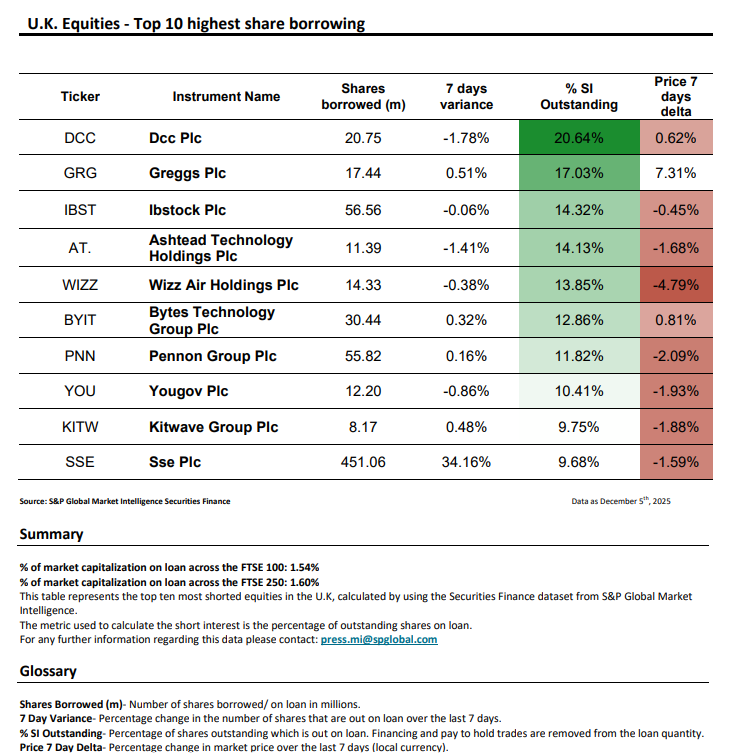
3.51pm: DCC, Greggs and Wizz among most shorted shares in London
The most shorted UK equities are DCC PLC (LSE:DCC) and Greggs PLC (LSE:GRG).
Following that pair is brickmaker Ibstock, Asthtead Technology, Wizz Air, Bytes Technology and Pennon, according to S&P Global.
2.53pm: Mixed start for US stocks
It's a mixed start on Wall Street, with the Dow Jones opening 0.35% higher, the S&P 500 up 0.1% but the Nasdaq slipping 0.2%.
Almost all the Mag 7 stocks are in the red, Apple and Tesla being the exception.
Nvidia and Microsoft are down 0.4%, Meta is down 1.8% after announcing a new AI model.
Leading the Dow higher are Johnson & Johnson, up 1.6%, and Procter & Gamble, up 1.3%.
1.54pm: FTSE flat, US futures turn red
The FTSE 100 is continuing to be pretty directionless, having dipped into the red and popped back out again.
Among the index's top 15 companies, RELX is being lifted after Deutsche Bank upgraded the information-services group from 'hold' to 'buy', arguing that worries over generative AI have created an attractive entry point for high-quality media names.
Despite a “tough” 2025 for the sector, a year that “started tough/got worse”, the backdrop looks “a bit better” in 2026, analysts reckon.
Falling interest rates should help sentiment, though Deutsche Bank cautioned that volatility remains a factor.
Elsewhere, European markets are mixed, with the DAX up and CAC down.
US stock futures have turned red, with the Nasdaq down 0.2% and the Dow and S&P both just below flat.
12.55pm: Analysts give their first Magnum opuses
A day after The Magnum Ice Cream Company (LSE:MICC) began trading as a listed standalone business, investment banks have started to give their views on its prospects.
UBS has initiated coverage with a 'buy' rating and a €14.3 price target, confident of outperformance in a "subdued" category facing mounting structural headwinds, a margin expansion plan and "meaningful" free cash flow (FCF) expected from 2028.
JPMorgan initiated with a 'neutral' rating and a very similar €14 price target, predicting earnings growth to be supported by supply-chain efficiencies but fearing that early-stage costs will weigh on delivery.
Analyst Celine Pannuti wrote: “We expect the ramp up in costs will lead to a delivery that is back end loaded", with 2025/26 margin expected to be weighed down by India consolidation, the impact of transition services agreements with former parent Unilever and weaker cash flows.
And, on MICC's former parent, Pannuti says Unilever "offers the potential for a re-rating as the company executes on its transformation towards becoming a more beauty and personal care company".
Management aim to deliver at around a 4-6% organic growth rate and moderate margin expansion.
She says "Unilever’s advantage rests in its ability to outperform its categories thanks to stronger marketing execution and focus on premiumization."
12.04pm: US market preview
US stock futures are, like at this point yesterday, indicating small gains when trading in New York opens - although yesterday ended with all three main indices closing lower.
Dow Jones futures are up 0.1%, while S&P 500 and Nasdaq futures are closer to flat.
This is despite premarket gains for Nvidia after President Trump agreed to lift export restrictions on chip sales to China, which will allow Nvidia to sell its H200 AI chips to Beijing.
Market analyst Kathleen Brooks at XTB says the Federal Reserve meeting, which starts today and finishes tomorrow, is "dominating market action today".
"Stocks are wavering, bond yields are falling this morning, even though bets on Fed rate cuts in 2026 have been scaled back slightly in recent days.
"However, there could be more volatility in bond markets as we near the end of the year, as global central banks turn towards a more hawkish stance ahead of 2026."
She says the process of markets digesting fewer global rate cuts next year "may cause stock markets to stall, especially as US markets approach record highs".
Brooks says the US stock market rally has broadened beyond the tech sector, with yesterday seeing the equal-weighted S&P 500 outperform the market cap-weighted S&P 500.
"The recent increase in bond yields is also a sign that the market is positioning for a rebound in US growth, which could help cyclical sectors continue to perform well into year end.
"Ultimately, if this trend continues, then US stocks could catch up with European indices, which have outperformed so far this year."
US data today includes Jolts job openings.
11.21am: EU sustainability rules pared back
Bad news, sustainability fans: the EU has reached a deal to soften corporate sustainability laws in the face of pressure from corporate and government lobbying, especially from Washington.
Changes have been agreed to weaken rules for most businesses, with some industries arguing that strict regulation made EU businesses less competitive than overseas rivals.
The corporate sustainability due diligence directive (CSDDD), requiring companies to fix human rights and environmental issues in their supply chains, will now only apply to EU corporations with more than 5,000 employees and €1.5 billion annual revenue. The rules will also cover foreign companies whose EU turnover exceeds that amount.
Fines of up to 3% of net global turnover can be applied for breaching the law.
The EU also pushed back the deadline to comply with CSDDD to mid-2029, and dropped a requirement for companies to adopt climate change transition plans.
An ExxonMobil spokesperson told Reuters the changes "didn’t go nearly far enough".
The EU's corporate sustainability reporting directive (CSRD), which requires companies to disclose their environmental and social impact, will now only cover companies with more than 1,000 employees and €450 million net sales, up from companies with more than 250 employees currently.
11.02am: FTSE in green
The FTSE has broken into positive territory.
Unilever (up almost 13%) and defence groups Babcock and BAE (up 3.9% and 2.8%) are doing the heavy lifting.
Also, WPP is up 4.5%.
This comes after reports that marketers are forecasting an increase in brand ad spend for 2026. The global CMO survey shows more than half of marketers surveyed expect a rise, Campaign magazine reports, with a strong contingent of 17% forecasting double-digit gains
10.21am: Bond investment view from UBS
While bond yields have been rising (see below), with the US 10-year yield up to 4.18%, the highest level since September, UBS reckons this won't last long.
"We maintain the view that government bond yields will move lower, and we forecast the yield on 10-year Treasuries to fall to 3.75% over the next six months," says Mark Haefele, chief investment officer of the Swiss bank.
"With returns coming from a mix of yield and capital appreciation, we continue to see value in holding quality fixed income in a portfolio."
Further Fed cuts are likely, he says, with recent inflation data suggesting that price pressures are not intensifying, and jobs numbers down.
"The US government is likely to manage the cost of government borrowing through further financial repression. Both the US administration and the Fed have an interest in keeping yields contained given rising debt and large fiscal deficits."
With yields still elevated and likely to fall, he believes "quality fixed income offers an appealing combination of income and potential to perform well in the event of slowing economic activity and if rates are cut further".
Medium-duration quality bonds (four to seven years) should exceed cash rates, "making them a valuable source of portfolio income. Their potential to help dampen portfolio volatility is also critical in navigating the markets ahead."
9.33am: Mixed and languid stocks, bond selling
Stocks are "looking a bit mixed and languid", says market analyst Neil Wilson at Saxo, whose headline view is that as the Fed starts its two-day meeting today the market backdrop is of "a bond market selloff that’s taken hold on bets that global central banks are turning hawkish".
The FTSE 100 has ticked very slightly lower due to commodities companies and British American Tobacco falling, while European stock markets are a little more on the front foot.
Germany's DAX is being marched higher by defence giant Rheinmetall (UK defence names are up too), as Chancellor Friedrich Merz is set to approve a record £52 billion in defence orders.
"Whether there is peace in Ukraine or not, Europe is rearming fast and for the long haul," says Wilson.
Shares are under some pressure from the selling across the sovereign debt space, he adds, where yesterday saw Treasury yields rise back to where they were a month ago, and the yield on the 10yr German bund hit its highest in nine months.
This followed the ECB’s Isabel Schnabel saying that the next move in rates, when it happens, would likely be to hike, albeit that time is not soon.
Down under, RBA governor Michele Bullock also talked about a possible hike as the next move as she called an end to the easing cycle, sending Australian bond yields to their highest in over a year.
"If they’re hiking with the Fed ‘running it hot’ next year with a couple more cuts then we should expect further dollar weakness, which could be good for risk assets even if bond yields are rising," says Wilson.
"However, the hawkishness we are starting to sense will almost certainly be echoed in a 'hawkish cut' by the Fed tomorrow."
Wilson also noted that European clean energy stocks "caught some favourable tailwinds after federal judge Patti Saris ruled that President Donald Trump’s executive order banning new wind projects is illegal. Watch Vestas, Orsted, Nordex, Siemens Energy".
8.47am: Grocery sales data
Grocery price inflation held steady at 4.7% last month, according to supermarket till data collated by Numerator (formerly Kantar).
Supermarket sales rose below inflation at 3.4% over the four-week period, as grocery groups were ramping up promotions in the run-up to Christmas.
Total sales this month are expected to exceed £13.6 billion.
Of the listed food retailers, Sainsbury’s grew sales 5.1% over the 12 weeks to 30 November, bringing its market share to 16.0%, while Tesco grew 4.7% and holds 28.3% of the market.
Take-home grocery sales at M&S were up 8.9%.
Among the other big names, Asda sales were down 4.3% and it has 11.5% of the market, followed by Aldi at 10.5%, Morrisons at 8.3% and Lidl at 8.1% after another period of sales growth above 10%.
8.34am: Two-way pull for BAT
BAT shares are likely to be undergoing a "two-way pull", says Jefferies analyst Andrei Andon-Ionita.
On the positive side, positive momentum is continuing for new categories like vapes and nicotine pouches, especially in the States, as well as the new share buyback for 2026.
On the negative, he says, are "gentle expected cuts" to underlying profit expectations.
Guidance for 2026 is at the lower end of its medium-term framework, with BAT confident in delivering mid-term algorithm of 3-5% organic revenue growth and 4-6% adjusted profit from operations growth from 2026 onwards, with 2026 at the lower-end of the range and the consensus having been at 4.6%.
8.15am: FTSE opens lower as BAT drops
The FTSE 100 has opened lower, down 9 points at 9,635.9, with British American Tobacco PLC (LSE:BATS) leading the way with a decline of over 4%.
BAT is down as new guidance for profit growth this year and next is behind City expectations.
Miners are also a weight on the index, with Antofagasta, Endeavour Mining, Fresnillo and Anglo American down between 2.3% and 0.9%. Copper and iron ore prices are down this morning, gold is flat.
Top of the leaderboard is Unilever, up 12% following its share consolidation.
Defence companies are also up there, with Babcock and BAE Systems both rising 2%.
7.58am: Frasers buys Swindon designer outlet
Mike Ashley's Frasers Group PLC (LSE:FRAS) has moved into the world of designer outlets with an acquisition in Swindon to continue its property shopping spree.
The owner of Sports Direct, House of Fraser and Flannels did not disclose a price for the purchase, which follows a deal to buy Scotland's Braehead Shopping Centre last month for a price thought to be around £220 million.
Frasers said buying a strategic physical retail location such as Swindon Designer Outlet means the group "supports key brand partners' outlet strategies", name-dropping Nike, Adidas and Hugo Boss as examples.
7.46am: BAT says it is on track
British American Tobacco PLC (LSE:BATS) has announced an increased share buyback of £1.3 billion for next year as it also backed its financial outlook for this year and next.
The cigarette and vape maker now expects around 2% growth in both revenue and adjusted profit from operations for the current year, with revenues at the top end of guidance in the summer for 1-2% growth, whereas profit guidance was for an increase of 1.5-2.5%.
Sales of new category products, which include Vuse vape kits, tobacco heating brand Glo and Velo nicotine pouches, increased at a double-digit percentage in the second half, supported by strong performance from Velo Plus in the US, where the product is on track for full-year profitability.
7.24am: Retail sales hit by pre-Budget jitters, weather
As well as the Barclays data, there are also the retail sales monitor from the British Retail Consortium and KPMG.
Total sales rose 1.4% year-on-year in November, down from 1.6% in October and the weakest in six months.
Like-for-like sales rose by 1.2%, slowing the pace from 1.5% in October, and below the consensus forcast of 2.5%.
Food sales increased by 3.0% and non-food sales were up just 0.1%.
Helen Dickinson, BRC chief executive, put it down to "pre-Budget jitters" among shoppers.
"Not unexpectedly, online dominated, with the proportion of non-food bought online reaching its highest level since 2022," she said, with homeware and upholstery selling well, while fashion lagged, "especially with the mild first half of November dampening demand for winterwear".
KPMG's Linda Ellett said: "November delivered some growth in retail sales, but many retailers will be disappointed that Black Friday period promotions failed to deliver the bigger boost that they were hoping for."
Categories such as computing and household appliances outperformed Black Friday week last year, she said, even though total non-food sales growth across all categories was minimal overall.
"Rising household costs and nervousness about the economy continue to impact discretionary buying. But retailers will be hoping that Budget clarity has now provided more certainty for consumers about their ability to spend in the months ahead."
Economist Elliott Jordan-Doak at Pantheon Macroeconomics said BRC-measured retail growth weakened "as fiscal worries led consumers to pull back on spending ahead of the Autumn Budget", highlighting "the chilling effect that months of pre-Budget tax-hike speculation has had on economic activity recently".
"Admittedly, the weather was poor in November, with the UK seeing 131% of its average rainfall for the month. That weighed on activity according to the BRC’s own data, with measured footfall down by 0.8% year-over-year in November and providing a challenging backdrop for retailers."
7.15am: FTSE 100 set for flat start
The FTSE 100 is predicted to make another hesitant start on Tuesday, as fresh data shows UK households cut back pre-Christmas spending at the fastest pace in four and a half years.
Card spending last month was down 1.1% compared to November last year, according to Barclays, the largest fall since February 2021.
On the futures market, London's blue-chip index is seen starting one point lower, having dropped almost 22 points to close at 9,645.09 the day before.
US stocks ended their winning run overnight, with the Dow Jones falling 0.45%, the S&P 500 receding 0.35% and the Nasdaq dipping just over 0.1%.
Asian markets are mixed this morning, with Hong Kong's Hang Seng retreating 1.1% and mainland Chinese and Indian benchmarks down 0.3-0.4%, while Japan's Nikkei inches up 0.1%.