
Solis Minerals Ltd (ASX:SLM, TSX-V:SLMN, OTCQB:SLMFF) is set to begin drilling at the 100%-owned Cinto Copper Project in southern Peru after securing permits from the Ministry of Energy & Mines. Mobilisation of the diamond drill rig and drill pad preparation will commence during December, marking the start of the project’s maiden drill campaign.
The program is designed to test a series of coincident geochemical, geophysical and structural targets outlined through extensive groundwork completed over the past year. Drilling will initially focus on:
High-grade surface copper zones, where grab and channel sampling returned assays up to 7.14% Cu and continuous channel intervals such as 23.4 m at 0.88% Cu. These zones coincide with significant alteration and artisanal workings mapped across a 200m × 100m footprint.
Three priority induced polarisation (IP) anomalies, identified in the 2025 IP survey. These large-scale chargeability and resistivity anomalies—some reaching four times background levels—are interpreted as prospective sulphide-rich systems at depth.
Structural corridors along the Incapuquio Fault Zone, where NW–SE and E–W structures appear to control mineralisation. These settings are comparable to major porphyry systems in the region, including Toquepala and Quellaveco.
Seventeen drill pads have been permitted to provide flexibility as results come in, with approximately 2,500 metres of diamond drilling planned in the initial phase.
About Cinto
The Cinto Project is located within the Cenozoic Porphyry Belt, about 15 kilometres south-southeast of the Toquepala Copper Mine operated by Southern Copper Corp (NYSE: SCCO). Both Toquepala and Cinto lie along the Incapuquio Fault Zone, a major regional structural corridor associated with several large porphyry systems, including Quellaveco (Anglo American 60%, LON: AAL; Mitsubishi Corporation 40%, TYO: 8058), Cuajone (Southern Peru Copper Corp, NYSE: SCCO) and Cerro Verde (Freeport 53.5%, NYSE: FCX; Sumitomo Metal Mining 21%; Peruvian investors 25.5%).
The Incapuquio Fault Zone parallels the Andes volcanic arc and has played a significant role in the tectonic development of southern Peru, influencing the emplacement of mineralised porphyry systems throughout the region.
Previous work supporting the drill program
Solis has undertaken an extensive suite of early-stage exploration activities to define compelling drill targets at Cinto.
Magnetometry Survey
A combined drone and ground magnetometry survey outlined magnetic anomalies south of an intrusive batholith contact, coincident with alteration detected through WorldView-3 remote sensing. Areas of low magnetic response northeast of the batholith correspond with mapped alteration and visible copper mineralisation.
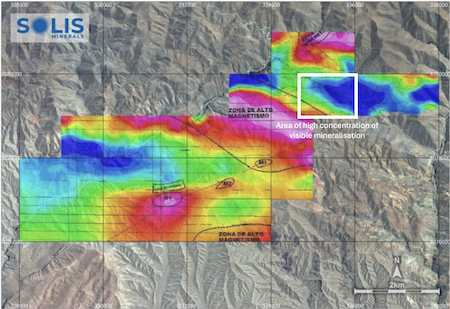
Field magnetic data. High magnetic response in red. Low magnetic response in blue shows probable alteration zones.
Surface and Channel Sampling
Historical workings and surface mapping have confirmed copper mineralisation across an approximate 200m × 100m zone, with grab and channel samples returning grades up to 7.14% copper.
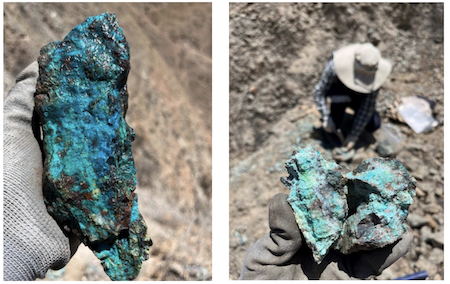
LHS: Cinto surface grab sample 17142 with visible copper oxides and silicification returned 7.14% Cu RHS: Grab sample 17181 (1.0 % Cu) with copper oxides and hyaline quartz from outcrop
Follow-up channel sampling completed in 2025 reported several high-grade intervals, including:
- 23.4m @ 0.88% Cu (Channel 1)
- 16.8m @ 0.52% Cu (Channel 6)
- 26.5m @ 0.28% Cu, including 5.4m @ 1.0% Cu (Channel 11)
Significant structural deformation and abundant visible copper were noted throughout the sampled areas.
Induced Polarisation (IP) Survey
An IP survey completed in July 2025 covered eight lines totalling 16.2 kilometres, collected at 100m dipole spacing and 200m line spacing. Processing and 3D inversion highlighted:
Chargeability anomalies up to 4× background levels, particularly in the northwest of the grid, suggesting elevated sulphide content.
Resistivity contrasts aligning with NW–SE and E–W structural trends associated with the Incapuquio Fault Zone, indicating strong structural controls on mineralisation.
Three large-scale, untested drill targets were outlined from the IP results.
Drilling Program
Drilling will initially focus on areas where high-grade surface geochemistry and channel samples coincide with priority IP anomalies (Figure 3). The final drill sequence will be set following a site visit by Solis Minerals’ technical team and the drilling contractor in the coming days.
Seventeen drill pads have been permitted to provide maximum flexibility as results emerge during the programme. The company expects water permit approval by mid-December 2025. The maiden program comprises approximately 2,500 metres of diamond drilling, or about five holes.
Upcoming assay results from Ilo Este and Chancho al Palo (both 100% Solis Minerals) are expected in December 2025.