
Yandal Resources Ltd (ASX:YRL) has reported a new diamond drilling intercept from the Arrakis prospect that reinforces the depth extent and scale of the emerging mineralised system within its Ironstone Well–Barwidgee Gold Project.
The first full diamond test of the Arrakis mineralisation — hole 25IWBDD0011 — returned 17.7 metres at 1.4 g/t gold from 309.3 metres, including 7.95 metres at 2.5 g/t gold. Estimated true width is 10–14 metres.
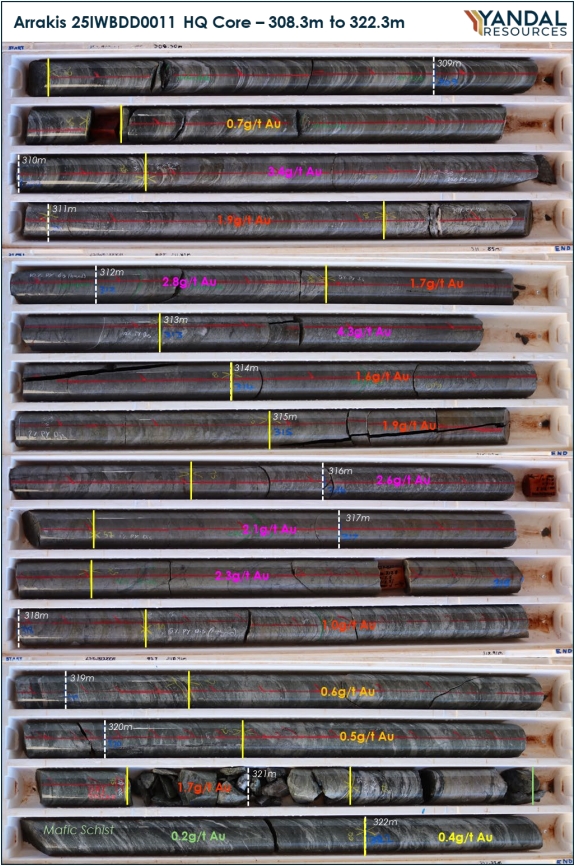
HQ diamond core from 25IWBDD0011 showing the mineralisation intercepted that includes 7.95m @ 2.5g/t Au from 310.25m. Metre marks are shown and annotated in white; sample boundaries are marked in yellow.
The hole intercepted the structure about 120 metres below notable reverse circulation (RC) results released in late November from 25IWBRC0040D and 25IWBRC0041D, which delivered:
- 56.5 metres at 1.3 g/t gold from 108 metres (including 14.75 metres at 3.3 g/t); and
- 37 metres at 0.6 g/t gold from 180 metres (including 6.5 metres at 1.5 g/t).
Read more: Yandal Resources expands Arrakis footprint as diamond drilling confirms 35-metre true widths
The deeper diamond intercept supports the company’s interpretation that mineralisation persists at depth along the 2.2-kilometre Arrakis trend.
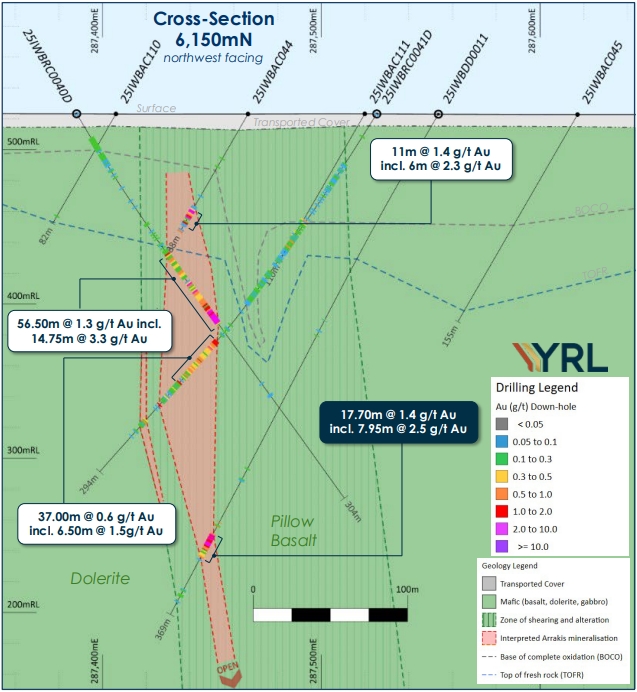
6,150mN cross-section showing all drilling results from 25IWBRC0040D, 25IWBRC0041D, and 25IWBDD0011 with a simple preliminary interpretation of geology. The red mineralisation envelope also represents the interpreted host volcano-sedimentary unit.
Geological model supported by new core
Managing director Chris Oorschot said the result provides an important geological reference point for the program.
“This is an excellent result from our first full diamond test of Arrakis,” he said. “The results, combined with geological observations, validate the recently developed geological model and confirm mineralisation can be readily identified through visual observations within fresh rock.
“The visual nature of mineralisation has enabled the team to test and model the Arrakis mineralised system more effectively during the current RC program.”
Oorschot noted that the grades observed align with those recorded up-dip in 25IWBRC0040D and along strike in 25IWBRC0042, with both broad and higher-grade styles present across the system.
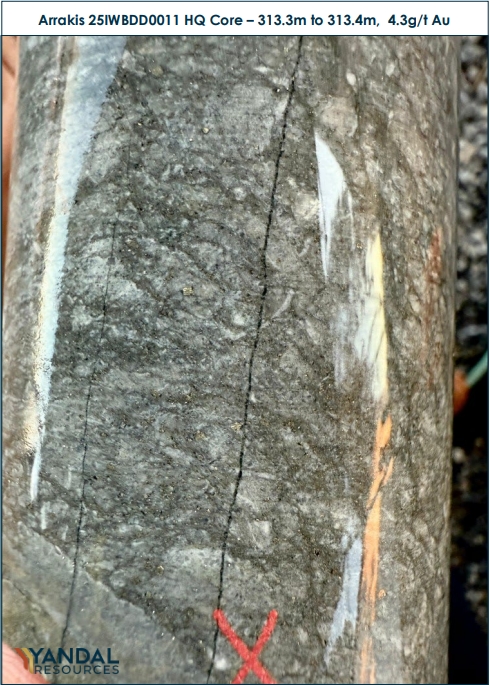
Close-up of mineralisation from 25IWBDD0011 from 313.3m to 313.4m, with the broader interval grading at 4.3g/t Au. HQ core has an approximate diameter of 63.5mm.
Multi-rig RC program ramps up
The intercept forms part of a broader work program involving eight diamond holes (1,931 metres) and a 5,000-metre RC campaign aimed at mapping mineralisation across the entire Arrakis trend.
Around 3,000 metres of RC drilling has been completed since November. The program is systematically testing 200-metre-spaced lines to understand how gold mineralisation varies along strike and with depth.
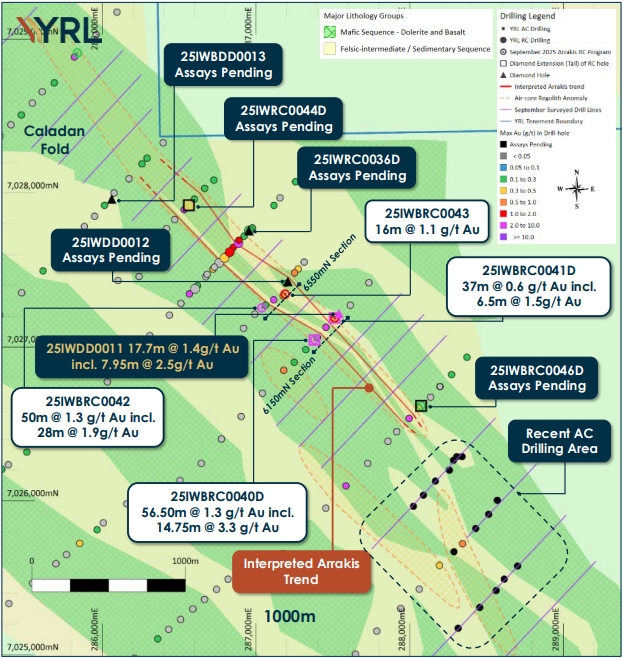
A collar plan over the Arrakis Prospect within the Caladan target area, showing simplified bedrock geology interpretation. All Yandal drilling is plotted (historic drilling has been excluded. Collars are thematically coloured by max Au (g/t) in the hole. The red line represents the approximate position of the interpreted Arrakis mineralised structure over more than 2.2km in strike length. Dashed yellow polygons represent air-core regolith anomalies (Results include ~4m @ 0.1 g/t Au or greater, with the upper profile or the bottom-of-hole sample is 0.1g/t Au or greater).
A second RC rig has commenced drilling to accelerate progress ahead of the Christmas break, with significant assay flow expected through December and January.
Fresh rock mineralisation at Arrakis is associated with a more than 2.2-kilometre trend defined by aircore drilling, remaining open to the southeast with several parallel anomalies still to be evaluated.
Results to date indicate two mineralisation styles:
- a broad, lower-grade zone hosted in altered volcano-sedimentary rocks; and
- a narrower, higher-grade style associated with stronger deformation and silica–pyrite alteration.
Infrastructure in place for expanded 2026 program
To support the increasing activity, Yandal has secured a 21-person transportable camp, scheduled for mobilisation to site in early 2026.
“This significant upgrade to onsite facilities will enable us to accelerate and expand our 2026 drilling and exploration programs,” Oorschot said.
Steady newsflow expected
Yandal remains well funded and anticipates a strong pipeline of results over the coming months, including:
- further assays from the completed Arrakis diamond drilling program;
- ongoing RC drilling results from late December and through January;
- aircore results from lines southeast of Arrakis from mid-December; and
- assays from the New England Granite target area.
Yandal Resources continues to advance its portfolio of gold exploration projects across the Yandal and Norseman–Wiluna greenstone belts of Western Australia.
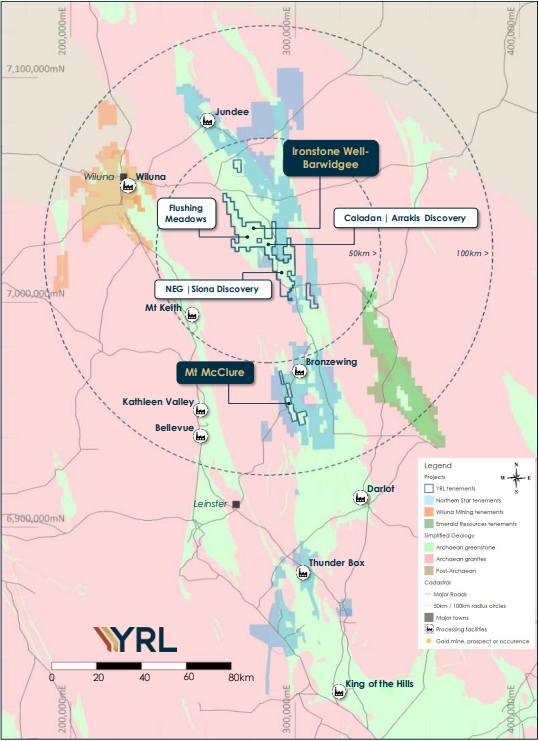
Yandal Resource exploration Project locations within the Yandal Greenstone Belt. The Arrakis Prospect is located within the Caladan target area.