
Lindian Resources Ltd (ASX:LIN, OTC:LINIF) earlier this week confirmed metallurgical results from the Kangankunde rare earths project in Malawi, highlighting high-grade recovery rates and low-radioactivity characteristics.
The company said its monazite concentrate contains 56% total rare earth oxides (TREO), with 20% being neodymium-praseodymium (NdPr), a key component for permanent magnet production. Lindian highlighted that this was “exactly what you want to monetise a rare earth ore body”.
The concentrate was processed using a sulphuric acid and water leach flow sheet, similar to that used by Lynas in Kalgoorlie. Lindian told investors that the tests achieved 94% extraction of rare earths and 97% extraction of NdPr. It said the industry benchmark typically sits at 85%, noting it had delivered a total recovery of 92%.
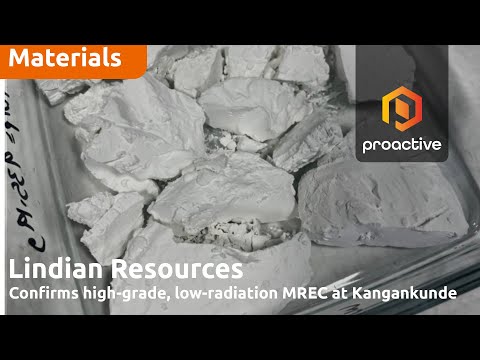
The resulting product is a mixed rare earth carbonate (MREC) containing 54% TREO and is classified as non-radioactive for transport. The company said uranium and thorium levels were both below 0.1% and not detected using standard instruments.
It also stated that levels of actinium-227 — a radionuclide which affects shelf life and handling — were negligible. As a result, the company said its carbonate can be stored long-term without degradation or radioactive waste requirements.
Lindian said the product’s low radioactivity removes the need for Class 7 dangerous goods classification. The company highlighted this could reduce costs and environmental risks for downstream customers.
CEO Zac Komur said the project offers a strategic advantage, with over 300 years of resource life and a low-cost operating profile.
He told Proactive: “Kangankunde is not just an exceptional resource… it’s a core asset in supplying a non-Chinese rare earth supply for decades to come.”
Lindian confirmed it is completing optimised test work with ANSTO to finalise reagent consumption data.
Proactive:
Welcome back to Proactive Newsroom. I'm now joined by Lindian Resources CEO Zac Komur. Zac, good to have you on here today.
Zac Komur:
Thanks for having me, Fouad.
Proactive:
Zac, there's been new confirmations out to the market this morning in regards to your monazite concentrate at the Kangankunde rare earths project in Malawi. What exactly is this all about and what have you confirmed to the market?
Zac Komur:
So what the Australian Nuclear Science and Technology Organisation (ANSTO) has shown is that Kangankunde is exactly what you want to monetise a rare earth ore body.
First, the feed is exceptional. What we produce at Kangankunde in Malawi is a monazite concentrate, which is about 56% total rare earth oxides. Of that, 20% is NdPr, which are the value-adding rare earths used in magnets.
Secondly, we’ve put that through a conventional sulphuric acid and water leach process, the same as the refinery Lynas uses in Kalgoorlie. We achieved 94% extraction of the rare earths, and 97% extraction of NdPr. Normally, industry benchmarking sits at about 85%. We achieved 92% total recovery.
Thirdly, it's a premium-grade concentrate that we've produced — a mixed rare earth carbonate (MREC), which has 54% total rare earth oxides, 20% NdPr, and exceptional grades for magnet applications.
Finally, it's ultra-low in uranium and thorium, which is undetected using standard instruments. So we’ve produced high-grade MREC with ultra-low radiation, through a conventional flow sheet. That reduces downstream processing risks for our customers.
Proactive:
And Zac, the concentrate you're reporting on now is classified as non-radioactive for transport. What advantage does that hold?
Zac Komur:
If you benchmark us against others, three things stand out.
Firstly, we’re producing a premium-grade concentrate for the market, and we’ve proven this with test work.
Secondly, our impurities and radionuclide levels are lower than others — uranium and thorium are both below 0.1% in the MREC.
Also, there's a radionuclide called actinium-227. That’s negligible in our product. Normally, if actinium is present, it degrades over time and creates radioactive waste. Because we don’t have that issue, our product has a longer shelf life and fewer ESG complications.
So there’s lower capex, lower opex, and less ESG headache for downstream parties.
Plus, we don’t require a Class 7 dangerous goods shipping label for our product — it opens many doors for Western-aligned parties and ourselves.
Proactive:
It opens many doors and gives Kangankunde a boost on multiple fronts, as you've just highlighted there Zac. But what does it actually mean for Kangankunde in the long run?
Zac Komur:
Strategically, it means Kangankunde is not just an exceptional resource with a long life — over 300 years — but we are a low-cost producer of NdPr-rich feed into the global supply chain.
We’ll finish the optimised test work with ANSTO to lock in reagent consumption for our customers and ourselves.
It’s a core asset in supplying a non-Chinese rare earth supply for decades to come, with a proven premium-grade product to market.
Proactive:
Lindian Resources CEO Zac Komur, thank you so much for those updates. It’s been great having you back.
Zac Komur:
Thanks a lot.