
Provaris Energy Ltd (ASX:PV1, OTC:GBBLF) has completed commissioning of its robotic welding cell in Norway, with welding rates on the H2 Prototype Tank ramping up. The company has also hosted strategic partners for both its H2 and CO2 programs on site, is leveraging learnings and IP from the H2 Prototype Tank for its CO2 FEED program, and has released a video update from its CEO and CTO.
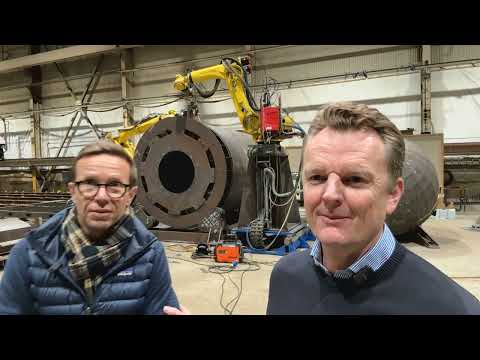
Commissioning complete and site visit by “K” Line, Yinson and Harbour Energy
With all commissioning activities for the installed robotic cell now complete, fabrication of the H2 Prototype Tank is underway using robotics for plate handling and laser-welding. Welding rates for the layered plate design will ramp up through December 2025 to support Provaris’ target to complete fabrication in the 1st quarter of 2026 and move into testing.
Successful completion of an extensive pressure-testing program will be a key milestone toward final Class approvals for the H2Neo carrier.
In November, an early Norwegian winter welcomed a delegation to the Robotics Innovation Centre at Fiskå, on the west coast of Norway. The visit showcased the installed robotic cell and demonstrated robotic automation for plate-handling and laser-welding of what Provaris describes as a world-first H2 prototype tank.
This first site visit by technical and commercial teams included management from “K” Line (Kawasaki Kisen Kaisha, Ltd), Yinson Production AS, Harbour Energy Plc and advisers Clarksons Norway AS. Provaris says the collaborations across its H2 and CO2 programs underline the relevance of its transport and storage solutions.
The robotic cell is positioned as a showcase of Provaris’ design and fabrication approach, supporting Norway’s ambitions to be an early-mover in industrial H2 supply and maritime transport to Germany. In parallel, Norway is seeking to build its role as a key hub for storage and injection of Europe’s captured CO2, with large-scale solutions for both H2 and CO2 seen as critical to unlocking these markets.
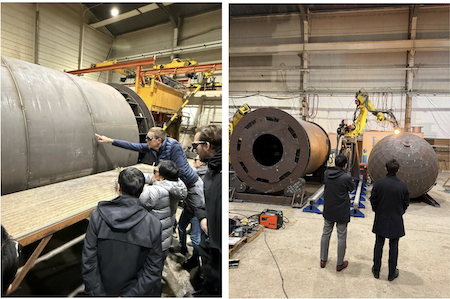
Innovation Centre site visit November 2025.
“K” Line to drive commercialisation of H2Neo
Provaris continues to deepen its partnership with “K” Line under an existing MOU, with technical and commercial work programs advancing. A three-day visit to Norway in November was used to further “K” Line’s understanding of the Norwegian market and Provaris’ technical program.
Workshops covered technical, operational and commercial development areas for H2 shipping as the parties work toward defining fleet ownership structures and commercial terms for hydrogen carriers targeted for 2026.
Provaris’ in-house technical and shipping expertise, combined with “K” Line’s global ship operations and financial strength, is being supported by verification of the robotics facility. According to the company, this gives shipyards, H2 suppliers and offtake stakeholders confidence in the use of advanced automation and robotic laser and laser-hybrid welding to build large carbon-steel tanks using proven technologies.
CO2 FEED program leverages H2 tank learnings
Provaris is well advanced in the FEED design phase for a 25,000 cbm low-pressure LCO2 tank to be integrated with Yinson’s FSIU for offshore storage and injection. The recent site visit was an important verification step for Yinson management and their CO2 supply chain partners “K” Line and Harbour Energy, allowing them to visualise the layered tank design being transferred from the H2 Prototype Tank to the CO2 tank and to see first-hand the fabrication of large steel plates.
The company considers its CO2 tank designs to be a potential game-changer for achieving the scale and cost targets required for CO2 storage, injection and marine transport.
Further updates on the FEED project with Yinson will be provided in line with interim milestones, with the main target to be “FID ready” by mid-2026. In parallel, Provaris and Yinson have begun consultations with Asian shipyards to assess feasibility and cost for constructing the full-scale CO2 tank design.