
St George Mining Ltd (ASX:SGQ) has highlighted growing state and local backing for its 100%-owned Araxá niobium–rare earths project in Minas Gerais, Brazil, following a well-attended Open Day and Critical Minerals Forum held on December 1.
More than 200 representatives from state and municipal governments, community organisations, industry bodies and project partners joined the event in the city of Araxá, underscoring what the company says is deepening stakeholder engagement around one of South America’s most significant emerging critical minerals projects.
The forum was headlined by Minas Gerais Governor Romeu Zema — himself an Araxá local — who spoke of the project’s importance for regional economic diversification and Brazil’s broader ambitions in critical minerals.
Governor Zema endorses ‘mining 2.0’
Governor Zema praised St George’s investment and approach to sustainability, describing the company’s work as part of a new era of mining.
“Mining is experiencing a new cycle, with much more responsibility,” he said. “Technology makes it possible to reduce impacts, increase safety and recover tailings as much as possible. And that's what St George is doing: mining 2.0.”
The State Government’s support builds on a cooperation agreement signed in late 2024, under which Minas Gerais will assist with expediting approvals in recognition of the project’s strategic value.
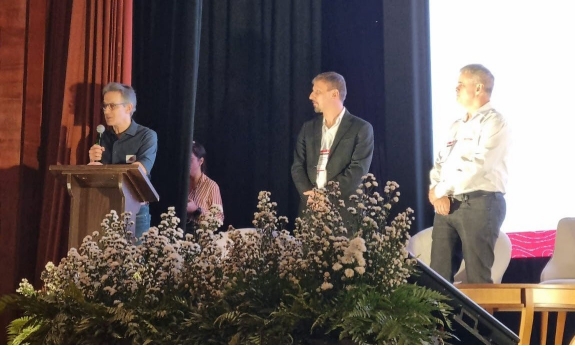
Minas Gerais Governor Romeu Zemo addresses the St George Open Day and Critical Minerals Forum at Araxá, watched by St George in-country leaders Thiago Amaral (2nd from left) and Adriano Rios (3rd from left).
Community leaders highlight benefits for Araxá
Local officials also used the forum to acknowledge the economic and social opportunities tied to the project, which sits within the well-established Barreiro Carbonatite — home to CBMM’s globally significant niobium mine and Mosaic’s large phosphate operation.
Araxá Mayor Robson Magela emphasised the importance of long-term job creation and local investment, while education leaders welcomed St George’s backing of new training and research initiatives, including a pilot plant being developed with CEFET MG for downstream processing of rare earths and niobium.
“Education, with research and training, is fundamental for the innovation ecosystem,” said CEFET professor Birgit Yara Frey Riffel.
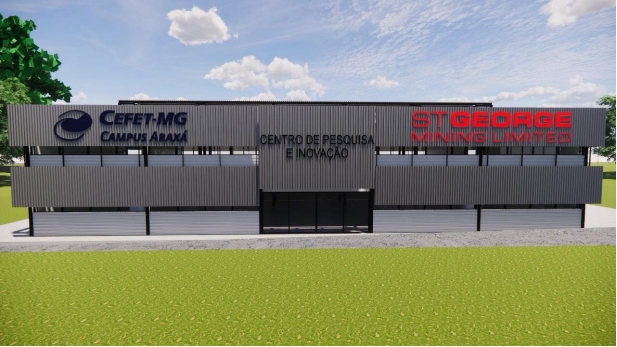
A model of the St George Technological Centre to be built by St George in collaboration with CEFET MG.
A globally significant resource
St George acquired the Araxá Project in February and quickly confirmed its scale, unveiling a maiden JORC resource of 40.6 million tonnes at 4.13% TREO, making it the largest and highest-grade carbonatite-hosted rare earths resource in South America and the second-highest-grade rare earths deposit in the Western world.
A complementary niobium resource totals 41.2 million tonnes at 0.68% Nb₂O₅.
Read more: St George extends high-grade rare earth footprint with new assays from Araxá
Executive chairman John Prineas said the event was designed to cement transparent and collaborative relationships as the project advances toward key development milestones.
“Our goal at the Araxá Project is to create value for all stakeholders by committing to the highest levels of social and environmental responsibility,” he said. “The St George Forum was arranged with this principle in mind — and particularly to further engage with government and community leaders and establish open and respectful relationships as we progress the development of our world-class rare earths and niobium resource.
“It was an honour to host Governor Zema, who has been a strong advocate for new critical mining projects needed to establish a resilient critical minerals supply chain in Brazil.”
Prineas added that Araxá’s high-grade carbonatite geology — the same style as Mountain Pass and Mt Weld — supports a relatively small environmental footprint, while the region’s long mining history and absence of affected Indigenous groups reduce permitting complexity.
Progress on drilling, partnerships and studies
The company’s in-country team updated attendees on 2025 achievements, including:
- completing the Araxá acquisition;
- participating in Brazil’s MagBras Mine-to-Magnet initiative;
- forming an education and pilot plant partnership with CEFET MG;
- completing more than 10,000 metres of drilling to expand the resource;
- advancing environmental studies towards permitting; and
- raising funds to progress the project to a final investment decision.
St George has also established partnerships with government-backed research agencies EMBRAPII and SENAI to assess innovative processing technologies.
With strong government alignment, community support and an expanding high-grade resource base, St George remains confident in delivering on its “vision for a globally significant rare earths and niobium mine at Araxá”, Prineas said.