
Critical Resources Ltd (ASX:CRR) has finalised the acquisition of the Cap Burn Gold Project in New Zealand’s South Island, securing Ministerial consent for the permit transfer and completing the handover of a key land access agreement that clears the way for drilling to begin in the coming weeks.
The company now has full legal and beneficial ownership of Cap Burn through its subsidiary, Goldfire Resources Ltd, with consideration comprising a 1.5% net smelter royalty payable to the vendors.
The project sits within the underexplored Otago Schist Belt — a region that has gained fresh attention following major discoveries by Santana Minerals and ongoing production at OceanaGold’s +10-million-ounce Macraes gold camp, roughly 11 kilometres to the southeast.
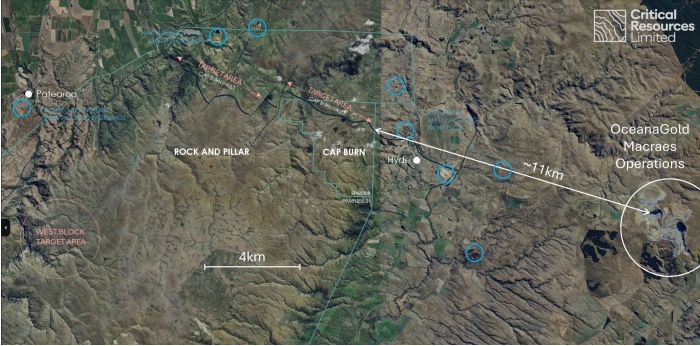
Cap Burn Project location ~11km from OceanaGold Macraes Gold Operations with major and minor interpreted structures.
Drilling to start shortly
With approvals in place, CRR has locked in drill sites and engaged Ecodrilling NZ as its preferred contractor, expected to mobilise shortly. The first phase of work will target about 1 kilometre of strike beneath a large arsenic-in-soil anomaly, interpreted as the surface expression of the Cap Burn Fault.
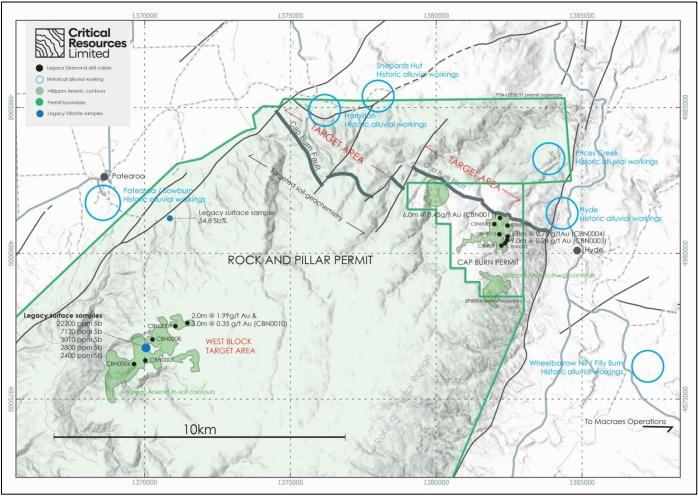
Cap Burn and Rock and Pillar Projects – legacy drilling targeting arsenic-in-soil anomaly.
“We are very pleased to announce the completion of the Cap Burn Gold Project acquisition, marking a significant step forward for Critical Resources in New Zealand,” managing director Tim Wither said.
“With Ministerial consent secured and land access agreement transfer finalised, we are now ready to commence our inaugural drilling program at Cap Burn. Our drill contractor Ecodrilling NZ is scheduled to mobilise to site in the coming weeks, ensuring rapid progress on exploration activities.”
He added that stakeholder support and close coordination with the station landowners would remain central as fieldwork ramps up.
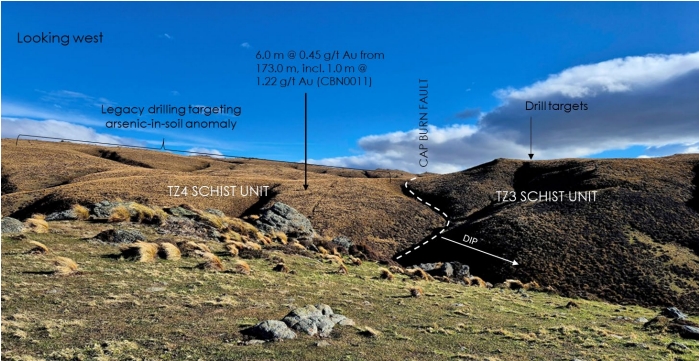
Cap Burn Project – looking west along the Cap Burn fault.
A geological analogue to major deposits nearby
Cap Burn is positioned along the same structural corridor as Macraes and the 2.3-million-ounce Bendigo–Ophir project, with previous geophysics and mapping identifying major northwest–southeast shear zones believed to host orogenic gold systems.
Earlier work defined a >1 km² arsenic-in-soil anomaly (20–150 ppm As) coincident with a strong EM boundary interpreted as the trace of the Cap Burn Fault. Limited legacy drilling in 2020 intersected low-grade gold within foliation-parallel shear zones, supporting a geological model similar to early-stage results once seen at Santana Minerals’ Rise and Shine deposit.
Rise and Shine has since emerged as New Zealand’s most significant gold discovery in four decades, with drilling in 2021 returning 16.5 metres at 8.9 g/t gold and reshaping understanding of the Otago Schist Belt’s mineral systems.
CRR believes the same down-plunge structures that control Rise and Shine mineralisation may be present at Cap Burn, but they remain untested at depth — providing an immediate focus for its upcoming reverse circulation drill program.
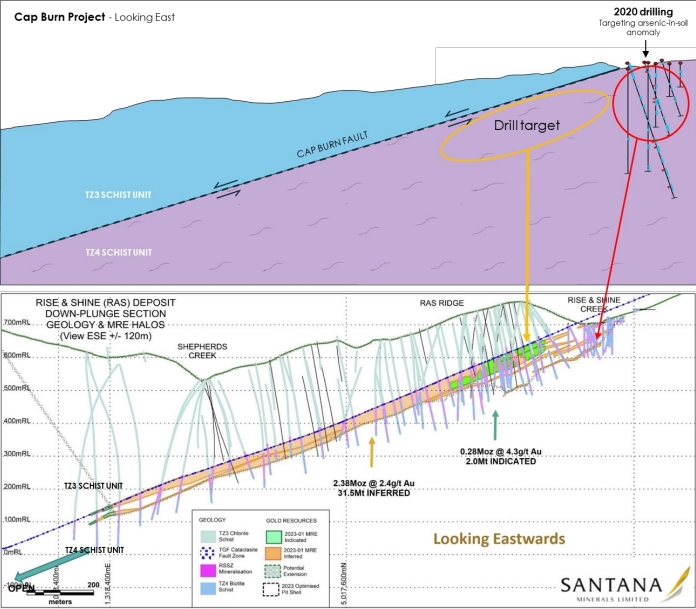
Cap Burn Project cross-section (top) – conceptual down-plunge target at Cap Burn with comparison to Santana Minerals Rise and Shine cross-section (bottom) (Santana Minerals (ASX:SMI) August 2023 investor presentation. slide 9) (note: cross-sections are not to the same scale).
Building a broader New Zealand gold portfolio
The company’s foothold in Otago is set to expand further, with permit transfers underway for Tokomairiro, Lammerlaw, Croesus, Silver Peaks and Rock & Pillar. Once completed, field mapping and geochemical sampling will begin across the wider portfolio.
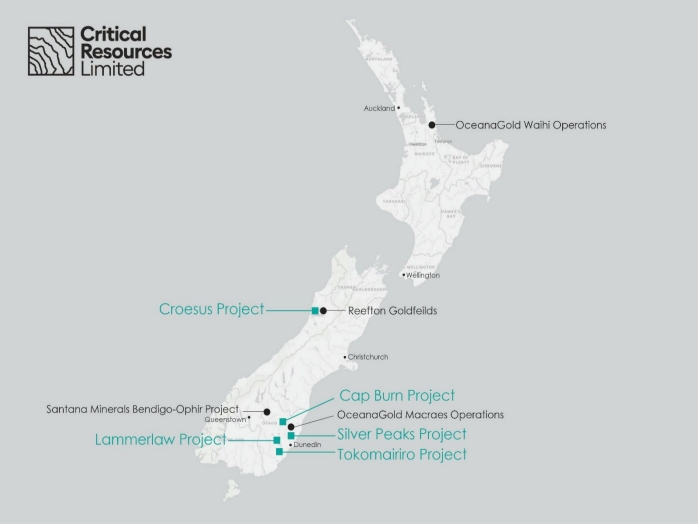
Location of acquired New Zealand projects (Green) with major gold mining projects.
CRR says Cap Burn and its adjoining permits offer a low-cost entry into a multimillion-ounce-producing region with renewed exploration interest, adding near-term work programs and long-term growth potential to the company’s diversified asset base.
“We look forward to updating shareholders as drilling begins and to advancing our strategy to deliver multi-cycle value across our global assets,” Wither said.