
Resolution Minerals Ltd (ASX:RML, OTC:RLMLF) has unveiled another strong set of assays from its maiden drilling program at the Horse Heaven Gold-Antimony-Tungsten-Silver Project in Idaho, United States, with new diamond holes returning broad, near-surface gold mineralisation that confirms a large intrusion-related gold system (IRGS) at the Golden Gate prospect.
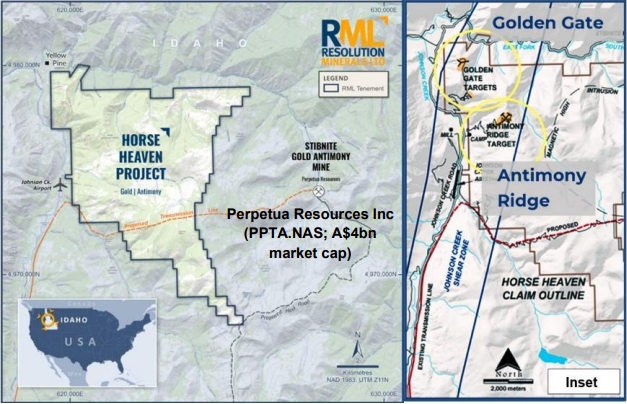
Horse Heaven Project location map, highlighting the location of the two current major antimony-gold-silvertungsten targets, the Golden Gate Target (where the Phase 1 Core Drilling Program was conducted) and the Antimony Ridge Target. Also highlighted is the fully-permitted Stibnite Gold Project, which is only 6km east of Horse Heaven.
The latest results — from three new diamond holes plus extended assays from an earlier hole — establish continuous gold mineralisation over a 600-metre strike at Golden Gate North, with every hole ending in mineralisation and the system remaining open along strike, to the east and at depth.
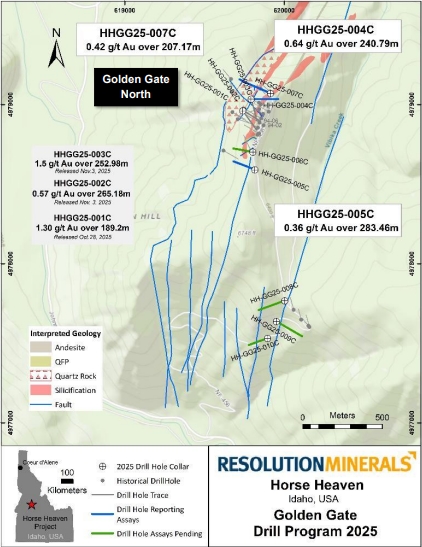
Drill hole location and simplified geology map of the Golden Gate 2025 drill program of the Golden Gate Prospect. Drill holes HH-GG25-004C, HH-GG25-005C, and HH-GG25-007C are located at the northern part of the Golden Gate Prospect, now referred to as the Golden Gate North Prospect. HH-GG25-005C is the southern most of the 2025 program at Golden Gate North, and HH-GG25-007C is the northern most of the 2025 program at Golden Gate North. They are approximately 500m apart.
The six diamond holes now reported form part of a much larger 57-hole program testing a 3-kilometre strike length at Golden Gate as Resolution advances one of the most closely watched new gold discoveries in the Stibnite Mining District.
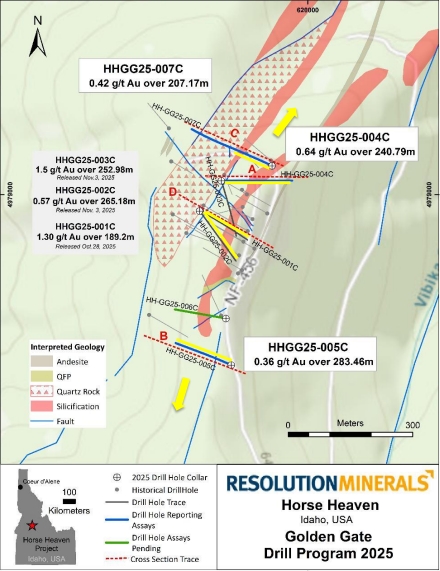
Drill hole location and simplified geology map of the Golden Gate North Prospect. The gold mineralised intervals are projected to surface and highlighted (solid yellow lines) along the drill stems of the reported holes, HH-GG25-001C, HH-GG25-002C, HH-GG25-003C, HH-GG25-004C, HH-GG25-005C, and HH-GG25-007C. Solid yellow arrows indicate the direction is which the mineralisation is considered open. There is a close spatial relationship with silicification, local faults and lithologies.
Long intervals from surface
Headline intercepts from the latest batch include:
- HH-GG25-004C: 240.8 metres at 0.64 g/t gold from surface to end-of-hole, including 61.6 metres at 0.98 g/t from 40.5 metres and 35.8 metres at 0.83 g/t from 119.5 metres.
- HH-GG25-005C: 283.5 metres at 0.36 g/t gold from surface, including 42.5 metres at 0.72 g/t from 65.7 metres.
- HH-GG25-007C: 207.2 metres at 0.42 g/t gold from surface, including 3.7 metres at 2.65 g/t from 176.5 metres.
- HH-GG25-001C (updated): now 197.5 metres at 1.26 g/t from 34 metres, confirming the hole is mineralised to its end.
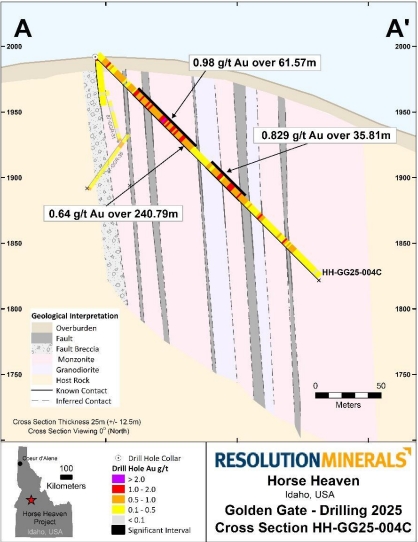
Schematic cross section of HH-GG25-004C showing the local geology, highlighting the significant gold intersections, and pre-RML RC drill holes intersections draw into the plane of the cross section. The cross section shows how the pervasive gold mineralisation of HH-GG25-004C traverses a repeating sequence of near-vertical fault breccias, within a structurally-bound monzonites and granodiorites.
These results build on earlier standout intercepts including 253 metres at 1.50 g/t from surface in HH-GG25-003C — featuring 18.3 metres at 3.98 g/t and a peak assay of 5.91 g/t — and 265.2 metres at 0.60 g/t from surface in HH-GG25-002C.
Resolution says the consistency of the long, open-ended intervals across multiple holes supports interpretation of a sizeable IRGS hosted within the Golden Gate shear zone, a regional structure known to localise mineralisation in the Stibnite district.
Large-scale potential emerging
CEO of US Operations Craig Lindsay said the latest results “materially advance our understanding of Golden Gate”.
“We now have six diamond core holes, all returning broad, continuous gold mineralisation at or near surface, and several of them end in mineralisation. Together they define a large intrusion-related gold system of at least 600 metres of strike that is open along strike, the east and at depth,” he said.
Lindsay emphasised that the six holes reported so far cover only a fraction of the 3-kilometre strike length under assessment and noted that Resolution recently secured a 25-acre processing and infrastructure site adjoining Horse Heaven, positioning the company for potential future gold-antimony-tungsten processing in the district.
“Golden Gate sits only 6 kilometres from the fully permitted Stibnite Gold Project and alongside the processing site we are in the process of acquiring,” he said. “That combination of scale potential, district infrastructure and a clear path to downstream processing gives us confidence that Horse Heaven can grow into a significant multi-commodity project for Resolution and its shareholders.”
Program advancing with more assays to come
All 10 Phase 1 diamond holes at Golden Gate have now been drilled, with assays pending for HH-GG25-006C at Golden Gate North and for holes HH-GG25-008C to HH-GG25-010C in the southern portion of the prospect.
Reverse circulation drilling has also been completed, with four shallow holes awaiting laboratory results.
Resolution lead geologist Austin Zinsser said the latest step-out drilling results “support the definition of a significant intrusion-related gold system with multiple similarities to those at Perpetua’s Stibnite Gold Project”.
Resolution plans to complete roughly 45 additional holes in 2026, covering around 2.5 kilometres of strike as it advances Golden Gate towards a district-scale resource opportunity.