
Astral Resources NL (ASX:AAR) has wrapped up a major in-fill drilling program at its flagship Mandilla Gold Project near Kalgoorlie in Western Australia, delivering a consistent suite of high-grade results that strengthen confidence in the proposed Stage 1 starter pit at the Theia deposit.
The 99-hole reverse circulation (RC) campaign — drilled on tight 12-by-12-metre spacing across an 80-by-120-metre panel — returned an average 52.2 gram-metres per hole and an average grade of 1.93 g/t gold across all reported intervals. Astral says the results validate the geological interpretation underpinning its Mandilla Pre-Feasibility Study (PFS), which outlines Theia as the primary engine room of the planned development.
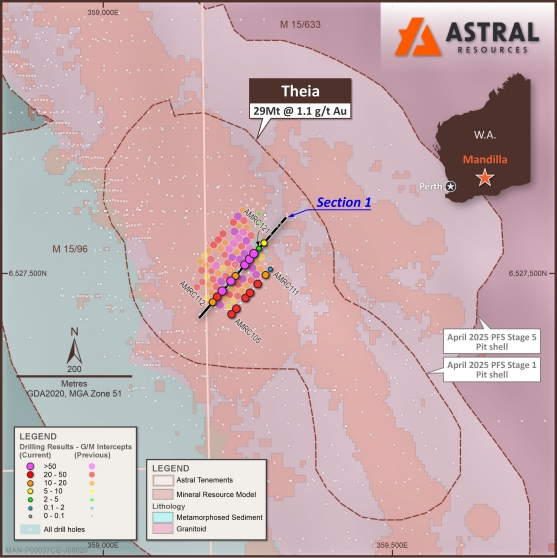
Map of Theia illustrating drill collar locations of recent and historical drilling on local area geology.
Managing director Marc Ducler said the program had “delivered exceptional results”, noting it had achieved exactly what it was designed to do: reduce risk and firm up near-term ounces in the first stage of mining.
“These latest results have continued to confirm wide zones of high-grade mineralisation within the Stage 1 Theia open pit,” Ducler said. “Bonanza grades were also a feature, including 1m at 184.7g/t Au, 2m at 63.8g/t Au, 1m at 35.0g/t Au, 1m at 28.4g/t Au and 1m at 25.2g/t Au.”
Final batch continues strong run of results
Assays for the last 17 holes (2,018 metres) extend the strong trajectory established across earlier batches reported in September, October and November. Standout intercepts include:
- 21 metres at 7.13 g/t gold from 40 metres, including 2 metres at 63.8 g/t (AMRC120);
- 4 metres at 46.8 g/t from 130 metres, including a 1-metre hit grading 184.7 g/t (AMRC116);
- 43 metres at 2.46 g/t from 48 metres with multiple high-grade 1-metre intervals above 10 g/t (AMRC118);
- 28 metres at 3.38 g/t from 102 metres, including 1 metre at 35.0 g/t (AMRC115); and
- 33 metres at 2.21 g/t from 44 metres (AMRC119).
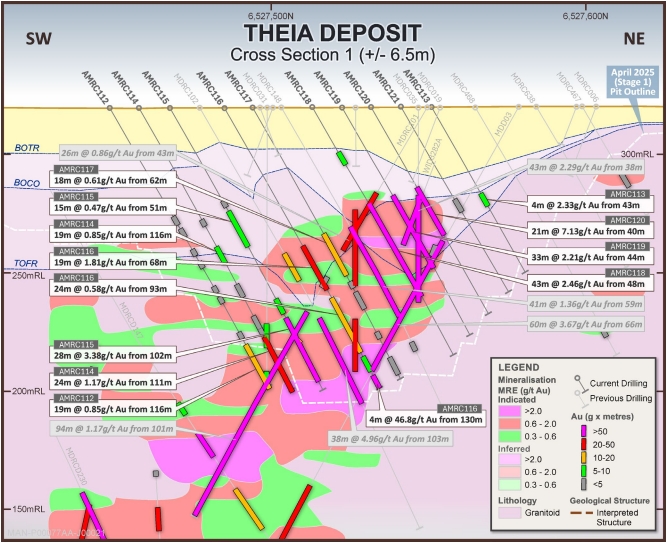
Cross-section through Theia illustrating drill trace, assay results and geological interpretation.
Astral reports a strong correlation between the in-fill results and its 2025 Mineral Resource Estimate (MRE), reinforcing the robustness of the high-grade core that feeds the Stage 1 production profile.
The Stage 1 pit — 4.2 million tonnes at 1.1 g/t for 146,000 ounces over the first 21 months — sits within Theia’s larger 1.2-million-ounce resource and remains central to Mandilla’s economics. As outlined in the PFS, Theia contributes roughly 75% of total project ounces.
Broader drilling and DFS work advancing
Beyond the in-fill program, drilling activity remains steady across both Mandilla and Feysville.
At Theia, diamond drilling has wrapped up with assays pending for work targeting the interpreted “230 shear” and a potential sub-parallel mineralised structure to the east. Astral says visual inspection has already confirmed an intensely sheared zone, with two holes also showing signs of Theia-style mineralisation.
Meanwhile, nine of 11 RC holes have been drilled at the emerging Theia West target, where a gap between earlier holes AMRC132 and AMRC133 is being tested along strike.
At Feysville, a 17-hole program at the Kamperman deposit has finished, designed to tighten spacing across known high-grade zones and probe possible parallel vein systems. Assays are also pending.
Astral’s diamond rig has now shifted to geotechnical drilling at Hestia and Eos to support the ongoing Definitive Feasibility Study (DFS), due for completion in 2026.
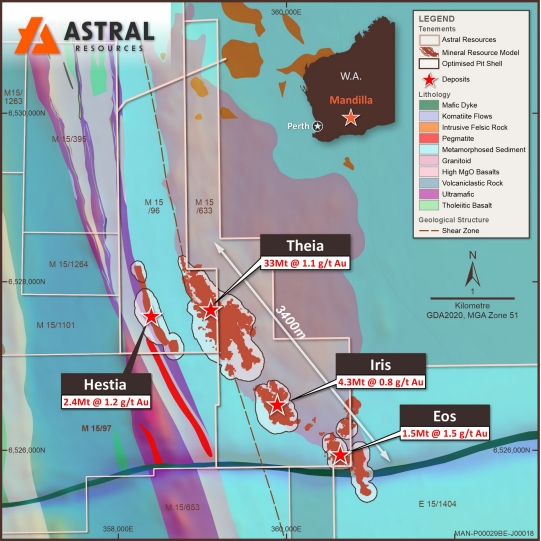
Map of Mandilla Gold Project on local area geology.
Ducler said drilling will pause for a short Christmas break, with activity scheduled to conclude on December 22 and resume in early January.