
Lindian Resources Ltd (ASX:LIN, OTC:LINIF) has reported another milestone in its downstream program, with new test work from Australia’s Nuclear Science and Technology Organisation (ANSTO) confirming that monazite concentrate from the Kangankunde Rare Earths Project in Malawi cracks cleanly under conventional processing to produce a high-grade, ultra-low-radiation mixed rare earth carbonate (MREC).
The results support a simple and scalable flowsheet that delivers high recoveries of key magnet rare earths — particularly neodymium and praseodymium (NdPr) — and position Kangankunde as a premium feedstock for downstream processors seeking specification-ready material that avoids the cost and complexity of radioactive-material handling.
Premium monazite concentrate validated
Head assays on the composite concentrate confirmed a grade of 55.9 percentage by weight (wt%) total rare earth oxide (TREO) (46.5 wt% TREY, or total rare earth elements plus yttrium), including NdPr at 20% of TREY and monazite at 83 wt% in the concentrate. Importantly, the material is classified as non-Class 7 for transport — meaning radiation levels are low enough that it does not fall under the UN’s Class 7 hazardous-materials code for radioactive substances.
Avoiding Class 7 designation is a meaningful commercial advantage: it enables simpler logistics, reduces packaging and transport requirements, lowers regulatory compliance burdens and widens the pool of potential buyers who may prefer, or require, non-radioactive feedstocks.
The concentrate also carries ultra-low uranium (0.003 wt%) and thorium (0.10 wt%), with specific activities of just ~0.3 becquerels per gram (Bq/g) and ~4.1 Bq/g respectively, underpinning broader customer acceptance and reducing compliance complexity across the value chain.
High recoveries using standard acid-bake route
ANSTO’s sighter program used a conventional sulphuric acid bake followed by ambient-temperature water leach. Across three tests, TREY extraction reached 91–94%, with NdPr extraction of 93–97%. More than 90% of rare earths dissolved within the first hour, demonstrating fast kinetics and a broad operating window.
The downstream impurity-removal sequence delivered clean filtrates suitable for final carbonate precipitation. Rare earth precipitation efficiencies exceeded 99.9%, producing an MREC grading 45 wt% TREY (54 wt% TREO including Y₂O₃) with Nd₂O₃ + Pr₆O₁₁ of 10.7 wt%. All base-metal impurities were at or below specification limits.
Radionuclides in the final MREC were below analytical detection limits, and Ac-227 activity was negligible (~0.02 Bq/g). With virtually no uranium or thorium present, the non-Class 7 material classification means downstream separation plants would not need specialised radioactive-material handling infrastructure — a rarity for monazite-derived products.
Combined acid-bake, leach and precipitation steps point to overall recoveries of 92% TREO and 97% NdPr, capturing nearly the full magnet-rare earth element value in the feed.
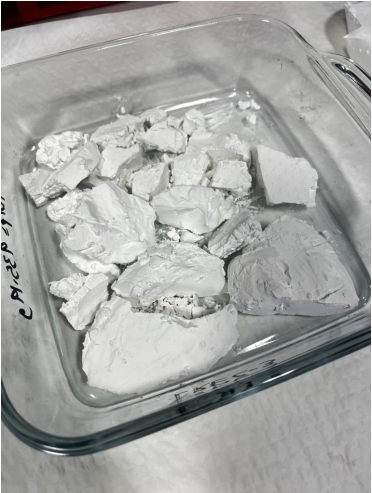
High-grade mixed rare earth carbonate (MREC) produced from Kangankunde monazite concentrate during ANSTO testwork, dense, low-radionuclide product.
‘Exactly what customers and partners are looking for’
Executive director Zac Komur said the results reinforce Kangankunde’s credentials as a premium feedstock.
“We have produced a high-grade, ultra-low-radiation MREC grading 54% TREO, 20% NdPr with 97% NdPr recovery from concentrate to MREC. The low thorium and uranium in concentrate and MREC means downstream separation plants can meet their radionuclide specifications without complex U/Th management,” Komur said.
“At the same time, acid consumption is already in a competitive range, and ANSTO’s next program is targeting further reductions while keeping recoveries at the top end,” he said, adding that Lindian is also benchmarking a refined caustic-conversion route for offtake optionality.
“Put simply, these results show Kangankunde can deliver a premium, specification-ready MREC using a standard flowsheet, with high recovery, low complexity, low radionuclides and strong REE exposure — exactly what customers and partners are looking for.”
Next steps
ANSTO will now optimise acid consumption, advance near-plant-scale impurity-removal and precipitation tests, complete the caustic-conversion route benchmarking, and run variability testing on additional concentrate samples.
Lindian says these results will feed directly into offtake and partnership discussions as it progresses Kangankunde towards commercial downstream readiness.