
Kali Metals Ltd (ASX:KM1) has kicked off its maiden gold drilling campaign at the Marble Bar Gold Project in Western Australia, after completing the necessary approvals and securing a drill contractor. The project sits in the eastern Pilbara, about 10 kilometres east (20 kilometres by road) of the town of Marble Bar and more than 10 kilometres north of the Klondyke Gold Project.
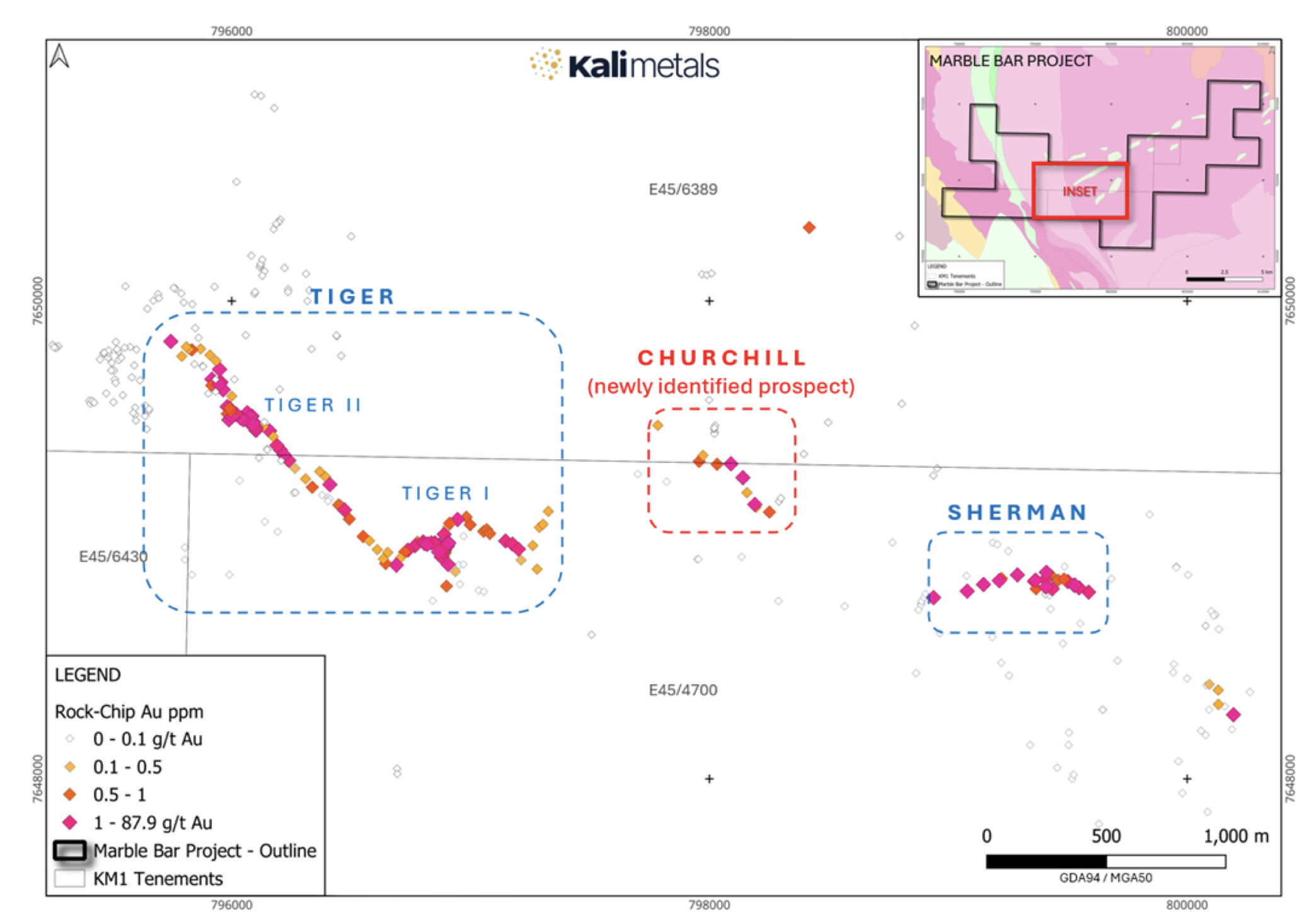
Marble Bar Gold Project – Three prospects with rock chip locations and grade ranges.
The company finalised approvals for the initial drill program following the lodgement of a Program of Works (PoW) with the Department of Mines, Petroleum and Energy (DMPE) in August 2025. The PoW was subsequently referred to the Department of Biodiversity, Conservation and Attractions (DBCA) for review. Recommendations from both the DBCA and DMPE have now been met, allowing Kali to move ahead with its Phase I drilling.
A drill contractor was engaged immediately after the PoW approval was received, with the rig arriving on site on Tuesday, November 25, and drilling starting on Thursday, November 27. The program is described as Kali’s first drill test of what it regards as a virgin gold discovery at Marble Bar.
Priority prospects
Drilling is targeting three priority prospects — Tiger, Sherman and Churchill — where Kali has mapped and sampled a cumulative 3-kilometre strike length of gold mineralisation at surface. Rock chip sampling across this trend has returned an average grade of 2.2 g/t gold, with peak values recorded up to 87.9 g/t gold at the Sherman prospect, reinforcing the decision to focus the initial work program on these areas.
Phase I drilling will comprise between 1,000 and 1,500 metres of shallow holes designed to test outcropping mineralisation and probe for down-dip extensions and potential parallel zones. Heritage surveys over the prospects were completed earlier in the year, clearing the way for on-ground work once regulatory approvals were in place.
With drilling now underway, Kali expects first assay results from the Marble Bar Gold Project within three to four weeks.