
Atomic Eagle Ltd (ASX:AEU) began trading on the Australian Securities Exchange yesterday, following the completion of a merger between ASX-listed Tombador Iron (ASX: TI1) and TSX-V-listed GoviEx Uranium (TSX-V: GXU). The transaction created an ASX-listed mineral resource company focused on the exploration and development of uranium assets in Africa, anchored by the 100%-owned Muntanga Uranium Project in Zambia as its core asset.
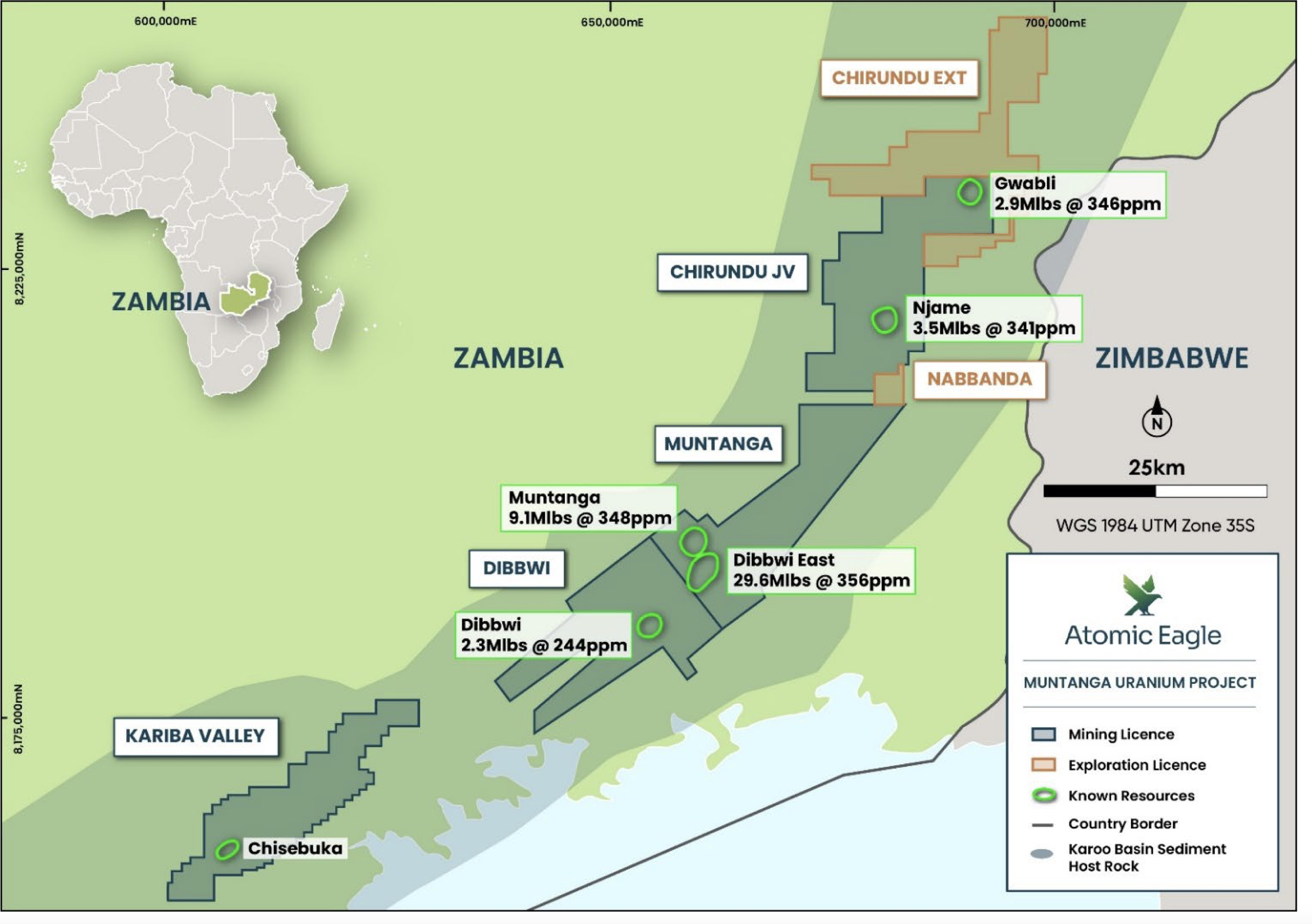
Muntanga Uranium Project location in Zambia.
The company entered the market with a strong balance sheet after completing a $10 million re-compliance capital raising (before costs), which, together with existing cash, delivers a current cash position of about $20 million. These funds will be directed towards advancing exploration across the broader Muntanga Project area in Zambia, where Atomic Eagle aims to build on previous work and define the project’s potential.
Matador Capital, the group behind the establishment of uranium developers Lotus Resources Ltd and Boss Energy Ltd, played a key role in structuring the merger and shaping Atomic Eagle’s strategy. Matador is continuing its involvement through both investment and technical support, with its co-founder Grant Davey engaged as a strategic advisor to the company.
“Combining Tombador and GoviEx to create Atomic Eagle provides a new chapter to lead development of the Muntanga Uranium Project in Zambia. The project has already secured mining permits and also offers a vast exploration upside over the broader project area which we are keen to pursue,” chairman Govind Friedland said.
“With a strengthened financial position and a new team set to execute a reinvigorated strategy, we are excited to take this step in commencing ASX trading and look forward to keeping the market up to date on our exploration and development plans over the coming months.”
High-level uranium experience
Atomic Eagle’s board and management team bring extensive uranium and resources sector experience. Former Lotus Resources managing director Keith Bowes has joined the board as a non-executive director alongside Stephen Quantrill and Eric Krafft, while Govind Friedland serves as non-executive chairman. This mix of technical, corporate and capital markets expertise is expected to support the company’s growth plans in Zambia.
In the near term, Atomic Eagle is planning a series of value-driving exploration milestones. The company expects to release a JORC-compliant Exploration Target for the broader Muntanga Project area and report maiden exploration drilling results from the Chisebuka and Muntanga East prospects, where a program of 100 shallow holes for 7,700 metres has been planned. Together, these activities are intended to provide a clearer view of the scale and potential of the Muntanga uranium project.
Substantial uranium resource
The Muntanga Uranium Project, 100% owned by Atomic Eagle, is located in southeastern Zambia within the Siavonga and Chirundu districts. The project area is centred on three granted mining licences — Muntanga (Licence no. 13880-HQ-LML), Dibbwi (Licence no. 13881-HQ-LML) and Chirundu (Licence no. 12634-HQ-LML) — which together cover 719 square kilometres. These licences lie about 200 kilometres south of Lusaka, immediately north of Lake Kariba.
In addition to these core mining licences, the company also holds two exploration licences, Nabbanda (Licence no. 22803-HQ-LEL) and Chirundu Extension (Licence no. 22075-HQ-LEL), as well as a recently granted mining licence over Kariba Valley (Licence no. 38555-HQ-LML). Collectively, these interests increase the total project area to 1,136 square kilometres.
Historical work at Muntanga has already outlined a substantial uranium resource. Previous drilling and studies defined a 50.4-million-tonne mineral resource grading an average 344 parts per million (ppm), comprising 40.0 million pounds U₃O₈ at 359ppm in the Measured and Indicated categories, plus a further 7.4 million pounds U₃O₈ (12.8 million tonnes at 263ppm) in the Inferred category. The bulk of this resource is hosted within the Muntanga and Dibbwi East deposits located near the centre of the licence package.
What’s next?
Atomic Eagle recently wrapped up its maiden drilling campaign at Muntanga, completing 100 shallow holes for a total of about 7,700 metres across high-priority targets, including Muntanga East and the Chisebuka prospect. The company is currently reviewing gamma logging data, with assay results from the program expected to be released in early 2026.
Looking ahead, Atomic Eagle is preparing an aggressive exploration program across the broader Muntanga Project area in 2026, focused on growing the existing uranium resource.