
Critical Resources Ltd (ASX:CRR) has moved to broaden its battery technology ambitions, securing a 12-month exclusive option to evaluate a suite of solid-state lithium-ion innovations developed by the South Dakota School of Mines & Technology (SDM).
The agreement gives the company access to five granted US patents and one pending patent covering non-sulphide solid electrolytes, engineered cathode architectures and scalable glass-ceramic synthesis — technology that aims to overcome key safety, cost and performance barriers holding back commercial solid-state batteries.
Management says the move strengthens its downstream strategy, building on its 2022 investment in Volt Carbon Technologies and potentially creating future pathways that link its Mavis Lake Lithium Project with emerging solid-state battery markets.
Access to patented, high-temperature solid-state designs
Under the option agreement, Critical Resources will evaluate SDM’s technology portfolio, which targets some of the most persistent limitations in today’s lithium-ion cells — thermal stability, dendrite formation and elevated-temperature performance.
The patents include:
- Lithium-halide antiperovskite solid-state electrolytes (SSEs), engineered to retain conductivity at higher temperatures and avoid toxic sulphide by-products.
- Microwave-enabled glass-ceramic synthesis (for SSEs), offering a potential route to lower-cost, higher-yield electrolyte production at scale.
- Polyoxometalate-functionalised cathode/interface architectures, designed to reduce interfacial losses and support high-rate charging.
- PEDOT-based conductive polymer nanocomposites, improving durability and cycle life in solid-state environments.
These components are designed to slot into existing lithium-ion and lithium-metal battery architectures, allowing incremental integration rather than wholesale replacement of current production lines — a point likely to appeal to established battery manufacturers.
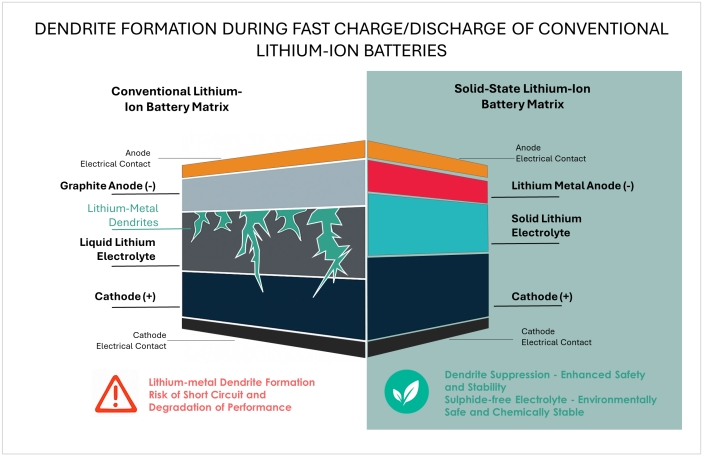
Dendrites are microscopic, needle-like lithium metal formations that can cause severe damage, including internal short circuits, capacity degradation, and safety risks like thermal runaway between battery cells.
Opportunity in advanced battery technologies
Managing director Tim Wither said the agreement broadens the company’s strategy beyond mineral supply into downstream innovation.
“This option agreement marks an extension of our focused critical minerals strategy, enabling vertical integration and unlocking new value pathways from Critical Resources’ mineral assets, capturing potential upside of our Mavis Lake Lithium Resource, to advanced battery technologies and global licensing opportunities,” he said. “As global attention intensifies on critical minerals — with supply chain security and new US-Australia partnerships driving unprecedented investment and regulatory focus — we are positioning Critical Resources at the forefront of this transformation.”
Wither said the next 12 months would involve a milestone-based R&D program overseen by a technical committee.
“We see immense potential for these advanced technologies developed by Dr [Alla (Alevtina)] Smirnova and the South Dakota School of Mines & Technology to deliver real-world impact, creating safer, more efficient energy storage solutions that address the needs of electric vehicles, grid storage, data centres, and beyond.”
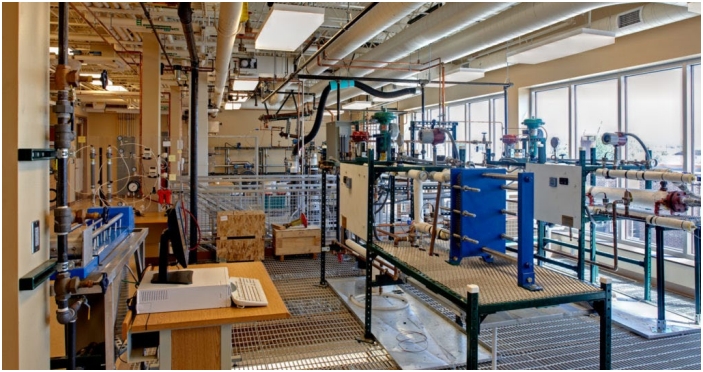
South Dakota School of Mines & Technology - Chemical & Biological Engineering / Chemistry (CBEC) facilities.
Why the technology matters
Solid-state batteries are widely viewed as a next-step architecture for high-performance energy storage, thanks to safer non-flammable electrolytes, compatibility with lithium-metal anodes, and the potential for lighter packs and faster charging.
However, cost, scale and durability issues have kept commercial adoption limited. SDM’s technology aims to tackle these challenges by improving chemical stability and thermal performance while avoiding complex sulphide-based systems that can generate toxic by-products and lower manufacturing yields.
The technology’s high-temperature capability is particularly relevant for heavy-load applications such as EV fast charging, industrial grids, aerospace systems and high-density data centres — markets that continue to expand rapidly.
Next steps and transaction terms
Over the option period, Critical Resources will focus on validating SDM’s performance claims, testing dendrite suppression, and building prototype coin and pouch cells that combine the patented electrolytes and cathode designs.
If results are favourable, the company may negotiate a licence agreement to secure long-term access to the technology.
Key commercial terms include:
- US$5,000 option fee for 12 months, with the option to extend by up to six months.
- Exclusive worldwide evaluation rights during the option period.
- Permission to make, have made and use the technology for evaluation only.
- Requirement to provide data and derived works to SDM, which retains ownership.
- CRR responsibility for reasonable patent prosecution and maintenance costs during the period.
- Standard confidentiality, export control and US Bayh-Dole Act requirements.
The program will run in parallel with development at Mavis Lake in Ontario, where CRR has defined an 8-million-tonne inferred lithium resource and continues to advance regional exploration.