
Riversgold Ltd (ASX:RGL, OTC:RVSGF) has restarted drilling at its Kalgoorlie Gold Project in Western Australia, which is about 25 kilometres east of the Kalgoorlie Super Pit. The current phase focused on the Northern Zone to expand the known gold mineralisation footprint. The Phase 2 program comprises 30 planned holes for a total of 2,000 metres of drilling and is expected to take two weeks, with results from Phase 1 expected to be received over the coming weeks.
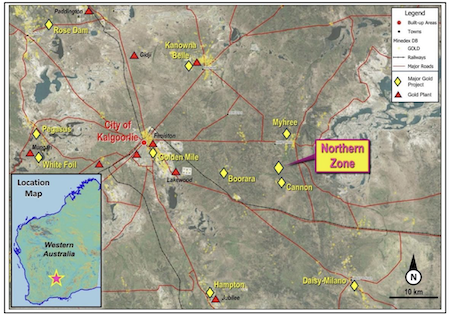
Location of Northern Zone Gold Project just 25km east of the Kalgoorlie “Super Pit” Fimiston.
Northern Zone mineralisation is hosted within a Tonalite–Trondhjemite Intrusion (TTI) porphyry unit, characterised by elevated background gold and horizontal gold-mineralised zones.
“As highlighted in previous news releases, we wanted to undertake two drill programs before the end of the calendar year to add to our gold footprint in the top 50-60 metres at our Kalgoorlie Gold Project, which comprises the Northern Zone Gold Project and our recently acquired Gold Wing Project,” RGL chairman David Lenigas said.
“These programs are designed to enhance the MEGA Resources mining scenario for 2026, and we are pleased to advise that our second shallow drill program is now underway at Northern Zone. The first batches of assay results from the grade control rig drilling completed in October are expected to start coming through in the coming weeks and we look forward to advising the market as they come to hand."
Further drilling to define mineralisation limits
The project area is situated within the Canon Shear or fault zone, and further drilling is required to define the limits of mineralisation identified to date. The sub-horizontal orientation of mineralisation means holes drilled so far have been largely perpendicular to the gold zones, while the absence of groundwater to around 60 metres' depth makes the TTI suitable for the drilling techniques applied to date.
Riversgold intends to continue building its geological understanding of the Kalgoorlie Project ahead of a maiden Mineral Resource Estimate (MRE).
In the meantime, results from the current and recent drilling programs will feed into mine planning work being undertaken by Mega Resources as part of the parties’ joint plans to commence mining in the first half of 2026.
Results include:
- 18m at 4.14g/t Au from 36m (NZRC001)
- 10m at 8.89 g/t Au from 46m (NZAC127)
- 7m at 3.14 g/t Au from 47m (NZAC124)
- 5m at 1.26 g/t Au from 46m (NZAC132)
- 12m at 0.80 g/t Au from 32m (NZAC118)
- 6m at 6.12 g/t Au from 35m (NZRC012)
- 11m at 1.38 g/t Au from 80m (NZRC015)
- 18m at 1.94 g/t Au from 49m (NZRC016)
- 15m at 2.1 g/t Au from 39m (NZRC007)
- 5m at 4.37 g/t Au from 37m (NZRC008)
- 15m at 0.75 g/t Au from 35m (NZRC010)
- 8m at 4.86 g/t Au from 34m (NZAC090)
- 6m at 3.13 g/t Au from 30m (NZAC097)
- 5m at 3.74 g/t Au from 31m (NZAC100)
- 5m at 12.27 g/t Au from 32m (NZAC062)
- 6m at 3.48 g/t Au from 73m (NZAC077)
- 8m at 2.07 g/t Au from 50m (NZAC079)
- 4m at 6.92 g/t Au from 57m (NZAC061)
- 7m at 3.9 g/t Au from 35m (NZAC055)
- 16m at 4.69 g/t Au from 30m (NZAC033)
The Northern Zone Project represents a significant bulk-tonnage gold opportunity. It carries an exploration target of 200–250 million tonnes at 0.4–0.6 g/t gold, equating to an estimated 2.5–4.8 million ounces.