
The cashed-up Lion Rock Minerals Ltd (ASX:LRM) has outlined a newly mapped monazite-enriched granite at its Minta Est project in Cameroon, linking the intrusive body to heavy-mineral concentrations that include monazite, xenotime and zircon within areas already known for high-grade rutile.
Covering roughly 250 square kilometres, the late-tectonic granite stands out on thorium radiometric imagery compiled after reconnaissance drilling began. Earlier, more widespread granites in the district do not show comparable thorium anomalism. Field work during the rutile program also logged monazite-rich alluvial soils, with primary tributary samples returning heavy-mineral concentrates grading up to 74% monazite. Within those concentrates, rare-earth pathfinders included dysprosium (Dy) to 1.8% and terbium (Tb) to 1.1%.
The Minta Rutile Project spans about 8,800 square kilometres across 18 granted exploration permits and three applications in a region that is critically under-explored but known for rutile. Early reconnaissance work has outlined zones of high-grade alluvial and residual rutile at Minta and Minta Est, with little to no overburden, supporting efficient near-surface targeting. Sampling has also reported zircon, gold and monazite at Minta Est, highlighting broader heavy-mineral potential alongside rutile.
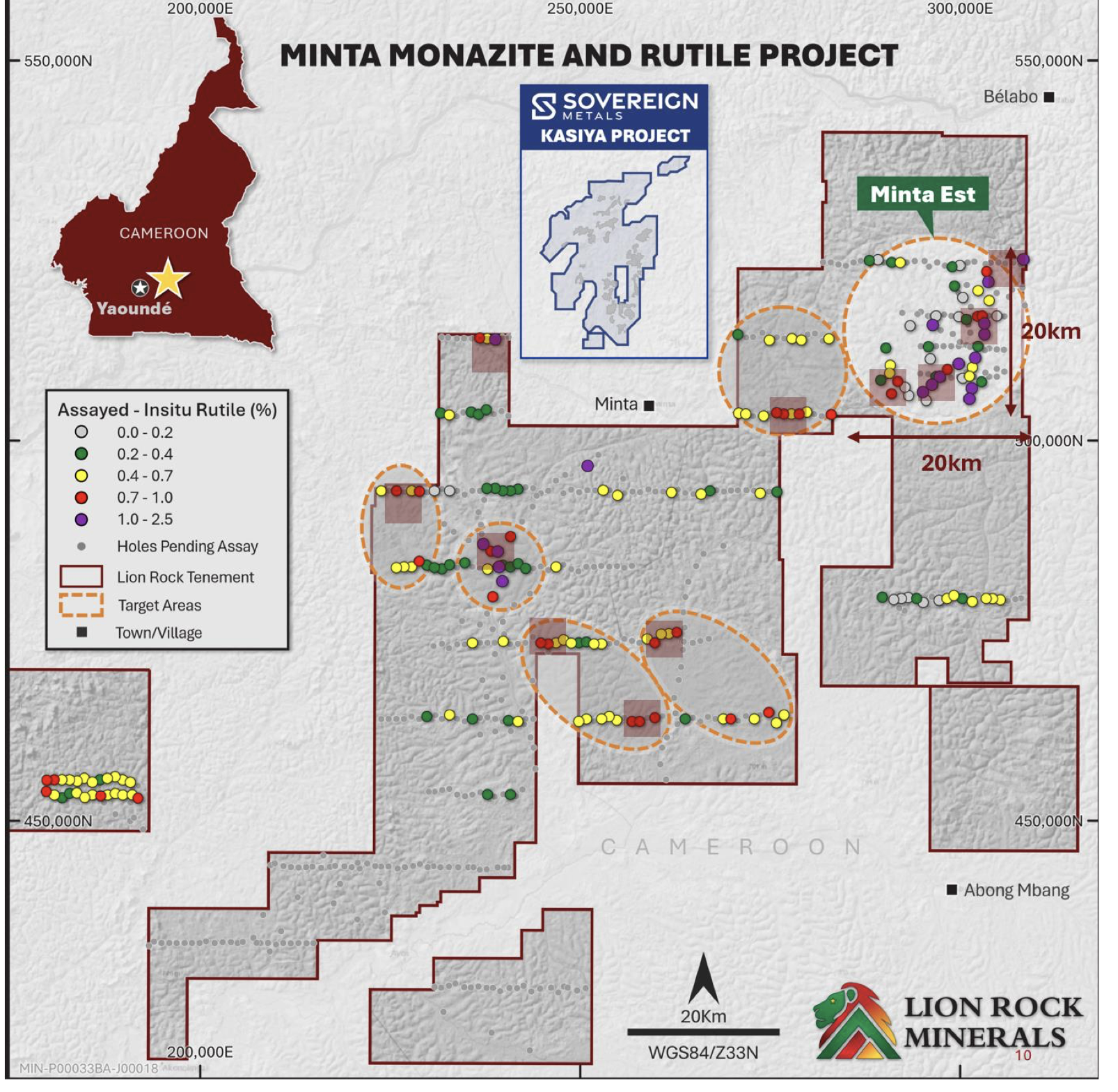
First pass results from the Minta Project with highest value rutile zones circled3. 5km x 5km zones are shown to demonstrate the scale of a large mineral sands mine. Minta Est, where rutile is coincident with monazite, xenotime and zircon, is also highlighted. Sovereign Metals Ltd’s (ASX: SVM) Kasiya project tenure outline displayed in image above. The \company notes the Kasiya Project is located in Malawi and is only shown for scale comparison purposes.
Notably, large, angular rutile nuggets have been found over broad areas in both recent and historical programs. This coarse material presents an additional source of rutile that could materially increase total Valuable Heavy Mineral grades in both residual and alluvial settings. Within the eastern Minta Est area, zones of very high-grade zircon have been delineated, while the northeastern tenements show both alluvial and hard-rock gold occurrences coincident with a geophysical anomaly interpreted to relate to granitic intrusions. Collectively, these results point to multiple shallow, high-priority targets with upside in zircon and gold, warranting systematic follow-up sampling and drill testing.
“Following the outstanding rutile results announced recently across what is emerging as a truly district-scale system, we’re now seeing the Minta Project reveal another exciting layer - a zone of monazite and xenotime mineralisation coincident with the rutile, potentially capable of generating a very high-value product suite," Lion Rock CEO, Casper Adson, said.
“Our geological team has done exceptional work in pinpointing the source of this mineralisation - a monazite-enriched granite - through the integration of thorium radiometric data and detailed
field mapping.
“The rare earth distribution within the monazite concentrate at Minta Est is particularly compelling, showing elevated levels of the high-value heavy rare earth elements dysprosium (Dy) and terbium (Tb) along with samarium (Sm) - the latter recently being recognised by the United States as the most critical mineral. Confirmation of the presence of xenotime as the source of Dy and Tb adds further value as these remain under Chinese export restrictions and are therefore in strong global demand.
“Infill drilling is now advancing rapidly to define the extent of this new monazite–xenotime zone, supported by expanded equipment that has doubled our on-ground capacity. With our strategic partnership alongside global rare-earth and titanium leader Tronox, Lion Rock is fully funded for the next phase of exploration and continues to deliver potential world-class discoveries across the Minta Project.”
Broadening the scope
Laboratory work by ANSTO indicates the Minta Est monazite sand concentrate is enriched in total rare-earth oxides (TREO) with elevated heavy rare-earths, notably Dy and Tb, at levels the company says exceed typical hard-rock monazite deposits. Samarium (Sm₂O₃) was reported up to 3.1% of TREO—considered high when paired with elevated Dy and Tb—pointing to a heavy rare-earth-enriched monazite or a mixed monazite–xenotime assemblage.
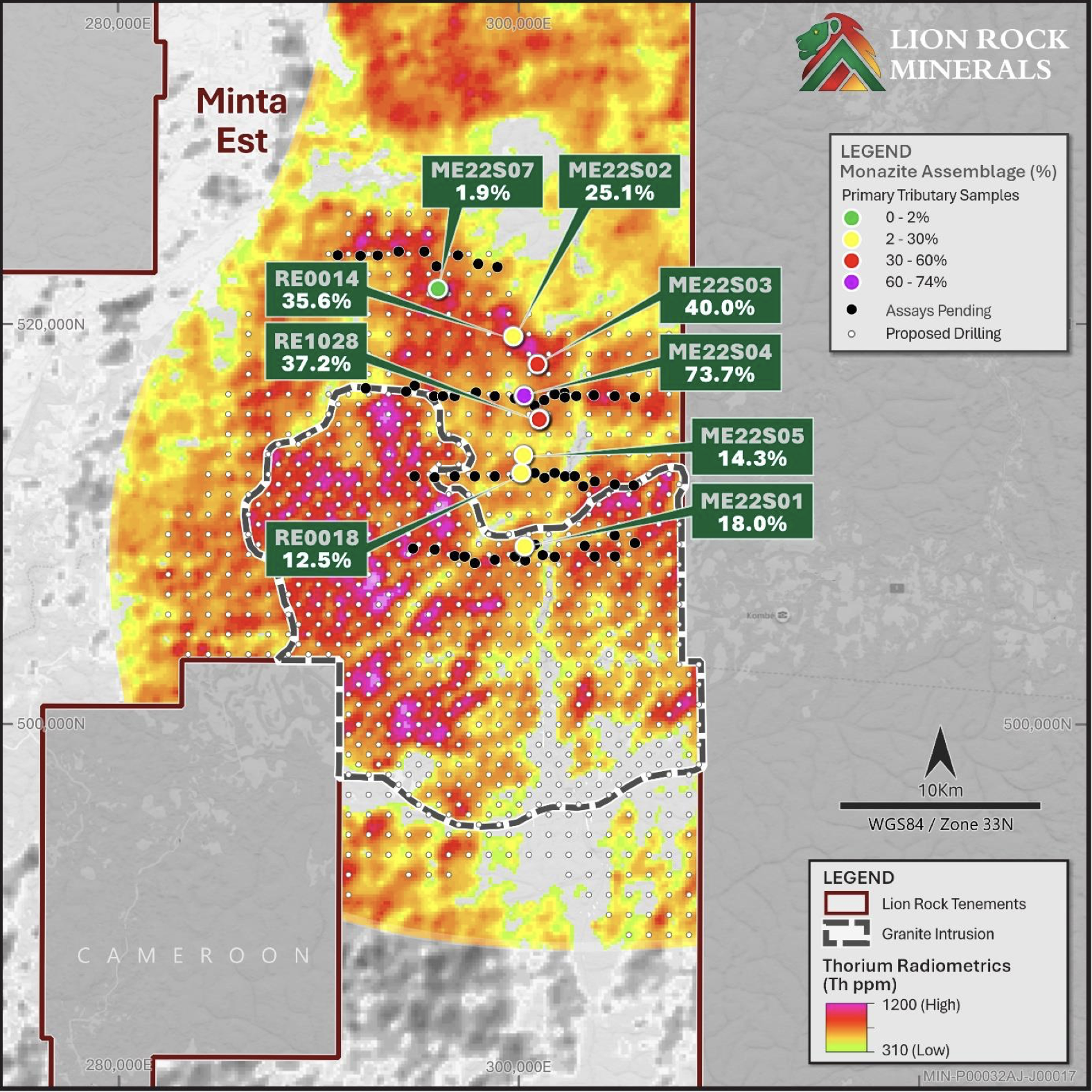
Thorium radiometric high zones and solid geology outline of granite intrusion indicate the “Monazite-enriched granite” at Minta Est. Monazite results and samples currently pending are shown alongside proposed infill drilling program.
On the back of the geological and geophysical interpretation, Lion Rock is moving into an infill drilling program at Minta Est to refine targets over the largest and strongest thorium anomalies above the mapped granite. Samples already drilled across the target but not yet analysed have been prioritised for assay.
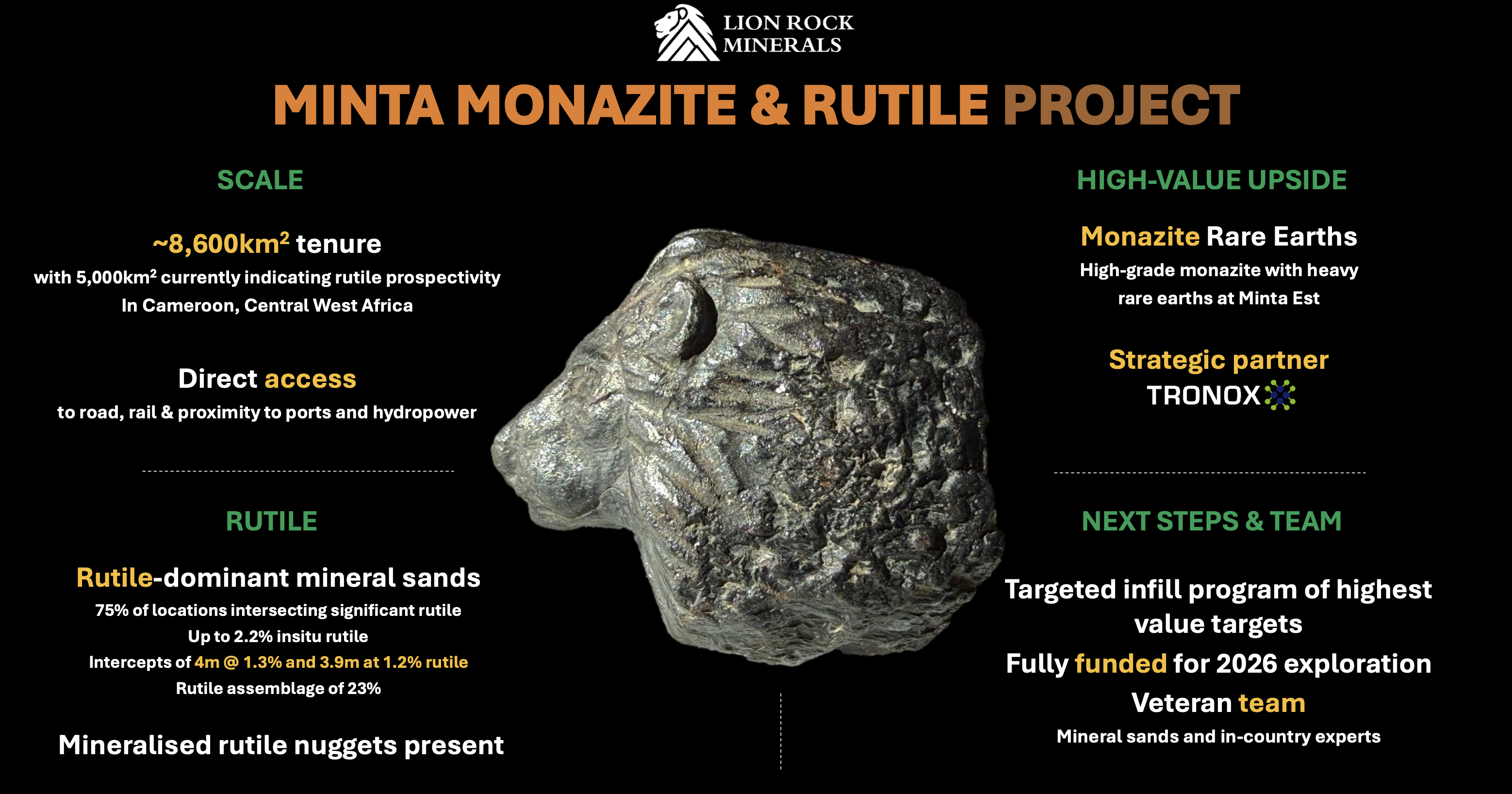
The results broaden the scope of the Minta and Minta Est project areas, which span about 5,000 square kilometres of reconnaissance ground and are now considered prospective for multiple high-value mineral sands deposits.
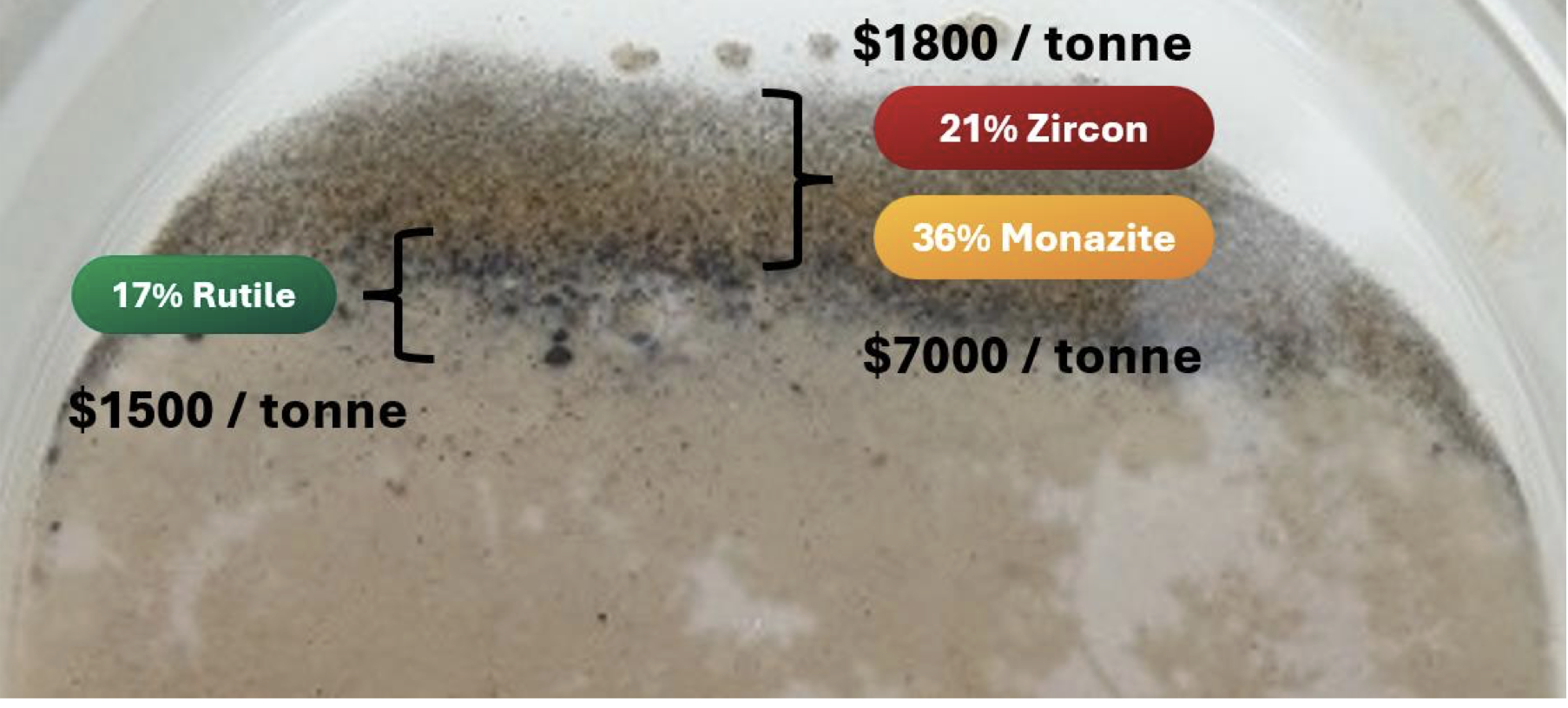
Panned concentrate RE0014 from primary tributary demonstrating the high-value of assemblage of rutile, monazite and zircon.
Strategic partnership
The company’s rare-earths workstream is advancing alongside rutile exploration and follows Lion Rock’s recent strategic partnership and placement with Tronox Holdings PLC (NYSE:TROX).
In its recent quarterly results, Tronox outlined plans to progress an end-to-end western rare-earths supply chain — mining, concentrating, cracking and leaching, and oxide refining/separation — with Minta identified as a long-term feed component.
Next steps
It’s a busy upcoming period for Lion Rock. The company plans to complete the following work:
- Prioritise downhole and adjacent rutile sample assessments around prospective intercepts.
- Receive and publish Minta Est reconnaissance assemblage results (monazite, xenotime, rutile, zircon).
- Start an infill program targeting monazite and xenotime at Minta Est, and rutile more broadly across the Minta Project.
- Complete Yaoundé laboratory construction, setup and commissioning.
- Finalise recruitment of laboratory and management staff to support expanded field operations and accelerate result processing.
All planned exploration activities for the remainder of 2025 and 2026 are fully funded.
What is Xenotime
- What it is: A rare-earth phosphate mineral (YPO₄) that is rich in heavy rare earth elements (HREEs)—notably Dy, Tb, Y, Er and Yb.
- Why it matters: HREEs are essential for high-temperature permanent magnets, defense systems and solid-state lasers. They are scarcer and harder to separate than light REEs, so they typically command higher prices.
- How it differs: Unlike monazite or bastnäsite (which are light-REE–dominant: Nd, Pr, La, Ce), xenotime is HREE-dominant, making it strategically valuable for diversifying non-Chinese supply.
- Where it occurs: Common in mineral sands (often intergrown with zircon); also in hydrothermal veins and pegmatites. Mineral-sands xenotime is preferred due to simpler, lower-cost mining (free-dig/dredge; no blasting/crushing).
- Strategic take: With growing HREE demand for EV/defense magnets and few high-grade resources, xenotime is a key complement to monazite in resilient REE supply chains.
What is Samarium
- What it is: A heavy lanthanide used primarily in samarium–cobalt (SmCo) magnets, advanced nuclear control rods, and other high-temperature aerospace/defense applications.
- Supply risk: Economically recoverable Sm is scarce and supply chains are concentrated (notably in China), creating high disruption risk; recent assessments place samarium among the most vulnerable critical minerals.
- Geopolitics: Existing export controls on Sm/HREEs heighten urgency to build ex-China extraction, separation and refining capacity.
- Strategic take: Sm has moved from niche to top-tier critical status—not just for its applications, but due to concentration risk and processing bottlenecks. Any magnet-centric supply chain should treat Sm as a priority feedstock.